The surveyor ran his hand along the hull in the dry dock, and the owner watched his face. To an untrained eye, the white surface looked perfect — smooth, glossy, ready for the water. The surveyor’s hand told a different story: a faint ripple here, a shallow hollow there, a barely visible wave running the length of the hull like a wrinkle in a bedsheet.
That is the world of yacht hull fairing: the patient, almost invisible craft of making a hull truly smooth. Fairing has no glamour — it is filler, sandpaper, and long hours under a tent in a boatyard — yet it decides how cleanly a yacht moves through the water.
What makes fairing so demanding is the scale of perfection it chases. The human eye can spot a hollow of less than a millimetre when light rakes across a curved surface, and water is an even harsher judge.
How It Works
Step 1: The hull is surveyed with battens and light
Fairing begins with a survey. Long, flexible battens — thin strips of wood or plastic several metres long — are held against the hull, and any gap between the batten and the surface reveals a hollow, while any rocking reveals a high spot. The surveyors also use raking light: bright lamps held low against the surface so that every ripple throws a shadow. The hull is marked up with pencil lines, highs in one colour and lows in another, until the whole surface wears a map of its own imperfections. The scale of the structures involved is hard to grasp without comparison — the container ship hull guide shows what hull engineering looks like when the vessel is hundreds of metres long.
Step 2: Rough fairing fills the deep hollows
With the map drawn, the fairers attack the worst lows first. They trowel on a fairing compound — usually a two-part epoxy filler loaded with lightweight microspheres — in the hollow areas, building it up in layers no thicker than a few millimetres at a time. Each layer must cure before the next goes on, or trapped solvents and heat can cause cracking later. The aim is not a finished surface yet — only a surface whose errors are small enough for the next stage.
Step 3: Longboarding levels the surface
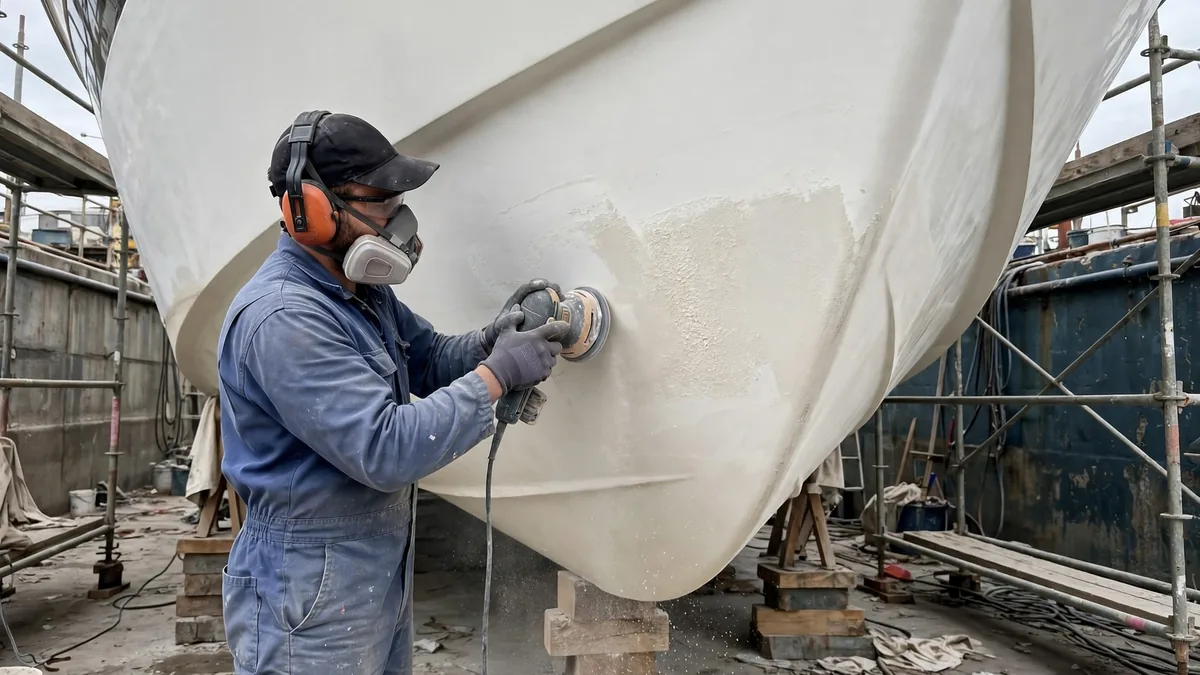
The defining tool of fairing is the longboard: a sanding board a metre or more long, worked by two people in long, overlapping strokes. A short sanding block follows every dip and bump and only makes them smoother; a longboard bridges across the lows and cuts down the highs, which is exactly what fairness means. The fairers work in a cross-hatch pattern, first diagonally one way, then the other, so that no single direction dominates the surface.
Step 4: A guide coat reveals what is left
After longboarding, the crew sprays or rolls on a guide coat — a thin, contrasting layer of paint, often black over white or the reverse. Then they sand it lightly with a longboard again. Where the guide coat disappears first, the surface is high; where it remains, the surface is still low. The guide coat turns invisible errors into visible ones, and the crew marks and fills the remaining lows, then longboards again. This cycle — fill, board, guide coat, check — repeats as many times as the specification demands.
Step 5: Primer seals and protects the fairing
Once the surface is fair, it is sealed with several coats of epoxy primer. The primer does two jobs: it locks the filler down and protects it from water, and it gives the topcoat something to grip. Between coats, the surface is sanded with progressively finer abrasives, from coarse paper down to grades so fine they feel almost smooth to the touch. Any pinholes or tiny defects found at this stage are filled with a fine spot filler and sanded flush. The engines that will push this fair hull through the water are feats of engineering in their own right, as the cruise ship engine guide explains on a much larger scale.
Step 6: Topcoat and polish deliver the mirror finish
The final stage is the topcoat: two or three coats of high-gloss polyurethane, sprayed in a sealed tent to keep dust off the wet paint. Between coats, the surface is sanded with ultra-fine paper and wiped down, and after the last coat cures, it is polished with compounds and a machine polisher until it reflects like a mirror. A yacht that passes this test will be faster, quieter, and cheaper to run — and it will look, from the dock, as if it were carved from a single piece of glass.

Yacht Hull Fairing Specs
| Specification | Typical range |
|---|---|
| Fairness tolerance on a superyacht | About 1 millimetre over a 3-metre batten length |
| Fairing compound | Two-part epoxy filler with lightweight microspheres |
| Maximum filler thickness per layer | About 3 to 5 millimetres, cured between coats |
| Longboard length | About 1 to 1.5 metres, worked by two people |
| Guide coat cycles | About 3 to 6 rounds of coat, sand, and check |
| Primer coats | About 3 to 5 coats of epoxy primer |
| Topcoat coats | About 2 to 3 coats of high-gloss polyurethane |
| Sanding grades used | From about 80 grit roughing down to 800 grit or finer |
| Filler used on a large yacht | Often several hundred kilograms across the whole hull |
| Time to fair a superyacht hull | About 2 to 6 months of full-time work |
What Does Yacht Hull Fairing Cost?
Hull fairing is priced by the size of the yacht and the standard of finish demanded. Specialist fairing labour is estimated at roughly $60 to $150 per hour, and a full fairing job on a 30-metre yacht is estimated at roughly $100,000 to $300,000 including materials. On a 50-metre-plus superyacht, a full fairing and paint job is estimated at roughly $500,000 to $1,500,000. All prices are estimates only and vary by yard, region, and finish standard.
A Rare Fact
The most famous fairing job in history was not on a yacht at all, but on an aircraft. When the supersonic airliner Concorde was built, its fuselage panels were faired and filled to tolerances tighter than most yachts, because at twice the speed of sound even a small surface ripple created drag and heat. The boatyards that fair superyachts today inherited their longboarding techniques from the aircraft factories of the same era, and some of the best yacht fairers in the world learned their trade smoothing aluminium aeroplane skins. The materials that survive such extremes are extraordinary in their own right, as the deep-sea submersible materials guide shows for the opposite extreme of pressure and depth.

Hull fairing is the most invisible craft in yachting: when it is done perfectly, nobody notices it at all — they only notice that the yacht looks right, moves quietly, and seems to glide rather than push through the water. That invisibility is the point.


