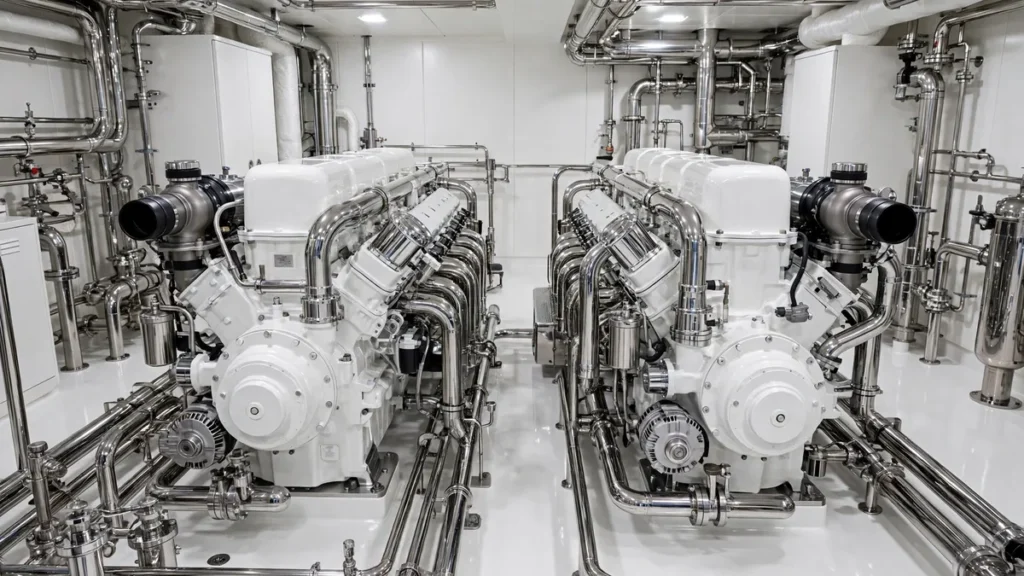
Stand beside a cruise ship in port and the hull rises above you like a cliff, fifteen decks high, longer than three football fields. What you cannot see, deep below the waterline, is the engine that moves it: a machine the size of a house, with cylinders you could climb inside and pistons that weigh more than a car each. It burns tonnes of fuel an hour and pushes 100,000 tonnes of steel, glass and holidaymakers across an ocean.
A cruise ship engine is the largest reciprocating machine most people will ever be near, built from cast iron, forged steel, chrome-molybdenum alloys and white metal bearings. The parts are measured in tonnes, the tolerances in millimetres, and the whole machine is designed to run for months without stopping, in a steel room that rolls and pitches with the sea.
The Materials Behind the Engine
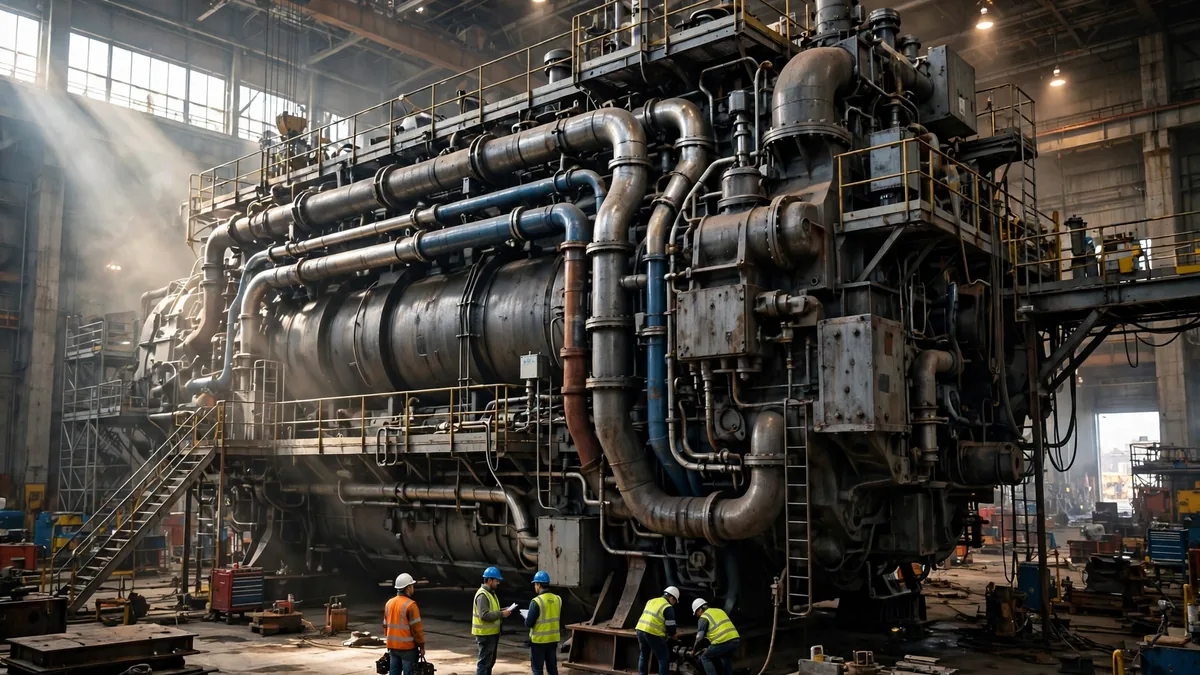
The heart of a cruise ship engine is its cast iron frame, a single enormous casting that holds the cylinders, the crankshaft and the bearings in alignment. Cast iron is chosen because it is heavy, rigid and excellent at damping vibration — a lighter frame would flex under the loads and shake itself apart. The crankshaft is forged steel, more than ten metres long and over a hundred tonnes, machined on the largest lathes in the world. Its journals run in white-metal bearings, a soft tin-copper alloy that can be replaced at sea if needed.
The pistons are forged steel crowns with aluminium skirts, surviving combustion temperatures while staying light enough to move. Their rings are cast iron, and the cylinder liners they run in are also cast iron, honed to a mirror finish. Chrome-molybdenum steel goes into the connecting rods and the bolts that hold the whole machine together — bolts as thick as a man’s arm, tightened with hydraulic jacks to forces measured in thousands of tonnes. The fuel injection equipment is made from hardened steels that resist both wear and corrosion.
Step 1: Casting the engine frame
The engine frame begins in a foundry, where molten iron is poured into a sand mould the size of a room. The casting weighs hundreds of tonnes and must cool slowly over weeks. Once cooled, the frame is machined on a gantry mill to tolerances of a fraction of a millimetre across ten metres or more. Modern cruise ships are built in sections, and the engine frame is lowered into its section before the decks above it are fitted.
Step 2: Forging and machining the crankshaft
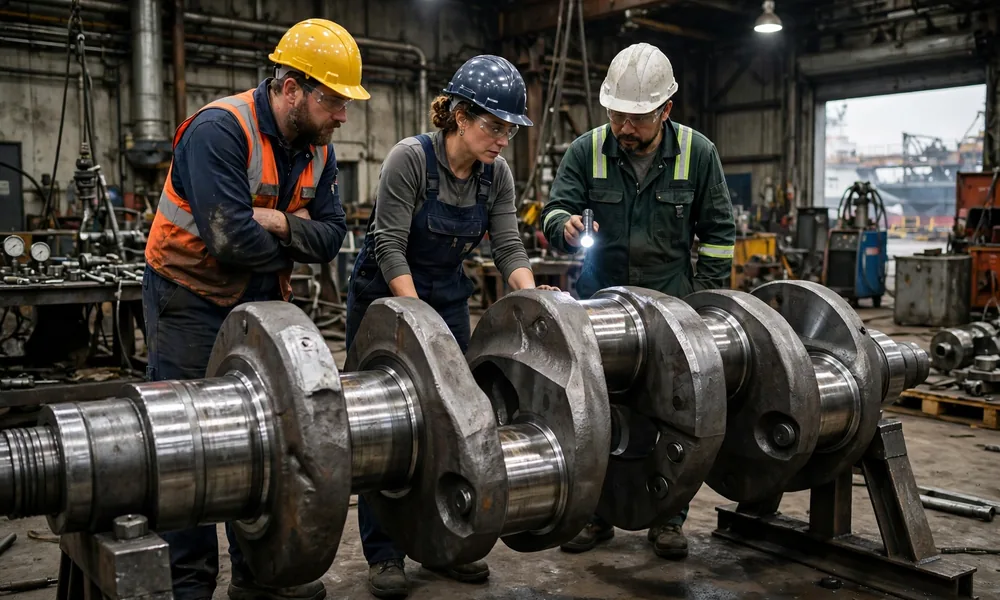
The crankshaft starts as a steel ingot of more than a hundred tonnes, heated and forged in a giant press. It is then machined over several weeks, its journals ground and polished until they are round to within a few microns. It is often built in sections and bolted together, the joints checked with dial gauges as the shaft is turned by hand. The finished shaft is balanced to spin at a hundred revolutions a minute without a tremor.
Step 3: Fitting pistons, liners and connecting rods
Each cylinder gets a cast-iron liner, honed to a mirror finish, with cooling passages carrying water around it. The piston — a steel crown on an aluminium skirt, weighing more than a tonne — is lowered into the liner and connected to the crankshaft by a forged steel rod. Clearances are checked with feeler gauges, because a piston that is too tight will seize and one that is too loose will hammer itself to pieces. On the largest engines a single cylinder has a bore of nearly a metre.
Step 4: Installing the fuel and turbocharging systems
Modern cruise ship engines are dual-fuel, able to burn liquefied natural gas or conventional fuel oil. The gas system uses cryogenic stainless steel pipework and double-walled tanks, because LNG is stored at minus 162 degrees Celsius. Turbochargers the size of cars force air into the cylinders, their turbine wheels made from nickel superalloys. The fuel injectors are precision-ground steel, opening and closing in milliseconds.
Step 5: Connecting the propeller and azipods
Many modern cruise ships have no long propeller shaft. Instead the engines generate electricity, and electric motors in steerable pods beneath the hull — azipods — drive the propellers directly. The pod housings are cast steel, the propeller blades are a nickel-aluminium-bronze alloy chosen because it resists corrosion and cavitation. A single propeller can be six metres across and weigh twenty tonnes.
Step 6: Testing at full power
Before the ship leaves the yard, the engines are run at full power for hours while engineers measure temperatures, pressures, vibration and emissions. The engines must prove they can run continuously at sea, because a cruise ship cannot pull over. The whole system is tested on both fuels. Only when the engines have run flawlessly at full load does the ship sail on its first voyage.
Why These Materials Win
Cast iron and forged steel win because nothing else can handle the scale: a lighter material would flex, a weaker one would crack, and a more exotic one would be impossible to repair at sea. The genius of the marine diesel is not in using rare materials but in using ordinary ones at an extraordinary scale — the same thinking behind a superyacht’s steel hull. The submarine pressure hull is built to survive crushing depth; the cruise ship engine is built to survive endless time, running day after day with maintenance done by a crew carrying hand tools.
The newest ships add one more material: LNG, which burns cleaner than heavy fuel oil and needs cryogenic stainless steel to contain it.
Specifications
| Specification | Detail |
|---|---|
| Engine type | Large dual-fuel marine diesel, LNG and fuel oil |
| Frame material | Cast iron, single casting of hundreds of tonnes |
| Crankshaft | Forged steel, over 10 metres long, over 100 tonnes |
| Cylinder bore | Up to approximately 960 mm on the largest engines |
| Piston weight | More than one tonne each |
| Connecting rods | Forged chrome-molybdenum steel |
| Propeller | Nickel-aluminium-bronze, up to 6 metres across |
| Propulsion | Diesel-electric with azipod electric motors |
| Fuel storage | LNG at minus 162 degrees Celsius in cryogenic tanks |
| Typical total power | Around 60,000 to 70,000 kW on a large cruise ship |
Price
A cruise ship engine is priced as part of the ship. A single large marine diesel engine can cost $10 million to $20 million (estimate), and a large cruise ship carries four to six of them, alongside generators, azipods and fuel systems. A complete large cruise ship costs roughly $1 billion to $1.5 billion (estimate), with the propulsion system accounting for a significant share. A large cruise ship can burn hundreds of tonnes of fuel a day at sea, which is why the switch to cleaner LNG matters so much to the cruise lines.

Rare Fact
A single cylinder on the largest marine diesel engines has a bore of nearly a metre — wide enough for a person to climb inside. The crankshaft alone can weigh more than a hundred tonnes, yet it is machined so precisely that it spins without a tremor, for months at a time.
The cruise ship engine is the largest machine most of us will ever travel with, built from the oldest materials in engineering: iron, steel and bronze. It is only tonnes of metal, machined to perfection, carrying a floating city across an ocean. When you stand on deck and feel nothing but a faint hum beneath your feet, that is a hundred tonnes of steel doing its job so well you never have to think about it.