Stand on a dock at dusk and watch a yacht come in, and you will see the water behind her stern boil white for a moment as she slows. That turbulence is the signature of the one part of the boat that does all the pushing: the propeller, turning out of sight beneath the hull. The engine can roar, the sails can fill, but without those curved bronze blades biting the water, a yacht is only a very expensive floating room.
The propeller’s job sounds simple — spin and push — but the physics is subtle. It does not paddle the water backwards like an oar. Each blade is a wing, and it flies through the water the way an aircraft wing flies through the air, generating a force that drives the yacht forward. Getting that wing right is a century-old craft of curves, angles, and balance. This is how it works.
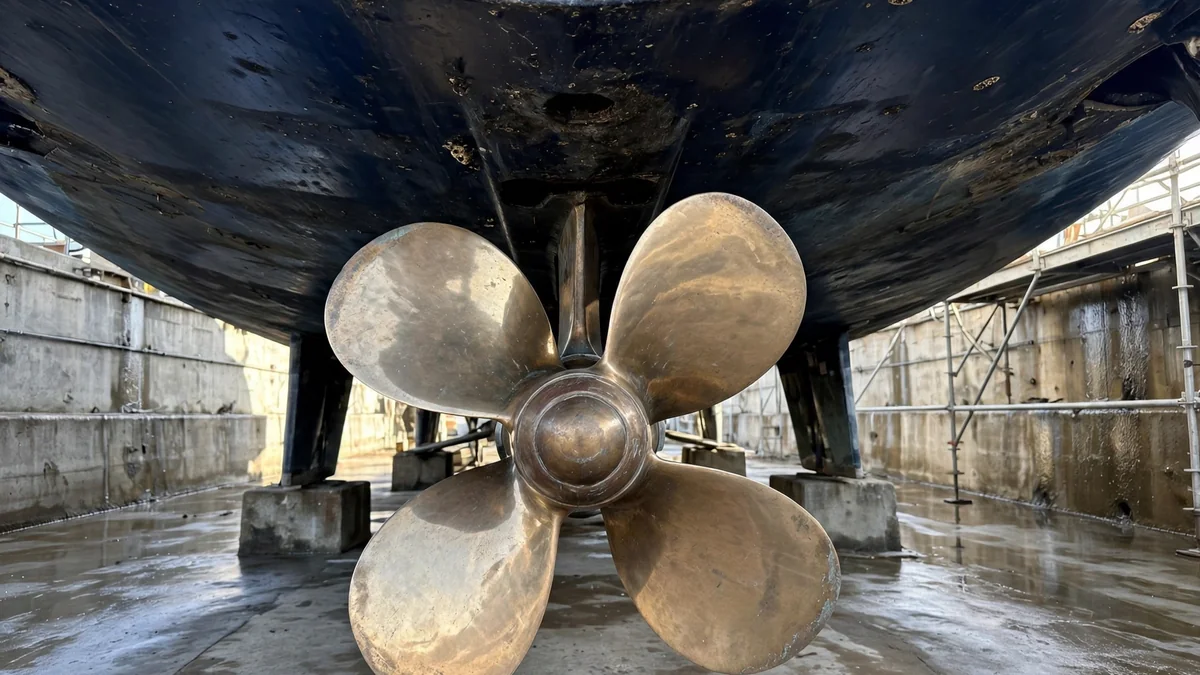
How It Works
Step 1: The engine turns the shaft
It begins deep inside the hull, where the engine turns a long steel shaft that runs aft through the stern tube and out into the water. The shaft is supported by bearings and sealed where it leaves the hull so seawater cannot creep in, and it spins at hundreds of revolutions per minute. The propeller is keyed onto the end of this shaft and held by a large nut, so every turn of the engine becomes a turn of the blades. The gearbox between engine and shaft lets the crew choose ahead, astern, or neutral, and sets the shaft speed to suit the propeller’s design.
Step 2: The blades meet the water at an angle
Each blade is set at a pitch — an angle to the plane of rotation — like the thread of a screw. Pitch is the distance the propeller would travel forward in one turn if it were screwing through a solid, and it is chosen to match the engine’s power and the hull’s speed. As the blades rotate, their angled faces meet the water and push it backwards and slightly sideways. The water, heavy and stubborn, resists, and that resistance becomes thrust. Too little pitch and the engine over-revs without pushing hard; too much and the engine labours and the boat feels sluggish. The right pitch is a sweet spot the designer finds for each yacht.
Step 3: Lift on the blades becomes thrust
The real magic is that a blade does not just shove water. Like an aircraft wing, each blade is shaped with a curved face and a flatter back, so water flows faster over one side than the other. The pressure difference creates lift — and because the blade is angled, that lift points mostly forward, along the shaft. This is far more efficient than simple pushing, and it is why propeller blades are twisted along their length: the tip of a blade travels faster than the root, so the twist keeps the angle of attack right all the way from hub to tip. A well-shaped blade slips through the water with barely a whisper; a badly shaped one churns it into froth.
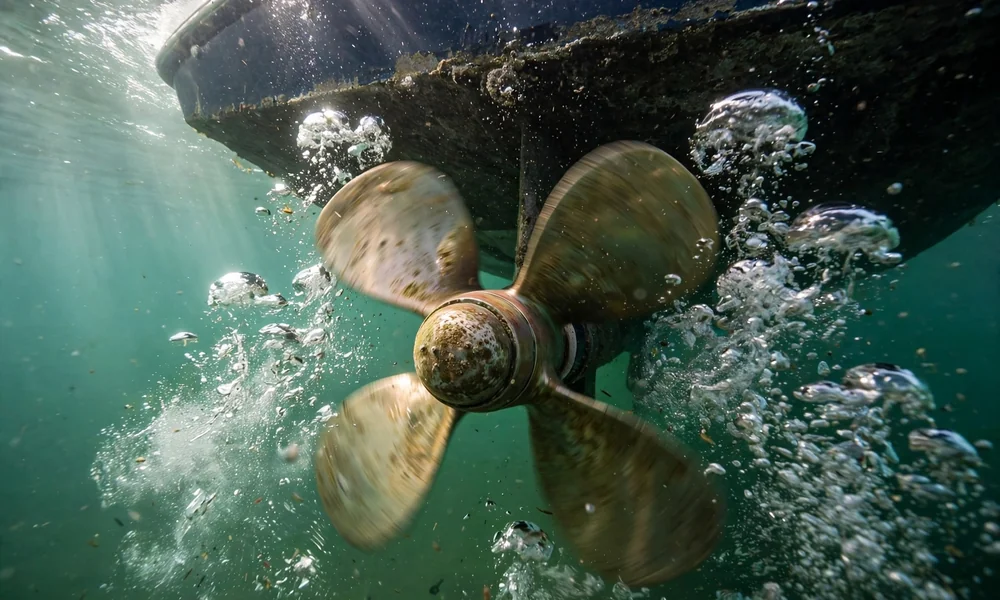
Step 4: Water is accelerated astern
Put the blades together and the propeller becomes a pump, drawing water in from ahead and accelerating it backwards in a fast, twisting stream called the slipstream. The thrust on the yacht is the reaction to that acceleration: throw water backwards, and the boat is pushed forwards, exactly as Newton promised. The faster and heavier the stream, the greater the thrust, which is why large propellers with more blade area can push a heavy hull with less fuss. But there is a limit: spin the blades too fast and the water cannot follow, and the propeller starts to waste its energy in turbulence instead of thrust.
Step 5: Cavitation is kept at bay
Every propeller faces an enemy called cavitation. When a blade moves fast enough, the pressure on its back drops so low that the water briefly boils at ordinary temperature, forming tiny vapour bubbles. Those bubbles collapse violently against the blade a moment later, pitting the bronze and stealing efficiency, and at speed they make a crackling noise like gravel in a drum. Designers fight cavitation with blade area, tip shape, and by keeping the propeller deep enough below the surface, and captains avoid it by not demanding full power from a standstill. A propeller that cavitates is a propeller crying for help.
Step 6: Reversing and manoeuvring
To go backwards, the gearbox reverses the shaft and the blades bite the water the other way, though less efficiently, since the blades are shaped for ahead running. At slow speeds in a marina, the propeller’s sideways push — called prop walk — swings the stern to one side, and a good skipper uses it to pivot the yacht neatly into a berth. Some yachts carry variable-pitch propellers, whose blades can be twisted by a mechanism in the hub so the pitch changes without changing shaft speed, giving fine control at low revs and the best efficiency at cruise. Folding and feathering propellers, meanwhile, streamline themselves under sail so they do not drag in the water.

Specs
| Specification | Typical figure |
|---|---|
| Material | Nickel-aluminium bronze |
| Blade count | Commonly 3–5 blades |
| Diameter | Roughly 400–900 mm for a cruising yacht |
| Pitch | Matched to engine power and hull speed |
| Blade shape | Twisted aerofoil section, wider near the tip |
| Shaft speed | Often 500–1,500 rpm at cruise |
| Drive | Engine and gearbox via a steel shaft |
| Variants | Fixed, folding, feathering, and variable-pitch |
| Efficiency | Often 50–70 percent of engine power becomes thrust |
Price
A custom bronze propeller for a cruising yacht typically costs roughly $3,000 to $20,000 as an estimate, depending on size, blade count, and whether it is fixed, folding, or feathering — these are estimates, and the final price depends on the foundry and the design work involved. Variable-pitch propellers cost considerably more because of their hub mechanisms. The craft of making one is told in how a yacht propeller is made, the reason for the price is explained in why a yacht propeller costs so much, and the material story is covered in how a yacht propeller is built from bronze.
A Rare Fact
The largest yacht propellers are so heavy that they are fitted with the help of divers and cranes, and a single blade can weigh more than a person. But the most surprising fact is about their sound: a perfectly balanced, well-shaped propeller is almost silent, and experienced sailors can hear the difference between a clean propeller and a fouled one from the cockpit. A faint hum that was not there last week often means weed or a rope has wrapped itself around a blade — and on a long passage, that hum is the first warning that the yacht is slowly losing speed.
From the engine’s spin to the slipstream astern, a yacht propeller is a wing that flies underwater, turning horsepower into forward motion one curved blade at a time.


