From the deck, a sailing yacht looks like it should fall over. The wind presses on the sails, the mast leans, the hull heels until the rail is almost in the water — and then it stops, at the same angle every time, steady as a table. What stops it is invisible from the deck: a fin of metal hanging below the hull, doing the hardest work on the boat while nobody looks at it. That fin is the keel, and without it a sailing yacht is just a very expensive raft.

How a Yacht Keel Works
A keel does two jobs at once: it stops the boat from being blown sideways, and it stops the boat from capsizing. It does both with the same trick — a heavy, streamlined fin that hangs below the hull and grips the water. The fin’s sideways surface resists leeway, the drift that would push a yacht sideways across the wind, while its weight, concentrated low down in a bulb of lead or iron, acts as a counterweight that pulls the boat upright.
Step 1: The fin resists sideways drift
When wind fills the sails, it pushes the boat forward — but it also pushes it sideways, and a hull alone is too slippery to resist that sideways push. The keel’s tall, flat surface acts like a wing turned on its side: as the boat tries to slide sideways, water presses against the fin and pushes back. Without a keel a yacht would slide sideways almost as fast as it sailed forward, and it could never sail upwind at all. With a keel, the sideways force is converted into forward motion. The rudder under the waterline works on the same principle, using a smaller flat surface to steer.
Step 2: The bulb pulls the boat upright
The second job is stability, and it comes from weight. Most of a keel’s weight sits in a bulb at its very bottom, often tonnes of lead, hanging as low as the designer dares. When the wind heels the boat over, that weight swings out to the side and its gravity pulls the boat back upright — the further the boat heels, the stronger the pull. Lead is used because it is enormously dense, packing maximum weight into minimum size, and a modern fin keel can carry half the boat’s entire weight in that one bulb.
Step 3: The shape cuts through the water
A keel is not a flat plate; it is a carefully shaped wing. Its leading edge is rounded to split the water cleanly, its body is thinned to reduce drag, and its trailing edge tapers away so the water rejoins smoothly behind it. A fat, draggy keel would slow the boat and make it wallow; a thin, sharp one lets the yacht slip through the water at speed. Designers spend months in towing tanks and computer simulations tuning this shape, because a keel that is one percent more efficient is a keel that wins races. The propeller of a yacht is shaped by the same obsession with water flow.
Step 4: The keel is bolted to the hull’s spine
All the forces on a keel — tonnes of sideways push and the full weight of the bulb — have to go somewhere, and they go into the hull through massive stainless-steel bolts. A keel is bolted through the hull into a reinforced grid of floors and stringers, the boat’s internal skeleton, and the joint is sealed so water cannot creep in. The bolts are checked at every haul-out, because a keel that works loose is a catastrophe: racing yachts have lost their keels and capsized in minutes.
Step 5: The keel sets the boat’s balance
Where the keel sits matters as much as how heavy it is. Move it a metre forward and the boat will want to turn into the wind; move it back and it will want to turn away. Designers place the keel so its centre of resistance lines up with the centre of effort of the sails, and the boat sails straight with barely a touch on the helm. The carbon mast that holds a yacht’s sails is part of the same balancing act — the mast sets where the wind’s push acts, and the keel sets where the water answers.
Step 6: Different keels for different sailing
Not all keels look alike. A racing yacht has a deep, narrow fin with a torpedo bulb, built for speed and nothing else. A cruising yacht has a shorter, heavier keel so it can enter shallow harbours. Some keels swing up for beaching, and some are twin bilge keels that let a boat stand upright on a drying mudflat. Every variant trades something: speed for shallow water, stability for simplicity. There is no perfect keel, only the right keel for the sailing you do.

Step 7: The keel is maintained like a hull
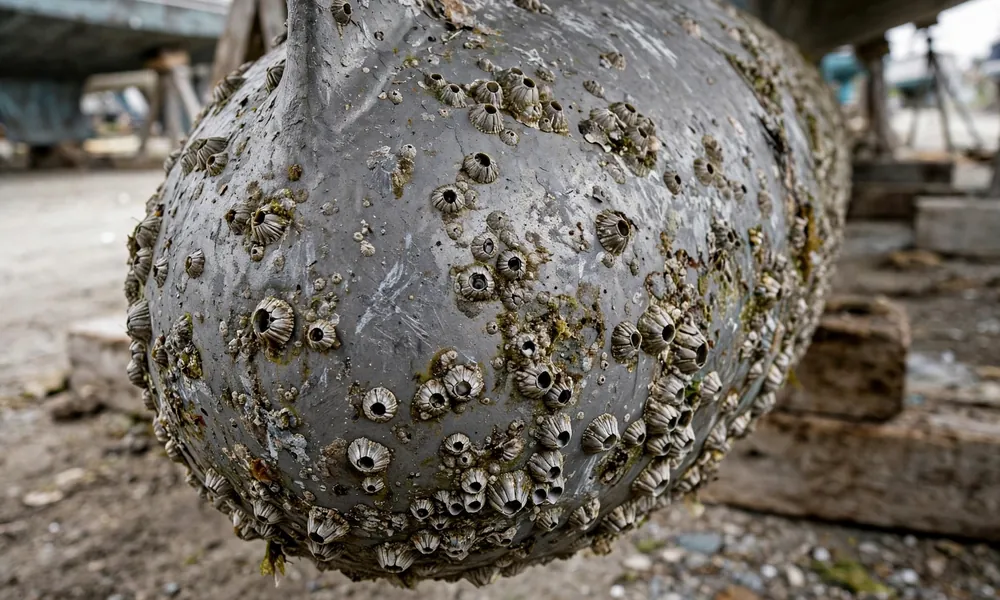
A keel lives underwater, so it needs the same care as the hull: antifouling paint to stop weed and barnacles, regular inspection for corrosion, and attention to the fairing where the keel meets the hull. Lead keels corrode slowly and are usually painted; iron keels rust and need more work. Every time the boat is lifted out, the yard checks the bolts, the seal and the surface, because a rough keel is a slow keel, and a loose keel is a dangerous one.
| Specification | Typical value |
|---|---|
| Depth below hull | 1.5 to 2.5 metres, cruising yacht |
| Keel weight | 30 to 45 percent of the boat’s weight |
| Bulb material | Lead, sometimes cast iron |
| Draft, racing fin keel | 2.5 to 3.5 metres |
| Righting moment | Several tonne-metres at 30 degrees heel |
| Keel bolts | Stainless steel, 6 to 10 bolts |
| Antifouling interval | Every 12 months |
Price is folded into the cost of the boat, but a keel on its own is not cheap. A replacement fin keel for a mid-size cruising yacht is estimated at roughly 5,000 to 15,000 US dollars, and a racing keel with a lead bulb is estimated at 20,000 to 60,000 US dollars. The lead in a large keel bulb alone is estimated at 2,000 to 5,000 US dollars at scrap value. Those are estimates, not list prices, but they show why keel damage is one of the most expensive accidents a yacht can suffer.
A rare fact: the word keel is one of the oldest in the English language, and it once meant the whole ship — a keel was laid when a ship was built, and the phrase “on an even keel” comes from sailing. The earliest keels were just the backbone timber of a wooden ship, and the fin we know today only appeared when yachts started racing and needed to sail upwind.
The next time you watch a yacht heel in a gust and hold its line, look below the waterline in your mind: a fin gripping the sea and a bulb of lead pulling the boat upright. The keel is the part of the yacht you never see, and it is the reason the boat you do see is still sailing.