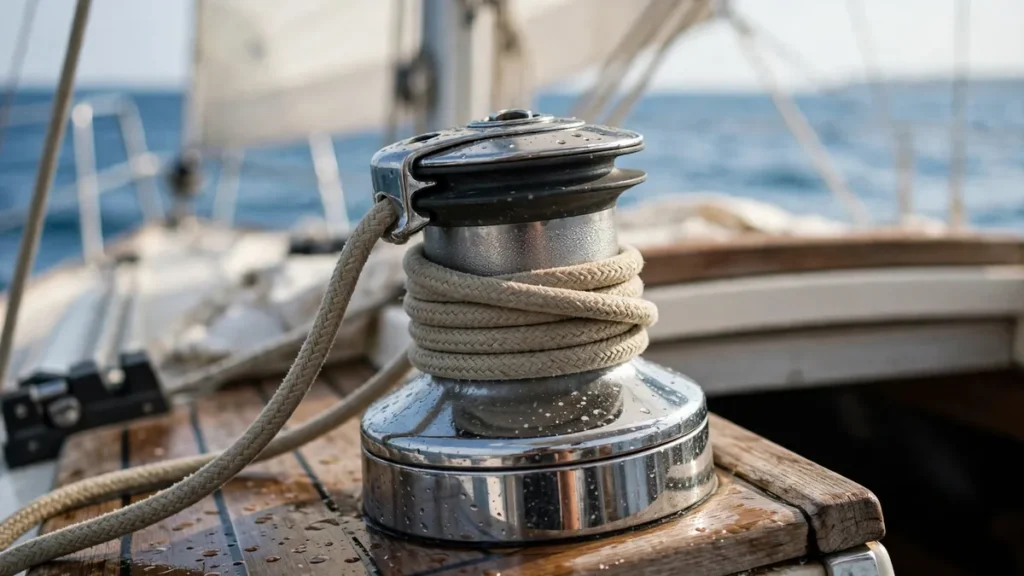
Stand on the deck of a sailing yacht and look up. Above you is a forest of wires, ropes and spars holding up a mast as tall as a house. Nothing about it looks simple, and yet every line has exactly one job, and every job matters. One wire holds the mast upright, one rope pulls the sail flat, one winch takes the strain that no human arm could hold. Together they form the rigging, the system that turns wind into motion, and it has worked in much the same way for centuries.
Rigging is really two systems in one. The standing rigging is the fixed set of wires that holds the mast up, and the running rigging is the moving set of ropes that controls the sails. One never moves, the other never stops moving, and the boat only sails when both are working together. This is how the whole system works, from the masthead down to the winch in the cockpit.
How Yacht Sail Rigging Works
Step 1: The mast stands on the keel
Everything in the rigging starts with the mast, a tall spar that rises from the deck and is stepped — set down — either on the deck itself or straight through to the keel below. The mast is held in a socket and braced by the standing rigging, and it carries the sails, the boom and the weight of every wire attached to it. Modern masts are usually aluminium, while racing yachts use carbon fibre for its lightness and stiffness. The mast is the spine of the whole system, and the loads it carries are enormous, which is why its construction matters as much as any rope on the boat, as the yacht carbon mast guide explains.
Step 2: Standing rigging holds the mast up
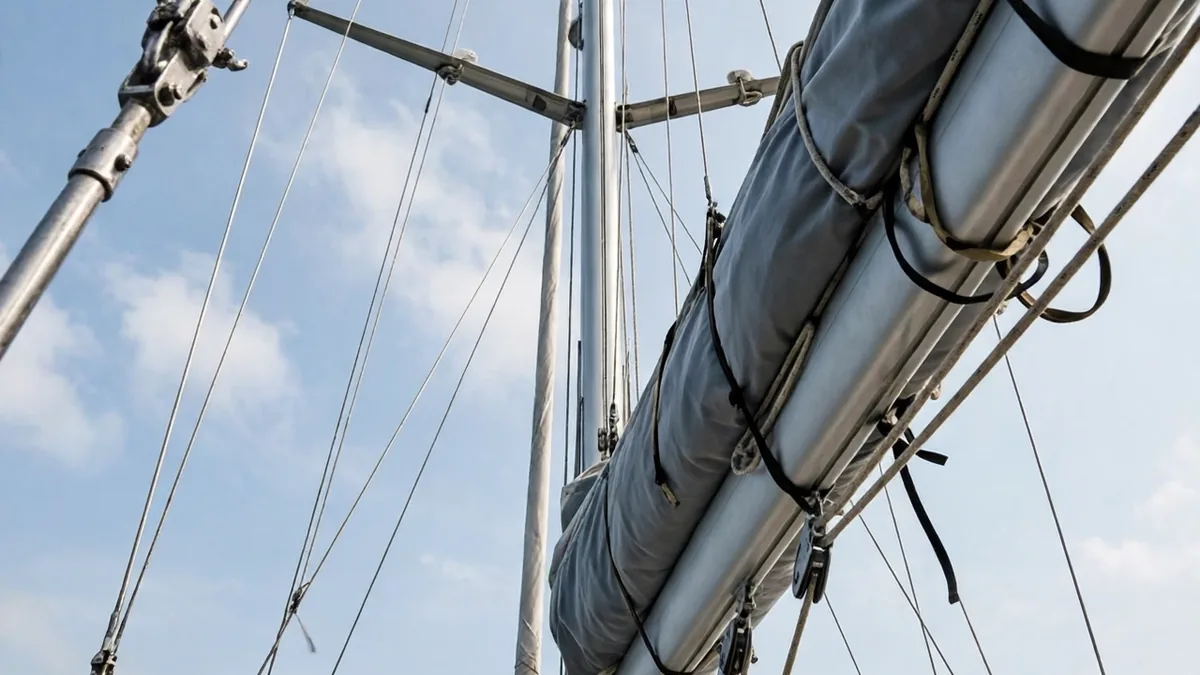
The standing rigging is a set of steel wires that runs from the top of the mast down to the hull, and it never moves once the boat is sailing. The forestay runs forward to the bow and keeps the mast from falling backwards, the backstay runs aft and keeps it from falling forwards, and the shrouds run to either side and stop it falling sideways. Spreaders — short horizontal arms part-way up the mast — push the shrouds outwards, widening the angle so they can hold the mast more effectively. Each wire is tensioned with a turnbuckle, a threaded fitting that lets the crew tighten it precisely, because slack lets the mast bend.
Step 3: Running rigging controls the sails
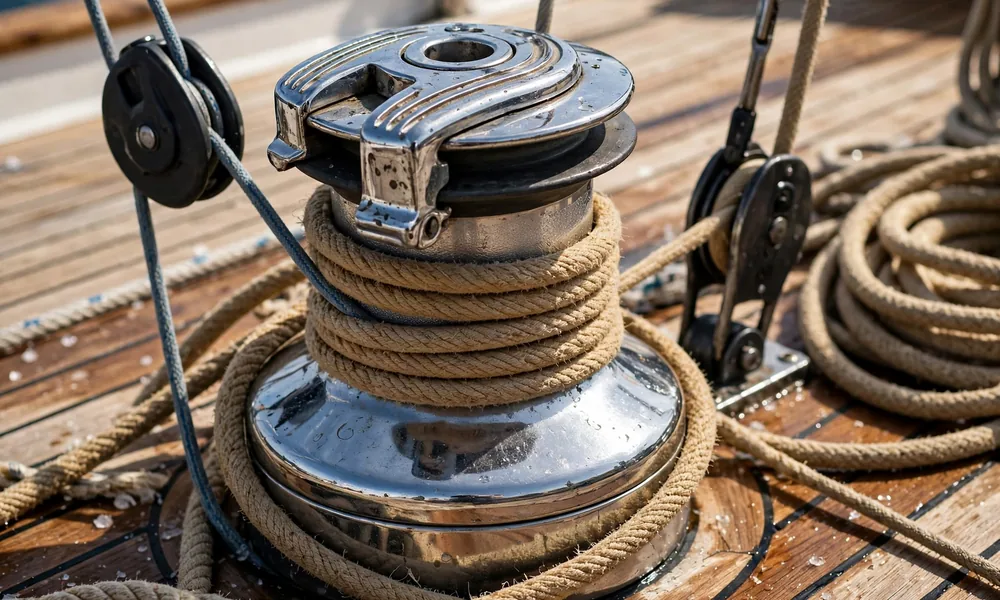
While the standing rigging holds things still, the running rigging is the set of ropes that moves. Halyards hoist the sails up the mast, sheets pull the sails in and out to set their angle to the wind, and control lines adjust the shape of the sail itself. These ropes run through blocks — pulleys mounted on the deck and the mast — so a single crew member can control a sail far larger than they could ever pull by hand. The ropes themselves are usually braided Dyneema or polyester, chosen because they stretch very little under load. The materials in these lines, and why they behave the way they do, are covered in the yacht sail rigging materials guide.
Step 4: Winches multiply human strength
A sail in a strong wind can pull with a force of several tonnes, far beyond what any crew member can hold. The winch solves this: the sheet is wrapped around a ribbed drum, and turning the handle gears the drum down so that a small effort on the handle becomes a large pull on the rope. Modern winches are often self-tailing, gripping the rope automatically so the crew member can use both hands on the handle, and many larger yachts use electric winches driven by a button. The winch is the muscle of the rigging, and without it the sails of a modern yacht could not be trimmed at all.
Step 5: Sails turn wind into forward pull
The rigging exists to hold the sails in the right shape, and the sails do the actual work. A sail works like a vertical wing: wind flowing across its curved surface creates low pressure on one side and high pressure on the other, and the difference pulls the boat forwards. The mainsail, attached to the mast and the boom, provides most of the power, while the headsail in front of it smooths the airflow and adds drive. The crew trims the sails constantly, easing the sheets when the wind drops and pulling them in when it rises, keeping the sail at the angle where it pulls hardest.
Step 6: The keel balances the whole system
All that sideways pull from the sails has to go somewhere, and the keel is what answers it. The heavy fin under the hull stops the boat from sliding sideways and provides the leverage that keeps the yacht upright against the force of the wind. The rigging pulls the top of the boat one way, the keel pulls the bottom the other way, and the balance between them is what lets a yacht sail upwind instead of simply being blown sideways. The shape and weight of that fin decide how stiff and stable the boat feels, as the yacht keel guide explains, and a well-matched rig and keel are what separate a fast yacht from a merely floating one.

Yacht Sail Rigging at a Glance
| Specification | Detail |
|---|---|
| Standing rigging | Fixed steel wires: forestay, backstay and shrouds |
| Running rigging | Moving ropes: halyards, sheets and sail control lines |
| Mast material | Aluminium on most yachts, carbon fibre on racing yachts |
| Rope material | Braided Dyneema or polyester, chosen for low stretch |
| Typical mast height | Approximately 12 to 20 metres on a cruising yacht |
| Winch type | Self-tailing manual winches, electric on larger yachts |
| Main sails | Mainsail on mast and boom, headsail forward of the mast |
| Main advantage | Silent, free propulsion with precise control |
| Main drawback | Needs constant attention, wires and ropes wear and need replacing |
What Does It Cost?
Standing rigging is a wear item, and replacing it is one of the bigger bills in yacht ownership. As rough estimates, a full replacement of the standing rigging on a mid-sized cruising yacht typically costs from around 3,000 to 10,000 dollars including labour, while a single electric winch can cost from about 2,000 to 6,000 dollars. Those figures are estimates, not quotes.
A Rare Fact
The word rigging comes from the same root as the rigging of old square-rigged ships, where a single large vessel could carry more than a kilometre of rope and hundreds of blocks. Modern yachts use a fraction of that, but the vocabulary survives: sailors still talk about sheets, halyards and stays, and much of that vocabulary is still in use today.
Yacht sail rigging works because it is honest about what it is. A set of wires holds the mast up, a set of ropes controls the sails, and a winch lets one person do the work of ten. There is no engine in the system, no fuel and no noise, just wind, rope and the balance of forces that has carried sailors across the sea for a thousand years.