Forty knots of wind, a heel that puts the rail in the water, and a mainsail the size of a tennis court pulling at the top of a mast as tall as a ten-storey building. Everything that keeps that sail flying — and keeps the mast standing — is the rigging: lines, wires and fittings carrying loads most people would associate with a bridge, not a boat. When a racing yacht’s rigging fails, the mast usually follows it into the sea within seconds. When it holds, nobody on board gives it a second thought.
Modern sail rigging is a long way from the hemp rope and tar of the age of sail. Today’s standing rigging — the wires and rods that hold the mast up — is made from carbon fibre and stainless steel so strong that a rod thinner than your finger can carry the weight of several cars. The running rigging — the lines the crew pulls to control the sails — is made from fibres originally developed for bulletproof vests, stronger than steel at a fraction of the weight.

The Materials Behind Yacht Sail Rigging
The headline materials are the high-modulus fibres: Dyneema, an ultra-high-molecular-weight polyethylene fifteen times stronger than steel by weight that floats on water, and aramid fibres such as Kevlar, stiff and heat-resistant. Carbon fibre dominates standing rigging on racing yachts, as solid rods or continuous fibre cables. Stainless steel — usually 316 grade — still holds the mast up on most cruising yachts, because it is tough, repairable anywhere, and forgiving. The fittings are machined from stainless steel, titanium or aluminium bronze, and the sails are laminated from polyester film, aramid and carbon fibres bonded into one membrane.
Step 1: Choosing the fibre for the job
Standing rigging and running rigging need opposite things. Standing rigging must not stretch at all — a forestay that stretches lets the sail sag and the boat slow down — so it uses the stiffest materials: carbon rod or high-modulus steel. Running rigging must be strong, light and kind to hands and winches, so it uses Dyneema cores with protective covers. The sailmaker and rigger match each line to its load: the backstay gets the strongest material; a spinnaker sheet, eased and trimmed constantly, gets the most flexible.
Step 2: Making the rope
A modern Dyneema line is not a rope in the old sense. The core is braided from twelve strands of ultra-high-molecular-weight polyethylene fibre, each finer than a hair, then heat-stretched to align its molecules and increase strength. Over the core goes a cover of braided polyester, protecting the slippery Dyneema from sunlight, abrasion and winches. The finished line is spliced, not knotted — a knot can cut a synthetic line’s strength in half, while a proper splice keeps almost all of it. Splicing is a skilled trade: the core is buried inside itself for many times the rope’s diameter, and that long bury’s friction is what holds it.
Step 3: Making the standing rigging
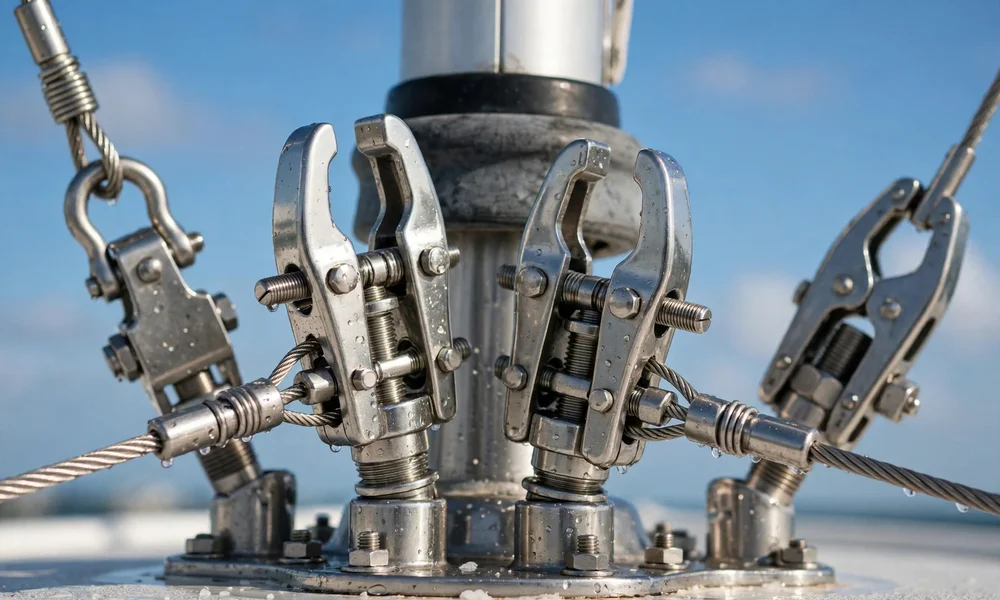
For a cruising yacht, standing rigging is usually stainless steel wire rope: strands of 316 stainless wire twisted into a rope, with swaged terminals pressed onto each end under immense pressure. For a racing yacht, it is carbon rod — pultruded carbon fibre drawn through a die and cured into a solid rod — or continuous carbon fibre cable. Carbon rigging is dramatically lighter: replacing a steel forestay with carbon can save tens of kilograms high above the deck, and weight saved up high is worth many times its own mass in stability. But carbon is unforgiving of damage and almost impossible to repair at sea, which is why cruisers still trust steel.

Step 4: Machining the fittings
Every line ends in a fitting: a turnbuckle that tensions the rigging, a toggle that lets it articulate, a terminal that joins wire to mast. These are machined from stainless steel, titanium or aluminium bronze, then polished until no sharp edge remains to chafe a line. A turnbuckle on a superyacht can carry loads of tens of tonnes, adjusted by hand with a wrench, a quarter-turn at a time, while the rig is tuned. The fittings are the most expensive part of the rigging by weight.
Step 5: Stepping the mast and tuning the rig
With the mast lying on the dock, the rigging is attached, the mast is lifted by crane and stepped onto the boat, and the tuning begins. The rigger tensions each stay in sequence, checking the mast is straight and the tension even on both sides. Too loose and the mast pumps and bends in a seaway; too tight and the hull itself is pulled out of shape. Tuning is done with a tension gauge and an experienced eye, and on a racing yacht it is repeated whenever the wind changes. The mast and rigging work as one system, as any crew that has sailed with a superyacht hull beneath them knows well.
Step 6: Setting the sails
The sails themselves are part of the materials story. A modern racing sail is not sewn cloth but a laminated membrane: fibres of carbon and aramid laid in the exact directions the loads run, sandwiched between films of polyester and bonded under heat. The result is a sail that holds its designed shape under load instead of stretching out of it — what makes a modern yacht so much faster than its ancestors.
Step 7: Inspection and replacement
Rigging is inspected constantly, because it fails without much warning. Stainless wire is checked for broken strands and cracks at the terminals, where corrosion hides; carbon rigging is inspected with ultrasound and tap tests for delamination; Dyneema lines are checked for chafe and glazing from overheating by a winch. Racing yachts replace standing rigging every few seasons regardless of how it looks, cruising yachts on a ten-year cycle. The same steady care that keeps a gyroscopic stabilizer spinning smoothly for years is what keeps a mast standing.
Yacht Sail Rigging at a Glance
| Specification | Detail |
|---|---|
| Standing rigging (racing) | Carbon fibre rod or cable |
| Standing rigging (cruising) | 316 stainless steel wire rope |
| Running rigging core | Dyneema (UHMWPE), ~15× stronger than steel by weight |
| Other fibres | Aramid (Kevlar), polyester covers, carbon sail laminates |
| Fittings | Stainless steel, titanium, aluminium bronze |
| Typical forestay load | Several tonnes; tens of tonnes on a superyacht |
| Replacement cycle | Racing: a few seasons; cruising: ~10 years |
What Does It Cost?
A full set of rigging for a mid-size cruising yacht costs several thousand dollars (estimate), with stainless steel wire and standard fittings. For a racing yacht, carbon standing rigging multiplies that several times over — a single carbon forestay for a large racing yacht can cost tens of thousands of dollars (estimate), and a complete carbon rigging package for a superyacht runs well into six figures.
A Rare Fact
Dyneema, the fibre at the heart of modern running rigging, is so slippery that it cannot be held by an ordinary knot — a bowline tied in Dyneema will simply slide undone under load. Sailors had to relearn splicing from scratch when it arrived, and the fibre is now so strong that racing lines are often sized not for strength but for handling: made thicker than they need to be simply so human hands can grip them. The strongest rope in sailing history is limited, in the end, by the size of a sailor’s hand.