A yacht rolls because the sea pushes one side up while the other side is still falling, tipping the hull around its centre line. A slow, deep roll makes guests seasick; a fast, snappy one throws glasses across the saloon. A stabilizer system takes the worst of that motion away before anyone on board feels it. On a modern yacht that system is not one device but a choice between several very different technologies, and the right one depends on size, cruising speed, and time at anchor.
The key split is between underway and zero-speed. Underway, water rushes past the hull and a stabilizer can use that flow to push back against the roll; at anchor there is no flow, and the system must create its own force from nothing. For decades that meant yachts were comfortable while moving and miserable at anchor — a problem, since a cruising yacht spends most of its life at anchor. The last twenty years of stabilizer engineering have been, above all, a war on that second problem.
Fins: the underway standard
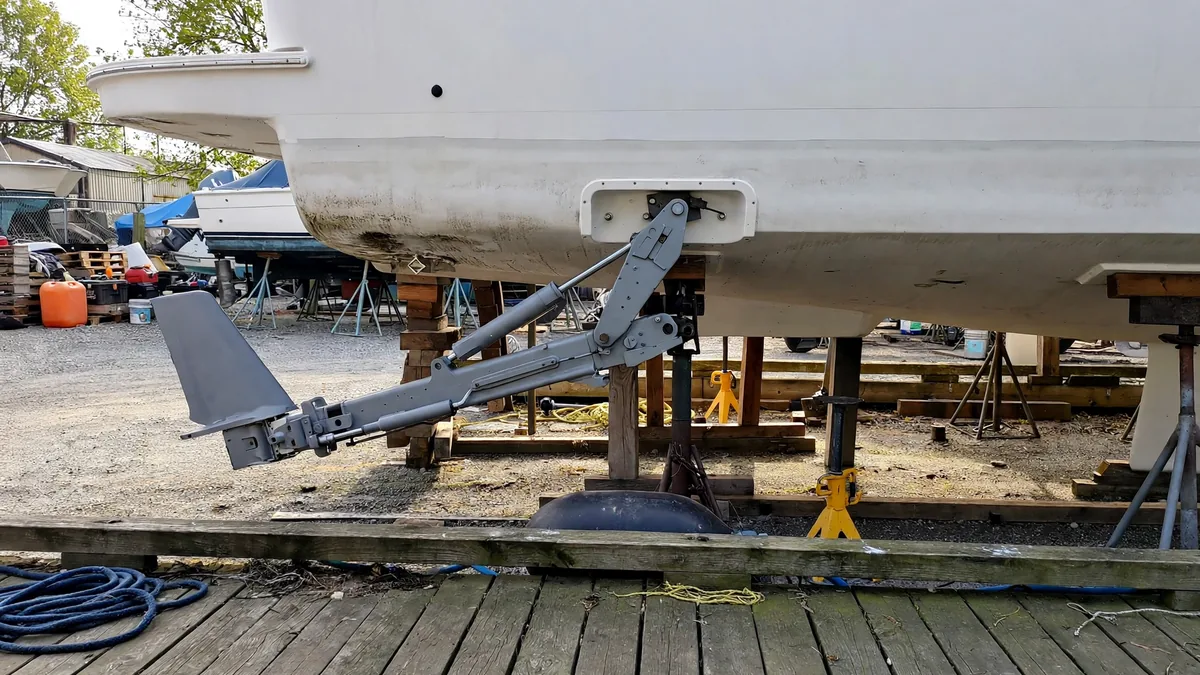
Active fin stabilizers are the traditional choice for larger yachts and remain the most effective at cruising speed. A pair of fins extends from the hull, roughly amidships, and a control computer twists them many times a second in response to sensors that feel the roll before a guest would notice it. Each fin acts like a small wing: angled one way it pushes the hull up, angled the other it pushes it down, applying a righting force exactly opposite to the roll.
Fins are powerful and efficient because they borrow energy from the yacht’s own motion: their actuators draw only a kilowatt or so, an order of magnitude less than a gyroscope needs. Their weakness is speed — below about six knots there is not enough flow over the fin to make useful lift, and at anchor they do nothing at all. That is why modern fin systems ship with a zero-speed mode, sweeping the fins through large, fast arcs to paddle against the water. It works, but it is noisy, draws far more power, and slowly walks the yacht around its anchor — a quirk crews call fin walk. The specs of yacht stabilizer fins show how fin size, speed, and actuator power trade against each other.
Gyroscopes: the at-anchor answer
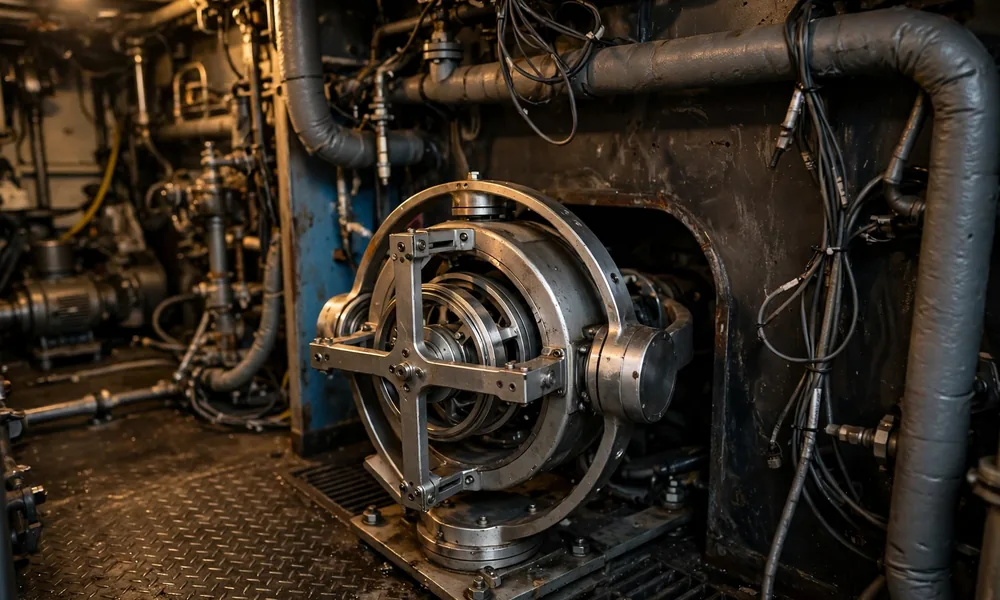
A gyroscopic stabilizer works on a completely different principle: inside a sealed housing, a heavy steel flywheel spins at five thousand to nine thousand revolutions per minute in a vacuum. When the yacht rolls, the housing tilts on its gimbal, and the flywheel’s angular momentum fights to stay upright, generating torque that resists the roll. The effect is the same underway and at anchor, needing no water flow at all — which is why the Seakeeper gyro is the default stabilizer on yachts under about seventy feet.
The price is power and space. A gyro draws two to eight kilowatts continuously, which means running a generator at anchor just to keep the boat steady, and it is a heavy box that must sit low in the hull near the centre line, where space is most contested. A gyro cannot stop a roll outright either — it converts the sharp side-to-side roll into a gentler bobbing motion, easier to live with, but not stillness. Fitted well, a gyro turns an anchorage from a place you endure into a place you enjoy.
Magnus rotors and interceptors: the newer ideas
The third family uses the Magnus effect — the physics that makes a spinning cricket ball swerve. A vertical cylinder, usually carbon fibre and about four feet long, extends into the water and spins; the spinning surface drags water around it, and the difference in flow speed on each side creates lift at right angles, countering the roll. Rotors work at low speed, fold flat against the hull when not needed, and use electric motors rather than hydraulics, which makes them simpler to retrofit. At rest the rotors pivot fore and aft to create their own water flow. The technology is younger than fins or gyros and fewer yards have fitted it, but it is gaining ground on long-distance cruising yachts.
Interceptors are the fourth option, and the smallest: a vertical blade on the transom that drops into the water flow to create lift at the stern, driven differentially to fight roll as well as pitch. They are cheap, light, and easy to retrofit, but only a partial solution — they help without transforming the motion the way a fin or gyro can, and they only work underway. Most yachts use them as a complement to a bigger system.
| Fins | Gyroscope | Magnus rotor | Interceptors | |
|---|---|---|---|---|
| Works at anchor | Yes, zero-speed mode | Yes, full strength | Yes, pivoting mode | No |
| Power draw | 0.5–1.5 kW underway | 2–8 kW continuous | Low–moderate | Very low |
| Best for | Over 70 ft | Under 70 ft | 40–80 ft | As a complement |
| Hull penetrations | Yes, below waterline | None | Yes, retractable | Transom only |
| Roll reduction | Up to 90% underway | 70–95% | Like fins | Partial |
The control system: sensing the roll before you feel it
Whatever the hardware, every modern stabilizer shares the same brain. Motion sensors near the yacht’s centre of motion measure the roll angle, how fast it is developing, and how quickly it is accelerating, updating many times a second. The control computer does not simply react to the roll it sees; it predicts the roll that is coming, because a fin or rotor takes a fraction of a second to move, and a force applied late can make the motion worse. The best systems learn the yacht’s behaviour, adjusting to the sea state rather than applying the same correction in all conditions.
That computer is also where stabilizers meet the rest of the yacht. A fin system needs hydraulic power from a pump driven off the main engines, while electric fins and gyros draw on the house electrical system and may decide whether the generator runs at anchor. The controller talks to the autopilot, and on many yachts the crew runs it from the same helm screens as the engines. A stabilizer is part of the yacht’s whole motion-control system, sharing its fate with the rudder and propellers — which is why the way a yacht rudder is made and the materials of a yacht propeller belong in the same conversation.
Choosing between them
There is no single best stabilizer, only the best fit for the yacht’s use. An ocean-crossing yacht wants fins, because nothing matches their power and efficiency underway. A yacht under seventy feet that spends its weekends at anchor wants a gyro, because nothing else keeps it still when it is not moving. A long-distance cruiser that does both increasingly carries both, and the combination is becoming the default on new builds over eighty feet.
The money is significant: a gyro installation runs from roughly twenty-five thousand dollars on a small boat to well over a hundred thousand on a large one, and a fin system on a big yacht can cost three hundred thousand or more before labour. Against that, the value is measured in the only currency that matters on a yacht — how many days a year the boat is actually pleasant to be on. A stabilizer does not make a yacht faster or safer. It makes the sea smaller, and for the people on board, that is the difference between a boat they use and a boat they avoid.