A cruising yacht drops anchor in a quiet bay, days from the nearest marina, and the crew still showers, cooks, and makes coffee as if they were tied up at home. The water tanks should have run dry long ago. Yet the tanks stay full, week after week, with no hose and no harbour in sight.
The secret is a small machine tucked into a locker below deck, a yacht watermaker. It takes seawater straight from the ocean, squeezes it through membranes finer than any filter, and turns it into fresh drinking water. It is the same reverse osmosis process used on superyachts, but shrunk down to fit a cruising yacht and run quietly off its batteries and solar panels. This is how it works.
How a Yacht Watermaker Works
Step 1: Seawater is drawn in and strained
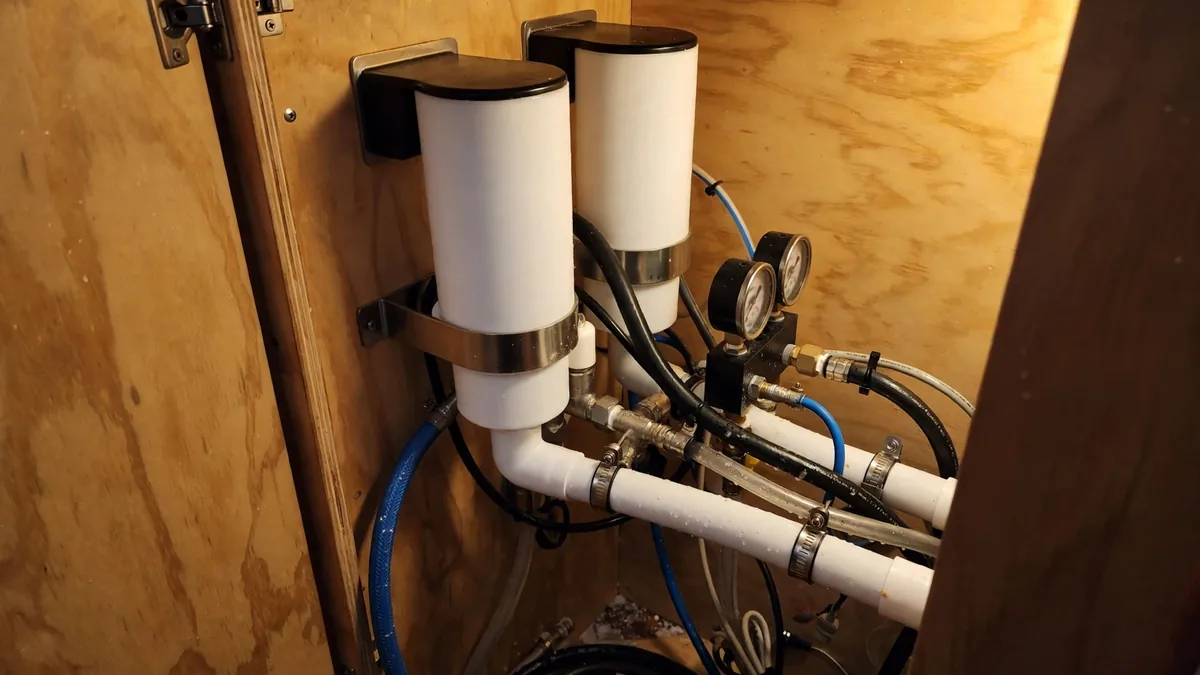
Everything starts below the waterline, where a through-hull fitting draws seawater into the boat. The first thing the water meets is a sea strainer, a small bronze basket that catches seaweed, jellyfish, and grit before they can reach the pumps. From there a low-pressure feed pump pushes the water through pre-filters, through coarse then fine five-micron filters. Clean water in means a long life for the delicate membranes downstream, and a clogged pre-filter is the most common reason a small watermaker loses output.
Step 2: A high-pressure pump squeezes the water
The heart of the system is pressure. Seawater holds about 35,000 parts per million of dissolved salt, and the only way to separate that salt is to push the water against a membrane harder than the sea pushes back, a force called osmotic pressure, roughly 27 bar for seawater. A yacht watermaker’s high-pressure pump raises the water to between 55 and 70 bar, about sixty times the pressure in a car tyre. On a small yacht this pump is usually a compact plunger pump driven by a 12-volt or 24-volt electric motor, drawing straight from the house batteries.
Step 3: Reverse osmosis membranes split salt from water
The pressurised water now flows along the inside of a long cylindrical membrane element, a tight spiral of semi-permeable sheets wrapped around a central tube. The membrane lets water molecules through but blocks salt ions, which are too large and too strongly charged to pass. Pure water seeps through the membrane and is collected in the central tube, while the remaining water, now saltier than the sea it came from, flows out the far end as brine and is discharged overboard. About a third of the water that enters becomes fresh water; the rest carries the salt away. A small yacht unit typically has one membrane, about a metre long, where a superyacht might run a whole row of them. The big-boat version of the same machine is described in how a superyacht watermaker works, where output is measured in thousands of litres a day rather than tens of litres an hour.

Step 4: The fresh water is tested and polished
The water that comes through the membranes is remarkably pure, often under 200 parts per million of dissolved solids, far cleaner than most tap water. But pure is not quite the same as drinkable. A conductivity sensor tests every litre as it leaves the membranes, and if the salt level rises above a set limit a valve automatically diverts the water back to the sea rather than into the tanks. Good water then passes through a carbon filter that removes any taste or odour, and a remineralising cartridge adds back a little calcium and magnesium, A small ultraviolet lamp gives a final sterilising pass, killing any bacteria that might have slipped through.
Step 5: Energy recovery keeps the power bill down
Forcing seawater to 60 bar takes a lot of energy, and the brine leaving the membranes still holds most of that pressure. The cleverest small watermakers recover it. An energy recovery device, a spinning pressure exchanger or a Clark pump, takes the high-pressure brine and uses it to pressurise the incoming seawater, so the electric pump only has to top up the pressure rather than create it from scratch. That one device can cut the machine’s electricity use by up to 80 percent, which is what makes a watermaker practical on a yacht that lives on batteries. A well-known energy-recovery unit makes about 24 litres an hour while drawing only 9 amps at 12 volts, and the smallest units make about 6 litres an hour on 4 amps. Without energy recovery, the same output can need three or four times as much power. The solar side of that equation is covered by how solar power works on a sailing yacht.
Step 6: Tanks store the water, and the machine looks after itself
Finished water flows into the yacht’s storage tanks, often holding 200 to 400 litres, where it waits for the domestic system. Pressure pumps then push it to the showers, galley, and heads. The tanks are kept full automatically: when the level drops, the watermaker starts itself, and when they are full it stops and flushes its membranes with fresh water so salt cannot crystallise on them overnight. If the yacht is left unused, the crew pickles the membranes, filling them with a preserving solution that stops bacteria growing inside. A pickled membrane can sit for months and wake up ready to work, while a neglected one can be ruined in weeks. Like the yacht’s other self-running systems, it rewards a crew that lets it do its job, as a yacht autopilot works by quietly correcting course.
Yacht Watermaker Specifications
| Specification | Typical figure |
|---|---|
| Output, small 12 V unit | About 6 to 30 litres per hour |
| Output, mid-size DC unit | About 30 to 60 litres per hour |
| Operating pressure | About 55 to 70 bar |
| Recovery rate | Around 30 to 40 percent of intake |
| Power, energy-recovery DC | About 100 to 240 W |
| Daily need per person | About 30 to 50 litres |
How Much Does a Yacht Watermaker Cost?
A small 12-volt yacht watermaker typically costs an estimated $5,000 to $10,000 before installation, A mid-size DC unit with energy recovery usually costs an estimated $7,500 to $12,000, and a high-output AC unit for a larger yacht can cost an estimated $12,000 to $20,000 installed. These are estimates, not list prices. Against that, a yacht that cannot make its own water must cut cruises short, carry heavy jerry cans, or pay for water in every port, so the machine pays for itself in freedom and range.
A Rare Fact
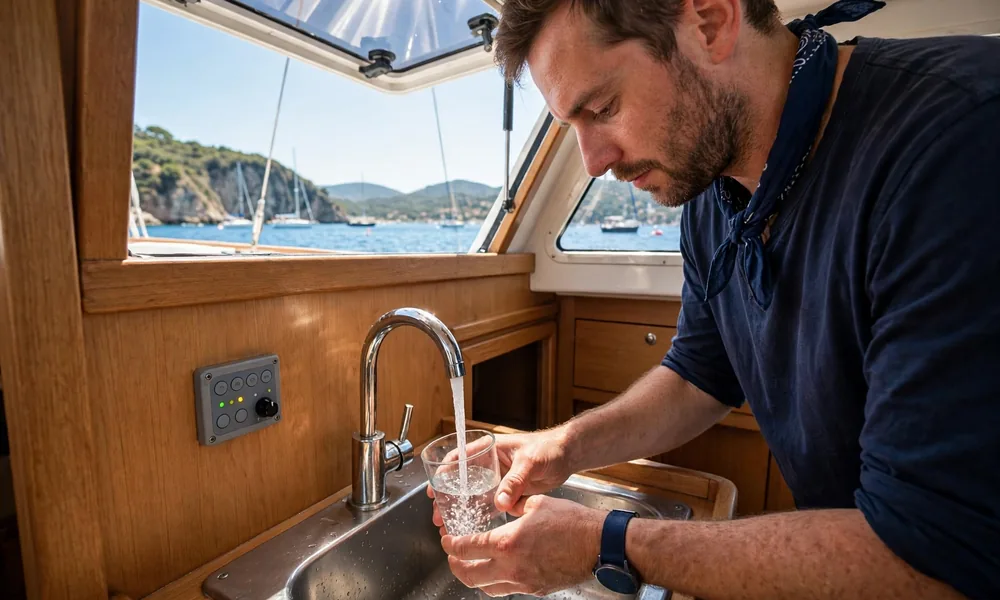
Here is something few people realise: the water a watermaker produces is too pure to drink straight. Reverse osmosis strips out almost everything, including the minerals that give water its taste. That is why every good system adds minerals back in, and why sailors in the age of sail, who collected rainwater in barrels, suffered from the same flat taste centuries before the chemistry was understood. Modern yachts solve it with a cartridge of crushed limestone that the water passes over, picking up just enough calcium to taste like a mountain spring.
So the next time you turn on a tap on a yacht miles from land, remember what is happening below deck: seawater strained and filtered, squeezed to sixty times the pressure of a car tyre, pushed through a membrane that lets only water through, tested and polished and given its minerals back, all on a few amps from the boat’s batteries.


