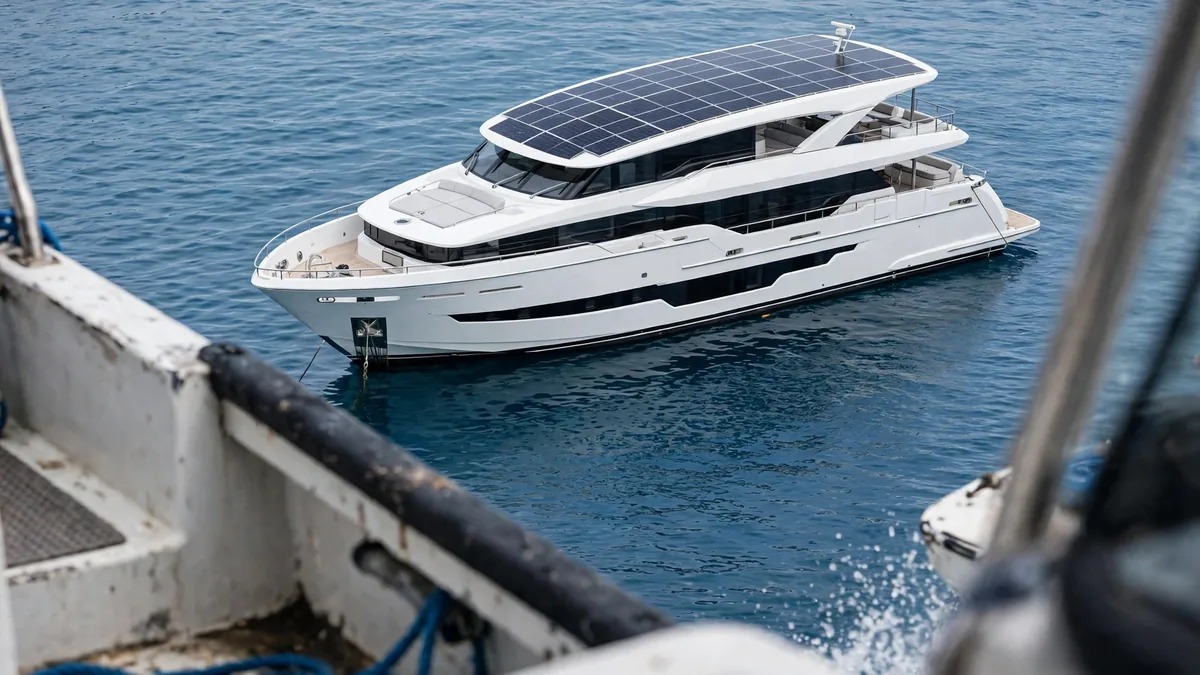
A solar electric yacht is a motor yacht that makes some of its own power from the sun. Solar panels, usually spread across the roof and hardtop, feed electricity into a battery bank, and electric motors draw on that bank to drive the boat. There is no mast and no sails doing the work: this is a powerboat, and the sun is a fuel source rather than a way of catching the wind.
The idea is straightforward, but the numbers matter. A yacht’s roof can hold only so many panels, and the sun delivers only so much energy per square metre, so solar power alone rarely drives a yacht at full speed for long. Instead the panels stretch the range, run the hotel loads, and let the boat move slowly and silently on sunshine. This explainer looks at how the pieces fit together and what the sun can realistically do.
The solar array
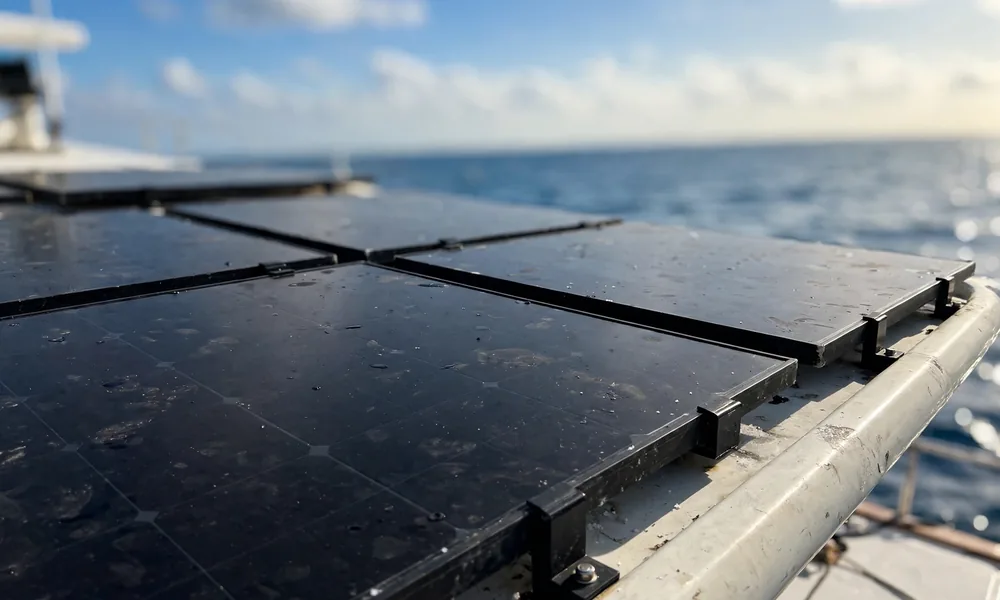
The panels on a solar yacht are usually marine-grade monocrystalline modules, chosen because they produce the most power from a given area. They are mounted flat or nearly flat on the roof, the hardtop and sometimes the foredeck, wherever the sun can reach them without shade from the superstructure. A large yacht might carry several kilowatts of panels; a smaller one, one or two kilowatts. The panels are toughened against salt, spray and the odd dropped fender.
Shade is the quiet enemy of a solar array. Even a small shadow across one panel can cut the output of a whole string, because the shaded cells drag the rest down. Good designs split the array into separate strings with their own controllers, so a shadow on the radar arch does not kill the panels on the roof. The panels feed their power through charge controllers that match the panel voltage to the battery and squeeze out the most energy as the light changes through the day.
The battery bank and motors
Between the panels and the motors sits the battery bank, and it does the heavy lifting. The sun is intermittent — clouds pass, night falls — so the battery stores the day’s harvest and releases it when the motors need it. Most solar yachts use lithium iron phosphate batteries, a chemistry chosen for safety and long life rather than maximum energy density. The bank is sized to the boat: enough to cruise for hours at low speed, with a reserve for manoeuvring in harbour.
The motors are electric, usually pod drives or shaft drives with permanent magnet motors. They are quiet, give full torque from rest, and need little maintenance. The power electronics between battery and motor work both ways: they drive the motor forward, and on some designs they can recover a little energy when the propeller turns while the boat is under way. That regeneration is modest, but on a solar boat every little helps.
Speed is where the maths shows. Moving a hull through water takes power that rises steeply with speed, so a solar yacht cruises slowly — often around five to eight knots — where the panels and battery can keep up. Push the throttles to fifteen knots and the power draw can be ten times higher, draining the bank in well under an hour. Owners learn to treat speed as something to spend carefully.
What the sun can actually do
On a bright summer day, a kilowatt of panels in the Mediterranean produces roughly four to five kilowatt-hours of energy. A yacht carrying six kilowatts of panels might harvest twenty-five to thirty kilowatt-hours in a day. That is plenty for the hotel loads — lights, fridges, air conditioning at a modest level, water-making — and it leaves enough to motor slowly for several hours. It is not enough to run at planing speed, and no honest builder claims otherwise.
The balance changes with latitude and season. In northern waters in winter, the same array might produce a quarter of its summer output, and the days are short. In the tropics, the output is steadier all year. Smart owners plan around this: they cruise slowly on solar in summer, plug into shore power in the marina, and accept that the sun is a supplement rather than a sole fuel source on longer passages.
That is why most solar electric yachts carry a backup. Some have a small diesel generator that tops up the battery when the sun falls short, making them a form of series hybrid. Others carry a large battery and a shore-power charger, and treat the generator as an option rather than a fixture. The generator does not spoil the idea: it means the boat can still cruise when the weather turns, and the solar panels still cut the fuel burned over a season.
Life on board
For the people on board, the most obvious difference is the silence. A solar yacht at low speed makes almost no noise — no engine thrum, no exhaust smell, no vibration through the deck. Wildlife comes closer, conversations stay easy, and anchoring in a quiet bay feels genuinely quiet. The second difference is the freedom from fuel stops: on a sunny cruising ground, the boat can spend days at anchor running its systems on sunshine alone.
The trade-offs are real. The roof has to be given over to panels, which limits space for sun pads and entertaining. The battery bank is heavy and takes up volume low in the hull. And the cruising speed is modest, so passages take longer and need more planning around weather. Owners who want to cross oceans at speed will not choose a solar yacht; owners who want to drift slowly along a sunny coast often love it.
How it differs from a solar sailboat
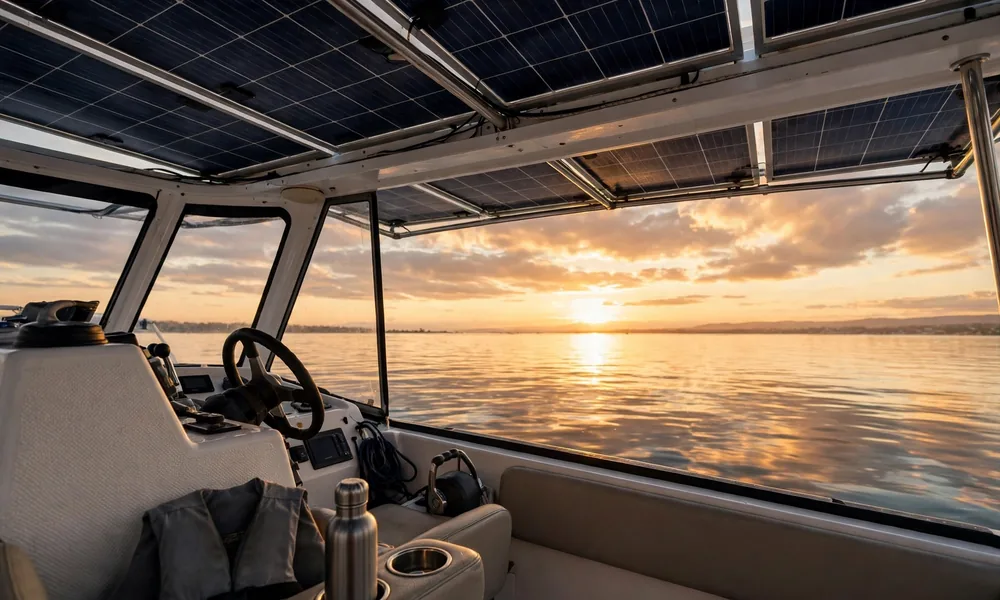
The confusion is understandable, because solar sailboats exist too. On a sailboat the wind does the driving and the solar panels run the lights, instruments and fridge. On a solar electric yacht the sun helps drive the boat itself, because there are no sails. That makes the power budget much tighter: a sailboat’s panels only need to cover the hotel loads, while a motor yacht’s panels have to move the hull as well.
The two types also differ in how they are used. A solar sailboat can cross an ocean on wind, with the panels as a bonus. A solar electric yacht is a coastal and island-hopping boat, happiest on short sunny passages with a marina or a generator to fall back on. Both are part of the same shift towards quieter, cleaner boating, but they solve different problems and suit different owners.
The Takeaway
A solar electric yacht is a motor yacht that turns sunlight into motion: panels on the roof feed a battery bank, the battery drives quiet electric motors, and the sun covers hotel loads and slow cruising, with a generator or shore power as backup when the weather turns. Its honest strength is silent, low-speed cruising in sunny waters, not fast passages. The sailing cousin is explained in what a solar sailboat is, the panel side in how a yacht solar panel works, and the wider electric picture in how electric yacht propulsion works.