On a car production line, a straight steel tube goes into a steel die, the die closes, and water is pumped inside at a pressure that would flatten a car tyre a hundred times over. The tube swells like a balloon, pressing itself into every curve of the die, and when the die opens, a single seamless exhaust manifold or chassis rail lies inside — a shape no press could stamp and no welder could join.
That is hydroforming. It shapes metal with pressurised fluid instead of a punch, and everything depends on the material: it must stretch without tearing, thin evenly without splitting, and hold its new shape when the pressure is released. Choose the right metal and a single tube can replace a dozen welded stampings.
Hydroforming builds car chassis parts, bicycle frames, exhaust systems and aircraft ducts, and it has quietly replaced many welded assemblies. Its closest relatives here are how hydroforming works, which follows the fluid through the process, and the hydroforming specifications that set the pressures and tolerances. Here is what the materials are, and why engineers chose them.

Steel: The Workhorse That Flows Under Pressure
Steel is the metal hydroforming was built around. It is strong, cheap, and it stretches a long way before it breaks, which is exactly what a tube needs when water pressure forces it into a new shape. The most common choice is low-carbon steel, the mild steel of car bodies, which can stretch by 30 to 40 per cent before it tears. That stretch lets a straight tube bulge into a complex chassis rail with varying cross-sections, thicker where the loads are high and slimmer where they are not.
High-strength steels are harder to please. They carry more load for less weight, which car makers love, but they stretch less — often only 10 to 20 per cent — and they spring back more when the pressure is released. Engineers answer that with higher pressures, sometimes above 4,000 bar, and with dies machined to compensate for the springback. Stainless steel sits in between: it stretches well, resists corrosion, and is the usual choice for exhaust manifolds and tubing that must survive heat and weather without rusting.
Aluminium and Copper: Light Metals, Gentle Handling
Aluminium is the second great hydroforming metal, and it brings a different bargain. It weighs about a third as much as steel, so a hydroformed aluminium chassis rail or bicycle frame saves real weight, but it stretches less and tears more easily, especially in the strong 6000 and 7000 series alloys. Engineers warm the metal or choose softer tempers — the 5000 series, used in marine parts, is a favourite — and accept slower forming to keep the tube intact. The reward is a part that is light, corrosion-proof and beautifully smooth.
Copper and brass are hydroformed too, mostly for smaller parts: plumbing fittings, heat exchanger tubes and musical instrument bells, where the metal’s softness is an advantage rather than a weakness. Copper can stretch by more than 40 per cent, so it fills intricate dies without complaint, and its superb heat conductivity makes it the natural choice for parts that must move heat. Titanium appears rarely, in aerospace ducts, because it is expensive and needs heat to form at all.
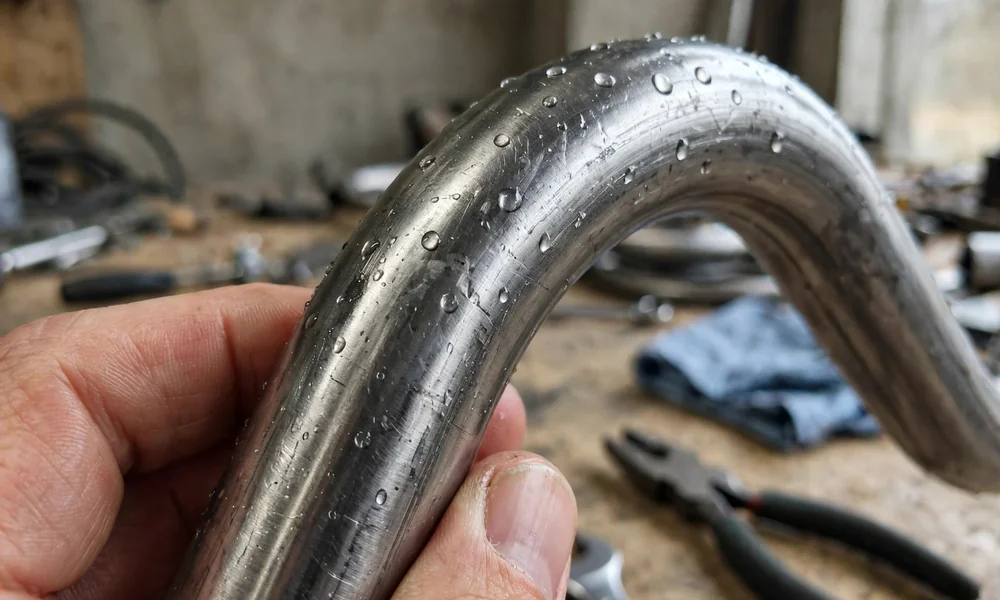
How a Hydroformed Part Is Made
- A straight metal tube is cut to length, cleaned, and placed inside a two-part die machined to the final shape of the part.
- The die closes and seals around the tube, and its ends are plugged so that pressurised fluid cannot escape.
- Water or oil is pumped into the tube, and the pressure is raised gradually to hundreds or thousands of bar.
- The internal pressure forces the tube wall outward until it presses against every curve and corner of the die.
- The ends of the tube are pushed inward at the same time, feeding extra metal into the bulging sections so the wall does not thin too much.
- The pressure is released, the die opens, and the finished part is removed, trimmed, and checked for thinning, wrinkles or cracks.
When the Materials Fail
Failure in hydroforming is usually a tear. If the metal cannot stretch far enough for the shape, the wall thins at the sharpest corner until it splits, and the pressurised fluid escapes in a spray. The usual cause is asking too much of one piece: a shape with a deep bulge and a tight corner needs either a more ductile metal, a warmer tube, or a redesign with gentler curves. Wrinkling is the opposite failure. If the ends are pushed in too hard while the pressure is too low, the tube buckles and folds, and the wrinkles are pressed permanently into the part.
Springback is the quieter failure: release the pressure and the metal relaxes slightly, so a part that matched the die perfectly can end up a millimetre or two out of shape — enough to fail assembly. Engineers fight it with higher pressure and with dies cut slightly beyond the target shape.
Hydroforming Materials
| Material | Where it is used | Why engineers chose it |
|---|---|---|
| Low-carbon steel | Car chassis rails, frames | Stretches 30 to 40 per cent; cheap and strong |
| High-strength steel | Crash structures, pillars | More load for less weight; needs higher pressure |
| Stainless steel | Exhaust manifolds, tubing | Stretches well and never rusts |
| Aluminium 5000 series | Bicycle frames, marine parts | Light, corrosion-proof, forms well |
| Aluminium 6000 / 7000 | Aircraft ducts, frames | Very strong; tears easily, needs care |
| Copper and brass | Plumbing, heat exchangers | Very ductile; moves heat superbly |
| Titanium | Aerospace ducts | Light and heat-proof; costly to form |
What Does Hydroforming Cost?
The fluid is cheap — it is mostly water — but the die is not. A hydroforming die is a massive block of machined tool steel, and a single die set is estimated to cost roughly $50,000 to $250,000, with the press itself estimated at $500,000 to several million dollars; all of these are estimates, and every installation is bespoke. That cost only makes sense at volume, which is why hydroforming lives in car factories. The savings come afterwards: one hydroformed part can replace a dozen stampings and welds, cutting assembly time, weight and failure points. The comparison that counts is with aluminium forging, where the metal is hammered rather than swelled, and the shapes are more limited.
A Rare Fact
Hydroforming is older than most people think. The idea was patented in the 1940s and first used to make aircraft parts, but its great moment came in the 1990s, when car makers began hydroforming entire chassis rails in a single piece. The 1997 Chevrolet Corvette used hydroformed frame rails, and the technique spread through the industry so fast that within a decade, most new cars carried at least one part shaped by water pressure. A process born for aeroplanes now holds up the cars on every road.
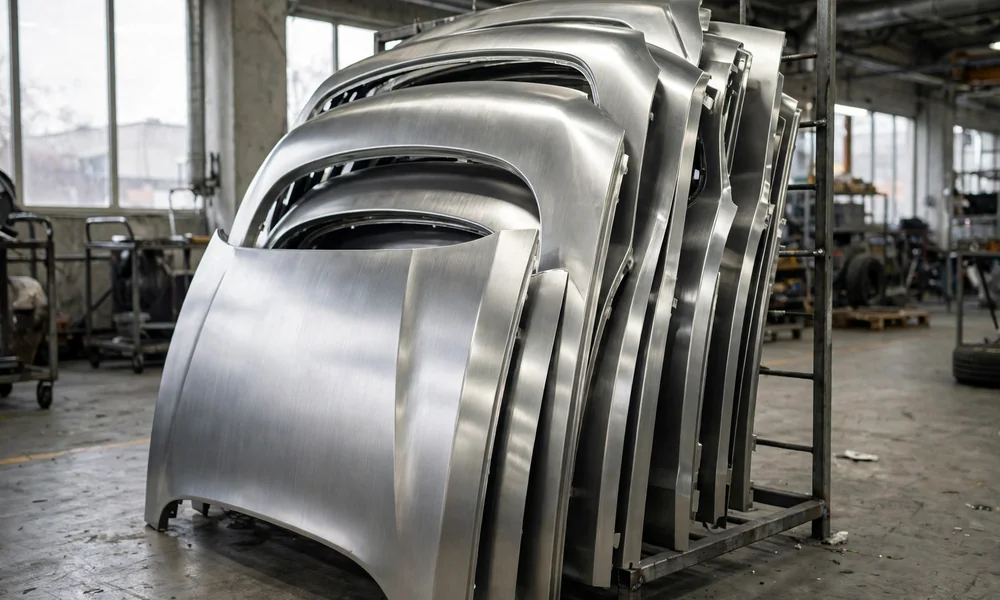
Hydroforming looks like a conjuring trick — water doing the work of a hammer — but it is really a materials story. The metal must stretch, thin evenly and hold its shape, and the engineers who choose it are really choosing a bargain: steel for strength and price, aluminium for weight, copper for heat. Get that bargain right, and a straight tube becomes a chassis rail in a single step, with no weld in sight.


