In a car factory, a steel tube goes into a machine and comes out a different shape — wider in the middle, narrower at the ends, bent in two directions at once. The tube was filled with water, sealed at both ends, and squeezed from the inside until the pressure forced the metal outward into a die.
That is hydroforming, one of the most elegant ideas in metalworking. A hollow tube or a flat sheet is placed inside a steel die, the die closes, and fluid — usually water mixed with a little oil — is pumped inside at enormous pressure. The pressure pushes the metal outward until it takes the exact shape of the die. When the die opens, out comes a single seamless part that would otherwise have needed several stamped pieces welded together.
Hydroforming has been shaping metal since the 1940s, and today it is everywhere you do not notice it: in car subframes and exhaust manifolds, in bicycle frames and aircraft ducts. Its numbers — fluid pressure, press force, expansion ratio, wall thinning — decide whether a part comes out perfect or bursts like a balloon. Its closest relatives are the hydroforming production line that turns tubes into finished parts at factory speed, and the aluminium forging that shapes solid metal by hammering it instead of inflating it. Here is what the specifications mean.

Fluid Pressure: The Force That Shapes the Metal
Fluid pressure is the headline number in hydroforming, and it is very large. In tube hydroforming, the water inside the tube is typically pressurised to 100 to 400 megapascals — 1,000 to 4,000 bar. High-strength steel parts can need up to about 600 megapascals. Sheet hydroforming, where a flat blank is pressed into a die by fluid on one side, works at lower pressures, typically 20 to 100 megapascals. A car tyre holds about 0.2 megapascals; a hydroforming press holds five hundred to two thousand times that. Pressure is raised in stages: first a low pressure seats the tube, then the ends are pushed inward to feed extra metal in, and only then does it climb to its peak. Too little pressure and the part comes out under-formed; too much and the tube bursts.
Press Force: Holding the Die Shut
The second key number is the force that holds the die closed against all that pressure. Hydroforming presses are rated by their closing force: typically 1,000 to 10,000 tonnes for automotive work — the weight of a thousand to ten thousand cars pressing down on a die the size of a table. That force matters because any gap between the two halves of the die lets metal squeeze out as a thin fin called flash, and lets the pressurised fluid leak. The press, the die and the seals are therefore built like a submarine hatch: massive, precise, and checked constantly.
Expansion Ratio: How Much a Tube Can Grow
The expansion ratio says how far a tube can be stretched. It is the ratio of the finished diameter to the starting diameter, and for most tube hydroforming it runs from about 1.3 to 1.6. A 50-millimetre tube can be expanded to about 65 to 80 millimetres; beyond that, the metal thins too much and splits. The trick that makes bigger expansions possible is axial feeding: while the pressure rises, hydraulic rams push the ends of the tube inward, feeding extra metal into the middle so the wall does not thin as fast. But there is always a limit set by the metal itself: aluminium expands less willingly than mild steel, and high-strength steel less willingly still.
Wall Thinning: The Price of Stretching
When a tube expands, its wall gets thinner — metal is not created, only moved around. Wall thinning in the most expanded zones typically runs from 10 to 25 per cent, so a tube that starts with a 2-millimetre wall might finish at 1.5 to 1.8 millimetres in the bulge. Engineers design the starting tube thicker where the most expansion will happen, and they use computer simulation to predict the thinning before the first real part is made. The starting wall thickness is typically 0.8 to 4 millimetres for automotive parts: thinner walls form more easily but carry less load, while thicker walls need higher pressures.
Speed and Precision: What Hydroforming Beats
Hydroforming is not the fastest way to make a metal part, but it is one of the most accurate. A typical cycle takes 20 to 60 seconds per part, including loading, forming, and unloading. What hydroforming wins on is consolidation and accuracy. A car subframe that would need five stamped pieces and a dozen welds can be made as a single hydroformed tube, which is lighter, stiffer and has no welds to fail. Tolerances of plus or minus 0.1 millimetres are achievable on key dimensions. That is why hydroforming is chosen where a part must be light, strong and precise at once — and why it shows up in the titanium forging world as the alternative engineers reach for when a hollow, seamless shape is needed instead of a solid forged one.

Hydroforming Specs
| Specification | Typical range |
|---|---|
| Fluid pressure, tube hydroforming | 100 to 400 MPa, up to about 600 MPa for high-strength steel |
| Fluid pressure, sheet hydroforming | 20 to 100 MPa |
| Press closing force | 1,000 to 10,000 tonnes for automotive work |
| Expansion ratio | 1.3 to 1.6 times the starting tube diameter |
| Wall thinning in expanded zones | 10 to 25 per cent |
| Starting wall thickness | 0.8 to 4 mm for automotive parts |
| Cycle time per part | 20 to 60 seconds |
| Dimensional tolerance | Plus or minus 0.1 mm |
| Common materials | Mild steel, high-strength steel, aluminium, copper, brass |
| Typical part weight saving | 20 to 40 per cent against a welded assembly |
What Does Hydroforming Cost?
Hydroforming is expensive to start and cheap to repeat. A hydroforming press line is estimated at roughly $1 million to $5 million, and the die for a single part at $50,000 to $250,000 — all estimates. The parts themselves are inexpensive once the tooling exists: an automotive hydroformed part is estimated at roughly $5 to $50 per piece in volume production, and the savings come from what disappears — fewer parts to stock, fewer welds to make, and a lighter finished product that saves fuel for the life of the vehicle. If the part is made in tens of thousands, the tooling pays for itself; if only a hundred are needed, stamping and welding are cheaper.
A Rare Fact
Hydroforming dates to the 1940s, when it first shaped copper plumbing fittings, and it has a quirk no other forming process shares. A hydroformed tube can finish wider in the middle than it is at the ends, which means the finished part is physically too fat to be pulled out of a one-piece die. The only way to get it out is to split the die open like a clamshell. Engineers call this an undercut, and it is why hydroforming dies are always made in two halves that separate after every part.
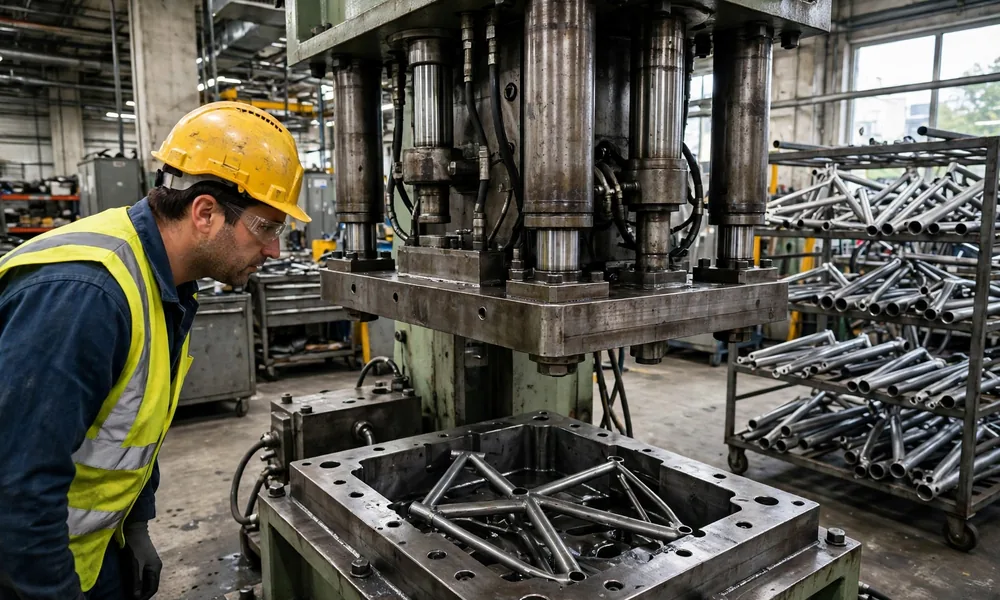
Sometimes the strongest tool in a factory is water, pushed hard enough to bend steel. A tube goes in plain and straight and comes out curved, bulged and seamless — lighter than the welded assembly it replaces and shaped to a tenth of a millimetre.


