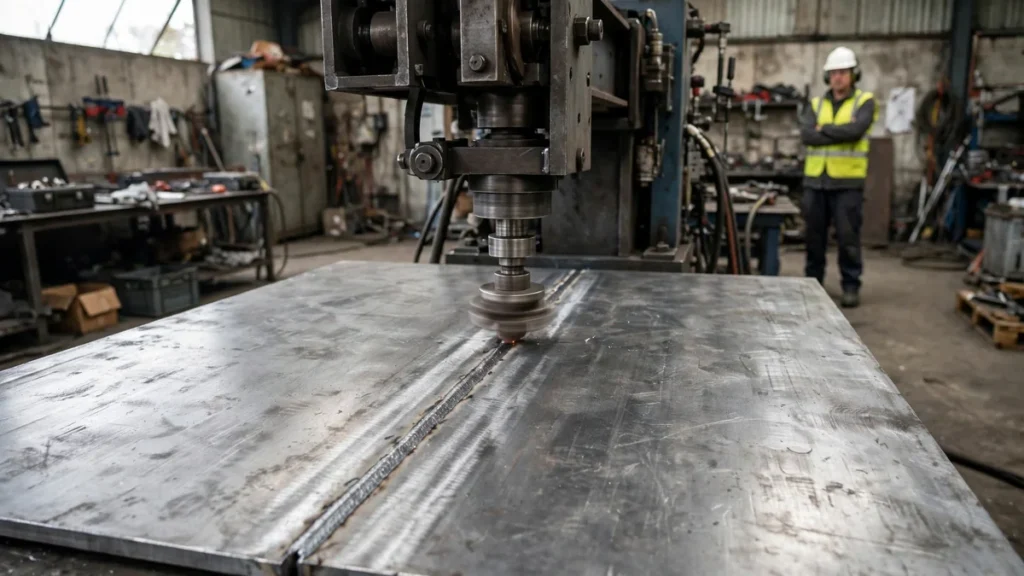
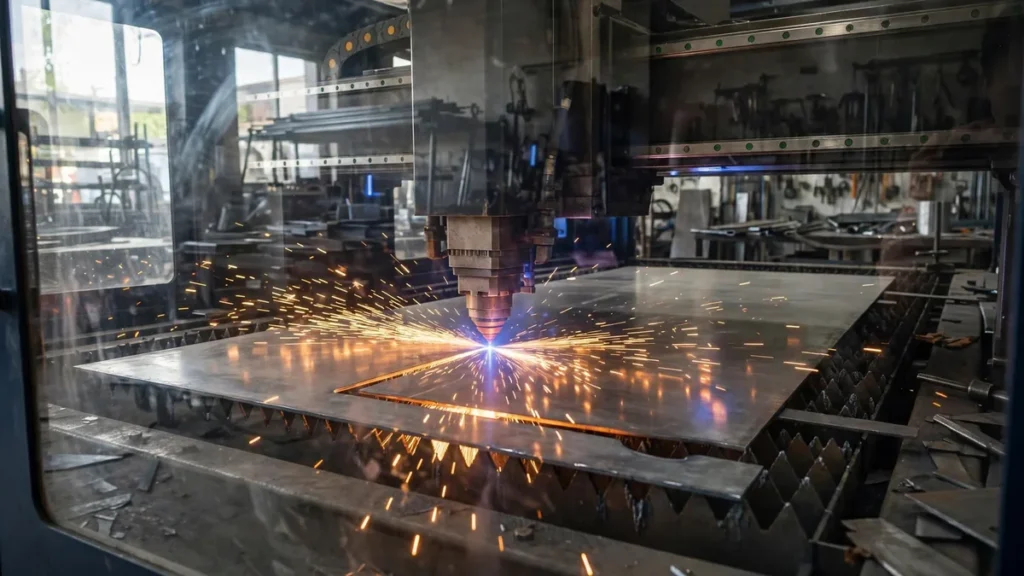
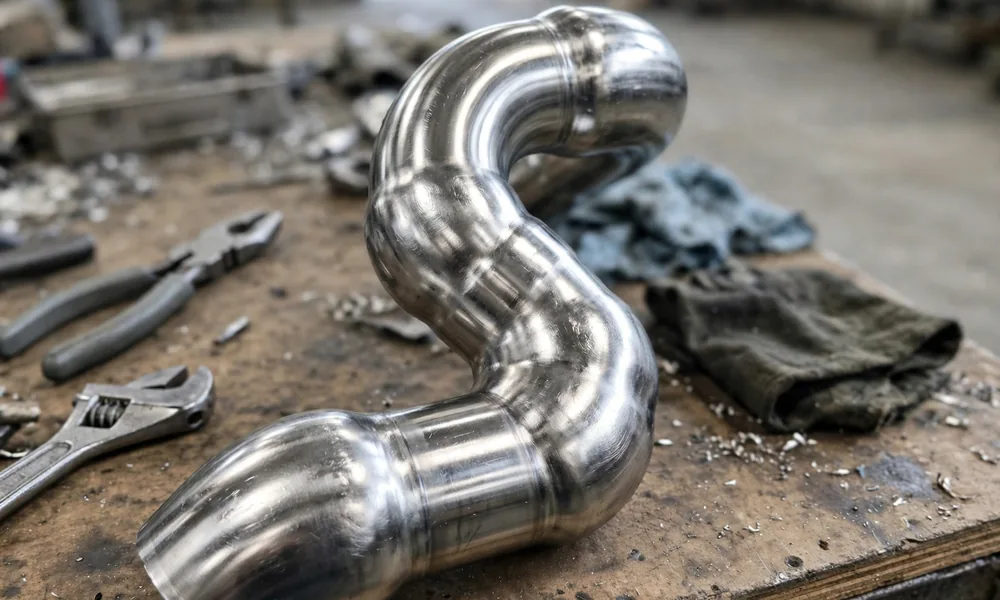
Take a steel tube, seal the ends, and pump water into it at a pressure that would flatten a car tyre a hundred times over. The tube does not burst. Instead, it swells — slowly, evenly, like a balloon made of steel — until it fills the mould around it and takes on a shape no press could stamp and no welder could build. When the water drains away, what remains is a single seamless part: a car frame rail, a bicycle frame, an exhaust manifold, curved and hollow and far stronger than it has any right to be.
That is hydroforming, and it is one of the quietest revolutions in car making.

How Hydroforming Works
Hydroforming uses pressurised fluid — usually water, sometimes oil — to force a metal tube or sheet into a mould. The metal is sealed inside the die, the fluid is pumped in, and the pressure rises until the metal yields and stretches to match the shape of the die cavity. The hydroforming process works because fluid pressure is perfectly even: every square millimetre of the metal feels the same push, so it expands uniformly instead of thinning in one spot and tearing. The result is a complex hollow shape made from a single piece of metal.
Step 1: Choosing and preparing the tube
It starts with a tube, usually steel, aluminium or copper, cut to length and checked for flaws. The tube’s diameter, wall thickness and alloy all matter, because they decide how far the metal can stretch before it splits. A tube with a scratch or a dent is rejected at this stage: under thousands of bars of pressure, the smallest flaw becomes the place where the metal tears. Preparation is dull, careful work, and it decides whether the rest of the process succeeds or fails.
Step 2: Loading the tube into the die
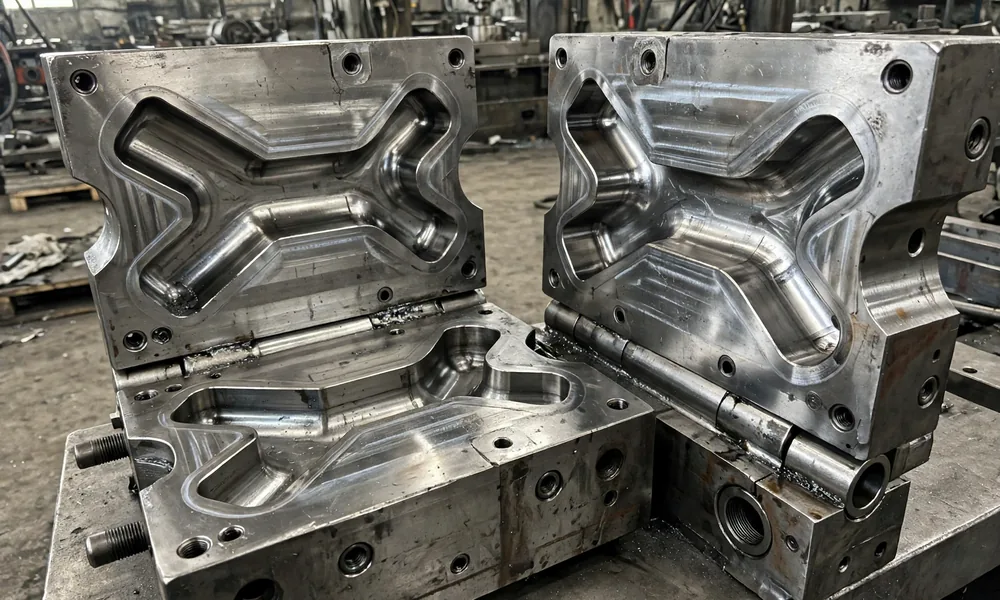
The die is a massive block of tool steel, split into two halves, with a cavity machined into it in the exact shape of the finished part. Workers lay the tube into the lower half, and the press closes the upper half down on top of it with a force of hundreds or thousands of tonnes. This is tube hydroforming; there is also a sheet version, where a flat sheet is pressed into a die by fluid on one side. Either way, the principle is the same: metal trapped in a mould, with nowhere to go but outward.
Step 3: Sealing and filling with fluid
With the die closed, the tube is filled with water — ordinary water, usually, with a little lubricant or corrosion inhibitor mixed in. Air is bled out first, because trapped air compresses and makes the pressure uneven. The sealing punches at each end press into the tube, closing it off completely, and a pump begins to fill it. Safety interlocks make sure nobody is near the press when the pressure rises.
Step 4: Pressurising and expanding the metal
Now the pressure climbs, and this is the moment the part is born. The pump drives the pressure up to 1,000 bars or more — in some machines, past 4,000 bars — and the tube wall begins to yield. The metal stretches outward, flowing into the corners and curves of the die cavity, thinning slightly as it expands. At the same time, the sealing punches at each end push inward, feeding extra metal into the die so the tube does not thin too much in the middle.
Step 5: Holding and calibrating the shape
Once the metal has filled the die, the pressure is held steady for a short calibration phase. This irons out springback — the tendency of metal to relax slightly when the force is removed — by pressing the part hard against the die walls one final time. The calibration pressure is the highest of the whole cycle, and it is what gives hydroformed parts their tight tolerances and crisp details.
Step 6: Draining, trimming and inspection
The water is drained and usually filtered and reused, the part is lifted out of the die, and the ends are trimmed off — the sections gripped by the sealing punches are not part of the finished shape. Workers check the part for the two classic defects: thinning, where the wall stretched too far, and wrinkling, where too much metal was fed in. What left the press as a single seamless tube is now a structural member of a vehicle, lighter and stronger than the welded assembly it replaced.
Hydroforming at a Glance
| Specification | Typical value |
|---|---|
| Working fluid | Water, sometimes oil |
| Forming pressure | 1,000–4,000 bar |
| Press closing force | 500–10,000 tonnes |
| Materials | Steel, aluminium, copper, brass |
| Wall thinning | Typically 10–25% |
| Cycle time | 30 seconds to 3 minutes |
| Best for | Car frame rails, exhaust parts, bicycle frames, plumbing |
What Hydroforming Costs
A hydroforming press and its tooling can cost roughly $1 million to $5 million as an estimate, and each die is machined for one specific part, so the upfront cost is high. The economics work because of what the process removes: a welded frame assembly that needed twenty stamped pieces, twenty welds and hours of labour becomes a single tube formed in under a minute. Aluminium forging faces the same trade-off between tooling cost and volume.
A Rare Fact
Hydroforming was first used in the 1940s and 1950s to make plumbing fittings and brass parts, and it stayed a niche process for decades. Its big break came in the 1990s, when carmakers needed lighter, stronger frames and realised that a hydroformed rail could replace a whole welded assembly. A process invented for taps and pipes now holds up the cars we drive every day — and most drivers have never heard of it.
Where Hydroforming Shows Up
Look closely at a modern car and hydroforming is everywhere you cannot see it. The frame rails under the floor, the roof rails above the doors, the cross members that hold the engine — many of them began life as plain tubes. Bicycle makers use it for frames with flowing, organic curves, and exhaust makers use it for manifolds that bend around an engine bay. Even plumbing and furniture use hydroformed tubes, because a single smooth part looks better and lasts longer than one assembled from pieces. It is a process that hides its own work, which is why most people have never heard of it, even though they ride inside its results every day. The next generation of electric vehicles uses it too, for battery enclosures and crash structures that must be both light and immensely strong.
So the next time you look under a car, or pick up a bicycle with a frame that curves in ways a welded tube never could, think of the water. Ship stabilizers are built on a different scale, but the same lesson applies across engineering: sometimes the gentlest force, applied evenly everywhere at once, is the strongest tool in the factory.