On a dark road, a hypercar announces itself long before you see its shape. Two thin blades of white light cut through the night, sharp at the edges, almost blue at their core, and they sweep across the tarmac in a way no ordinary headlight can match. The driver sees further, and the light is not decoration. It is one of the most engineered parts of the car.
A hypercar headlight has to do three jobs at once. It must light the road far enough ahead for a car travelling at more than 300 kilometres per hour, it must not blind other drivers, and it must fit into a body shape that leaves almost no room for a lamp at all. The specification sheet is where those three demands meet, measured in lumens, lux, kelvin, and watts.
Each number answers a simple question: how far can the driver see, how clearly, and for how long.
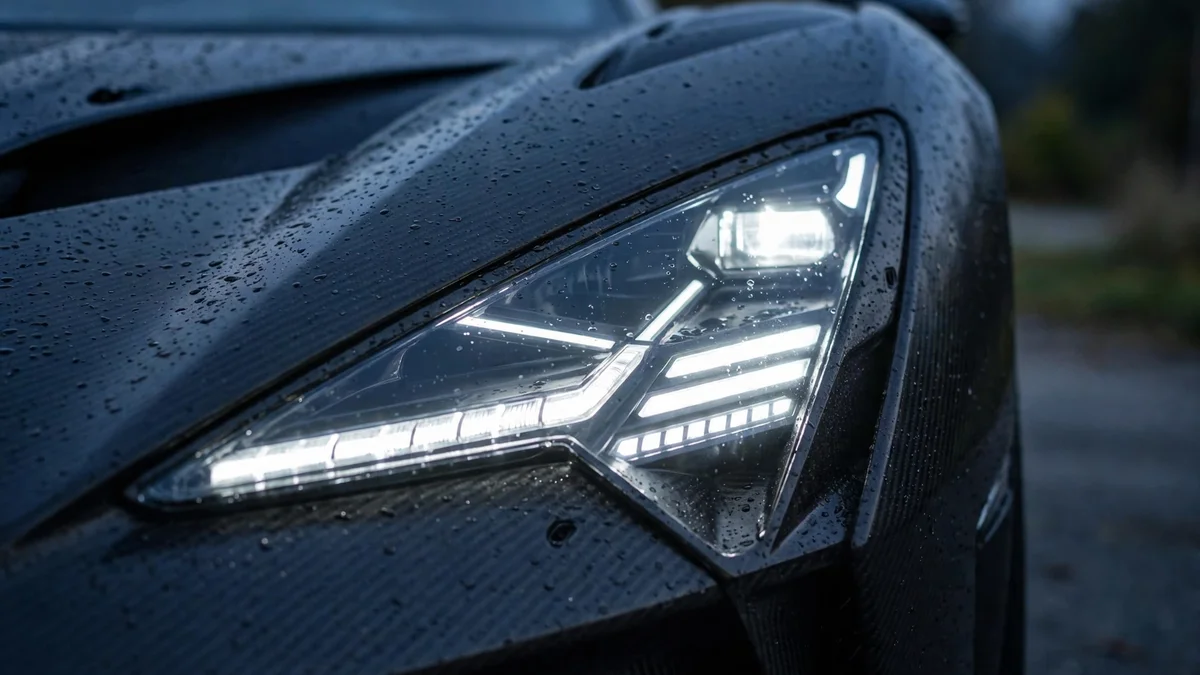
Hypercar Headlight Specs Explained
1. Light output: lumens
Lumens measure the total amount of light a headlight produces, and a modern hypercar headlight produces roughly 2,000 to 4,000 lumens per lamp on dipped beam, and more than 5,000 on full beam. The extra output matters because of speed: at 300 kilometres per hour, a car covers 83 metres every second, so the driver needs the road lit far ahead just to have time to react. More lumens alone do not help, though, because light thrown in the wrong direction is wasted or dangerous.
2. Beam distance and lux
Beam distance is the range at which the headlight still puts useful light on the road, and it is measured in lux, the amount of light falling on a surface. A hypercar headlight on full beam typically reaches 400 to 600 metres at 1 lux, roughly twice the distance of an ordinary car. The dipped beam is a different problem: it must light the road ahead while cutting off sharply below the eye line of oncoming drivers, a line engineers call the cut-off. Getting that cut-off crisp is why hypercar lamps use precisely shaped lenses and reflectors rather than simple bulbs.
3. Colour temperature: kelvin
Colour temperature, measured in kelvin, describes whether the light looks warm or cold. Hypercar headlights are usually rated between 5,000 and 6,500 kelvin, a cool white close to daylight. The human eye sees contrast best in light near daylight, about 5,500 kelvin, which is why it is chosen. Warmer light, around 3,000 kelvin, looks yellow and feels softer but shows less detail on the road. Cooler light above 6,500 kelvin starts to look blue, which can seem brighter but actually scatters more in rain and fog, making visibility worse rather than better.
4. Light source: LED, laser, and matrix
The light source is the heart of the specification sheet. Most hypercars now use LED headlights, with dozens of individual light-emitting diodes in each lamp. The most advanced use matrix LED systems, where each diode can be switched on or off independently, so the car can keep full beam on while switching off the diodes that would shine into the eyes of a driver ahead. Beyond that is laser light, used as a full-beam booster: a tiny laser excites a phosphor that glows brightly and throws light further than any LED. Laser boosters can extend the beam beyond 600 metres, but they only switch on above a certain speed and switch off the moment another vehicle is detected. That precision echoes the hypercar brake disc specifications, where tiny tolerances decide how the car behaves at speed.
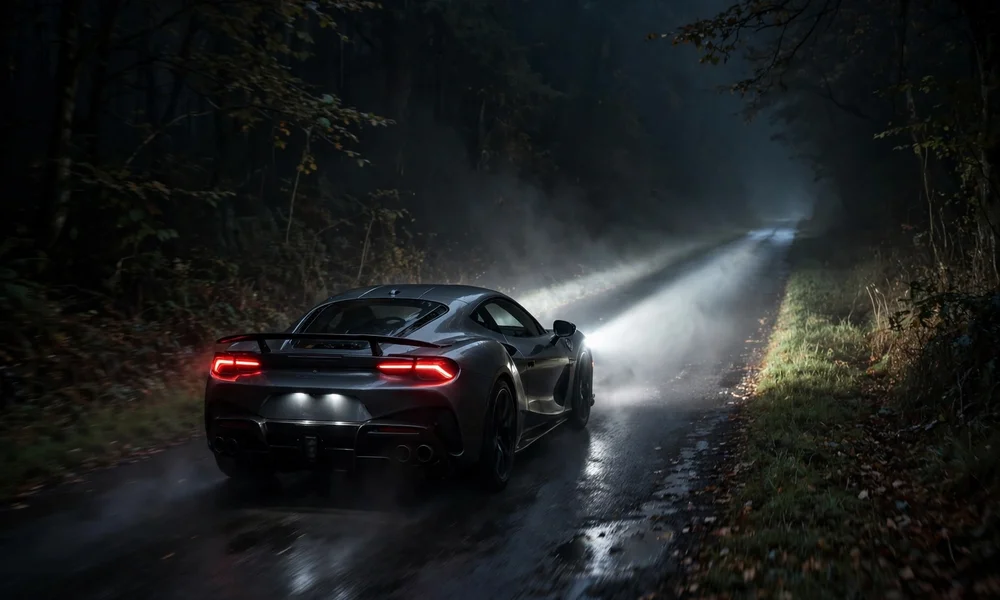
5. Power consumption: watts
Power consumption is the number that explains why LEDs took over. A hypercar LED headlight draws roughly 30 to 50 watts per lamp, against 55 watts or more for a single old halogen bulb producing far less light. Low consumption matters beyond efficiency: less power means less heat, and heat is the enemy of a headlight, because it shortens the life of the diodes and can warp the lens. Each lamp hides a small heatsink, sometimes a fan, behind it.
6. Adaptive functions: cornering, levelling, and glare-free beam
Adaptive functions are what separate a hypercar headlight from a bright lamp. Cornering lights swivel the beam into a bend, following the steering angle, so the driver sees around the corner rather than straight into the verge. Automatic levelling keeps the beam at the right height when the car accelerates, brakes, or carries a load, using sensors on the suspension. The glare-free beam goes further: a camera watches the road ahead, and the headlight switches off individual LEDs to carve a dark tunnel around oncoming cars while keeping full beam everywhere else. These systems react in milliseconds, and they are why a hypercar can run full beam almost all the time on an empty motorway. The same sensing-and-reacting idea runs through the dual-clutch gearbox specifications, where electronics pick the gear before the driver asks.
7. Durability, sealing, and service life
A headlight is expected to last the life of the car, and the specification sheet says how. LEDs are rated for 15,000 to 30,000 hours of use, many times longer than a halogen bulb, but the lamp can still fail if water gets in. That is why the sealing standard matters: headlights are tested against dust and water ingress, and the lens is made from polycarbonate with a hard coating to resist stone chips and ultraviolet light. Even so, a stone strike can crack the lens, and on a hypercar the replacement cost is high, because the lamp is a sealed unit with its own cooling, sensors, and control electronics built in.
Hypercar Headlight Specs
| Specification | Typical range |
|---|---|
| Light output, dipped beam | About 2,000 to 4,000 lumens per lamp |
| Light output, full beam | More than 5,000 lumens per lamp |
| Full beam distance | About 400 to 600 metres at 1 lux |
| Colour temperature | About 5,000 to 6,500 kelvin |
| Light source | Matrix LED, with laser booster on some cars |
| Power consumption | About 30 to 50 watts per lamp |
| LED service life | About 15,000 to 30,000 hours |
| Adaptive functions | Cornering, levelling, glare-free beam |
What Do Hypercar Headlights Cost?
A pair of hypercar matrix LED headlights is estimated to cost roughly $8,000 to $20,000 as a factory option (estimate), and a laser headlight system can add $10,000 or more (estimate). A single replacement lamp is estimated at roughly $4,000 to $12,000 (estimate), because the unit is sealed and contains its own cooling, sensors, and control electronics. That pricing matches cars built around the Bugatti W16 engine specifications, where every component is engineered to a limit.
A Rare Fact
The first laser headlights on a production car were not built for brightness alone, but because the tiny laser unit let designers shrink the whole headlight, freeing space for aerodynamics. The slim blades of light on today’s hypercars exist because a laser made them possible.

Read the lumens, the beam distance, the colour, and the adaptive functions together, and the lamp stops looking like a styling detail and becomes what it really is: the part of the car that decides how far ahead the driver can see.


