You are merging onto a motorway in a hot hatch, and you floor the throttle in third gear. The car surges forward, the revs climb, and then the next gear arrives with a small kick in the back, so fast you barely feel the gap. There is no pause, no dip in power, no moment where the car seems to think about it. The gearbox has already chosen the next gear before you asked for it.
That is a dual-clutch gearbox, usually shortened to DCT, and it is the gearbox that has taken over performance cars, from hot hatches to hypercars, in the last twenty years. The specification sheet for a DCT, though, is not about how fast it shifts. It is about clutches, torque, ratios, and cooling, and every number on it decides how the car feels when you drive it hard.
Read the sheet properly and you can tell a gearbox that will snap through gears for a hundred thousand kilometres from one that will overheat in traffic on a hot day. Here is what each of those numbers means, and how to read them together.
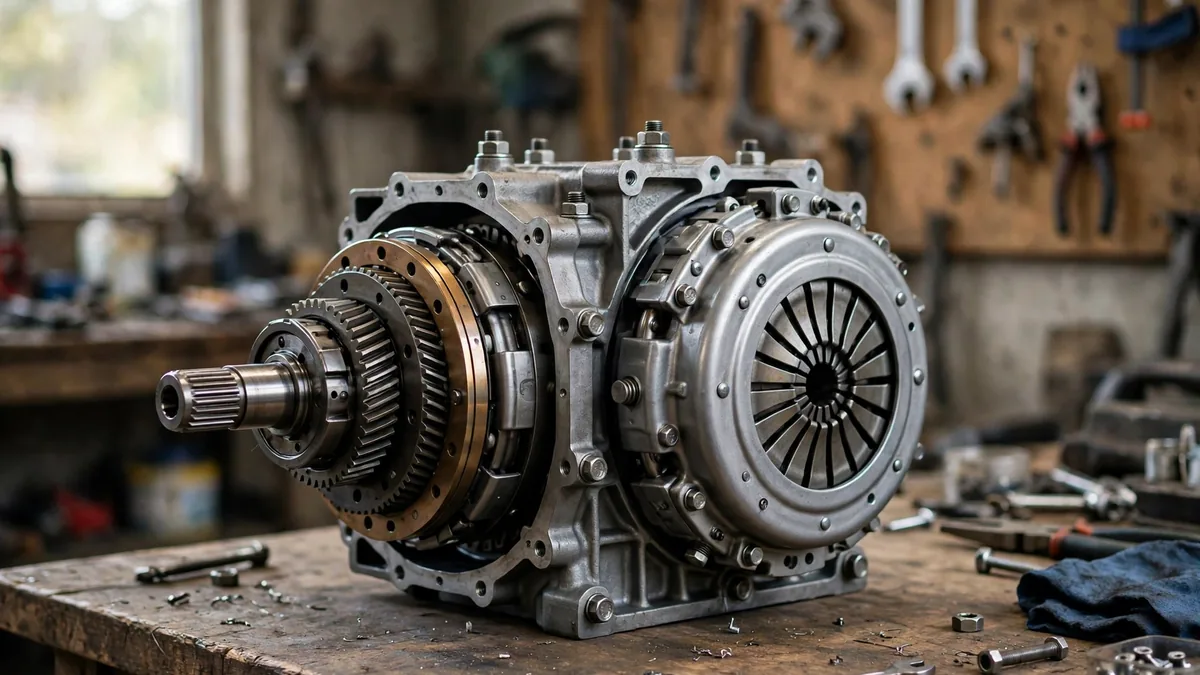
Dual-Clutch Gearbox Specs Explained
1. Number of gears and ratios
The number of gears is the first number on the sheet, and on a modern dual-clutch gearbox it is usually seven or eight, with some performance gearboxes reaching nine. More gears let the engine stay closer to its best revs, which improves both acceleration and fuel economy, because the engine is rarely too high or too low in its range. The spread between first gear and top gear, usually written as the ratio spread, tells you which the gearbox was built for.
2. Clutch type: wet versus dry
The clutch type is the reason the whole specification sheet looks the way it does. A dual-clutch gearbox has two clutches, one for the odd gears and one for the even gears, so the next gear is already engaged before the current gear lets go. A dry clutch works like the clutch in a manual car, with friction plates running in air, and it is light, efficient, and cheap to make, but it cannot shed heat quickly. The way those clutches are built is described in how a dual-clutch gearbox is made, from machining the clutch packs to assembling the finished gearbox.
3. Torque capacity
Torque capacity is the number that says how much twisting force the gearbox can handle, and on a modern dual-clutch gearbox it is usually between 250 and 700 newton-metres, with high-performance gearboxes reaching 1,000 newton-metres or more. This number decides which engine the gearbox can be paired with: a gearbox rated for 350 newton-metres cannot safely sit behind an engine that makes 500, because the clutches would slip and overheat.
4. Shift time
Shift time is the number everyone quotes, and on a modern dual-clutch gearbox it is usually between 80 and 200 milliseconds for a full-throttle upshift, with the fastest performance gearboxes claiming under 100 milliseconds. That is the time from the gearbox starting to change gear to the next gear being fully engaged, and it is so short that the power interruption is barely felt. The full working principle is set out in how a dual-clutch gearbox works, including how the two clutches hand over to each other without dropping power.

5. Gear ratio spread and top gear
The ratio spread is the difference between first gear and top gear, and on a modern dual-clutch gearbox it is usually between 7 and 9 to 1, meaning first gear multiplies the engine torque about eight times more than top gear does. A narrow spread gives closer gears and a more urgent feel, but the engine works harder at speed and uses more fuel. Read the first gear, the top gear, and the final drive together, and you can predict how the car will feel before you drive it.
6. Cooling and thermal limits
Cooling is the specification that decides whether a dual-clutch gearbox survives a hot day in traffic. Every shift generates heat in the clutches, and in stop-start traffic the clutches slip constantly as the car creeps forward, building heat with no airflow to carry it away. A wet-clutch gearbox pumps oil through the clutch packs and through an external cooler, so it can shed that heat and keep working. The sheet sometimes gives a maximum continuous torque or a maximum oil temperature, usually around 120 to 140 degrees Celsius, above which the gearbox protects itself by softening its shifts. A comparable performance gearbox is described in the hypercar gearbox specifications, where the same trade between shift speed, cooling, and torque capacity decides the design.
7. Weight and service life
Weight is the specification that surprises people most, because a dual-clutch gearbox is heavier than a manual gearbox with the same number of gears. A modern seven-speed dual-clutch gearbox weighs roughly 70 to 90 kilograms, against about 50 kilograms for a six-speed manual, because it carries two clutches, two input shafts, and a hydraulic control unit. Service life is usually given as a clutch life, and a wet-clutch gearbox can last more than 150,000 kilometres in normal use, while a dry-clutch gearbox may need new clutches after 80,000 to 120,000 kilometres, especially if it spends its life in traffic.
Dual-Clutch Gearbox Specs
| Specification | Typical range |
|---|---|
| Number of gears | Usually 7 or 8 |
| Clutch type | Wet or dry dual clutch |
| Torque capacity | About 250 to 700 newton-metres |
| Shift time | About 80 to 200 milliseconds |
| Ratio spread | About 7 to 9 to 1 |
| Maximum oil temperature | About 120 to 140 degrees Celsius |
| Gearbox weight | About 70 to 90 kilograms |
| Clutch service life | About 80,000 to 150,000 kilometres |
What Does a Dual-Clutch Gearbox Cost?
A dual-clutch gearbox fitted to a new car is estimated to cost roughly $2,000 to $5,000 more than a manual gearbox in the same car, depending on the number of gears and the torque capacity. A replacement clutch pack for a wet-clutch gearbox is estimated at roughly $1,500 to $3,000 before labour, and a full replacement gearbox is estimated at roughly $8,000 to $15,000. That figure is why a used car with a dual-clutch gearbox deserves a careful test drive in traffic, where a worn clutch shows up as hesitation or shuddering long before it fails outright.
A Rare Fact
The dual-clutch gearbox was invented for racing in the 1980s, not for road cars. Porsche developed the first working dual-clutch gearbox, called PDK, for its 956 and 962 racing cars, because it let the drivers shift without lifting off the throttle. The technology sat on the shelf for twenty years before it became cheap enough for road cars, and the first modern road-going dual-clutch gearbox arrived in a Volkswagen Golf in 2003.
A dual-clutch gearbox never gets the attention the engine gets, yet it is the part that decides how the engine’s power reaches the road. Read the gear count, the clutch type, the torque capacity, and the shift time together, and the gearbox stops being a black box under the car and becomes what it really is: two clutches taking turns, so the power never has to pause.


