There is a room in France where the most powerful production engine ever fitted to a road car is built by hand. It has no roaring assembly line, no river of parts rushing past on a conveyor. Instead, a small team of technicians works in near silence around a single engine, fitting each part by hand, checking each measurement twice, and signing their work when it is done. The engine is the Bugatti W16: sixteen cylinders, four turbochargers, eight litres of displacement, and more power than two racing cars combined.
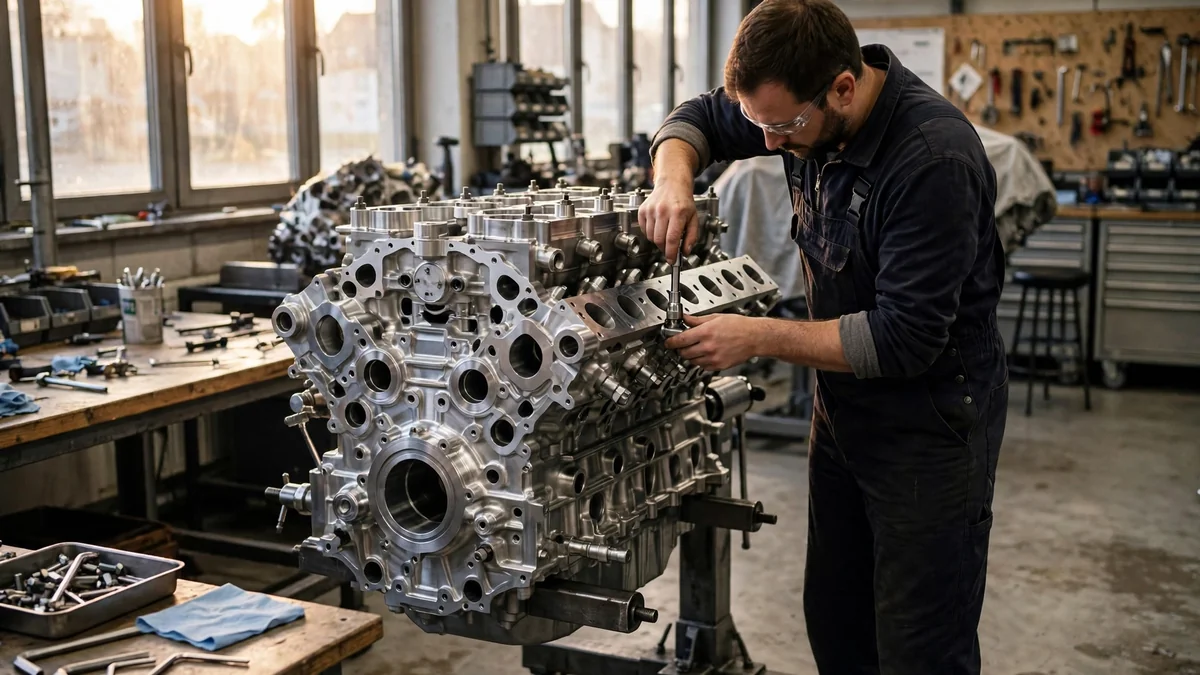
The W16 is not really one engine but two narrow-angle V8 engines joined together on a single crankshaft, arranged in a W shape. It has 64 valves, four turbochargers, and thousands of parts, and it is built to survive speeds of more than 400 kilometres per hour. Every engine is assembled by hand, tested on a bench for hours, and only then sent to the car it will power. Here is how a Bugatti W16 engine is built, from a bare block of aluminium to the beating heart of a Chiron.
How It’s Made
Step 1: Machining the engine block
The W16 block begins as a casting of aluminium alloy, made to hold sixteen cylinders in four banks of four. It is machined on computer-controlled mills that cut the cylinder bores, the coolant passages, and the mounting faces to tolerances measured in microns. The block is then washed, dried, and inspected with gauges and lasers, because a bore that is even slightly out of round will cost power and burn oil. The block is the foundation of everything that follows, and it is treated like one: it is handled with gloves, stored on padded stands, and never allowed to touch a hard surface unprotected.
Step 2: Fitting the crankshaft and pistons
The crankshaft is a single forged steel piece, machined and balanced until it spins true at more than 6,000 revolutions per minute. It is lowered into the block and its main bearings are torqued to exact values, each bolt tightened in a specific order and to a specific angle. Then come the sixteen pistons, each one fitted with rings and connected to the crankshaft by forged connecting rods. Every piston is weighed and matched, because an imbalance of even a few grams would shake the engine apart at full speed. The technicians check the clearance of every bearing with soft metal strips that squash to a measurable thickness — an old technique, still the most reliable way to measure a gap you cannot see.
Step 3: Assembling the cylinder heads
The W16 has four cylinder heads, one for each bank of four cylinders, and each head carries sixteen valves. The heads are assembled separately: valves are lapped into their seats by hand until they seal perfectly, springs and retainers are fitted, and the camshafts are timed to the crankshaft with a precision measured in fractions of a degree. The heads are then lowered onto the block and bolted down in a careful sequence, compressing the head gaskets evenly. A mistake here means a leaking engine, so every torque value is recorded. The full list of what the finished engine can do is the subject of Bugatti W16 engine specs explained, and the numbers start with this careful assembly.

Step 4: Fitting the four turbochargers
The four turbochargers are what make the W16 so powerful. Two turbos work at low revs, and the other two join in as the engine spins faster, a staged system that gives the car enormous pulling power from idle to top speed. Each turbo is a precision instrument in its own right, with a turbine wheel spinning at more than 200,000 revolutions per minute, and each one is balanced before it is fitted. The technicians bolt the turbos to the exhaust manifolds, connect the oil and coolant lines, and fit the intercoolers that chill the compressed air before it enters the engine. The pipework alone takes hours, because every joint must seal against exhaust gas hotter than 900 degrees Celsius.
Step 5: Wiring, plumbing, and the finishing touches
With the mechanical heart complete, the engine is dressed: fuel rails and injectors, the wiring loom with its dozens of sensors, the oil and water pumps, and the ten radiators’ worth of plumbing that keeps it all cool. The engine management system is connected, and every sensor is checked for a clean signal. The finished engine is a work of art as much as a machine — the aluminium is polished, the pipework is routed in neat runs, and the whole assembly is cleaned until it looks ready for a museum. Two technicians build each engine together from start to finish, and their names stay with it. The way the finished engine performs on the road is the subject of how the Bugatti W16 engine works, and it starts with this slow, careful dressing.
Step 6: Hours on the test bench
No W16 goes into a car without being run first. The engine is bolted to a test bench, connected to fuel, cooling, and exhaust systems, and run through a programme that takes hours. It is started cold, warmed up slowly, and then pushed through its full rev range while engineers watch power, torque, temperatures, and pressures on screens. They listen for knocks, check for leaks, and measure the exhaust. Only when the engine produces its full rated power smoothly, with no faults, is it signed off, crated, and sent to the atelier to be fitted to its car. The build itself is a story of its own, and how the Bugatti W16 engine is made covers the atelier in more detail.

Specs
| Specification | Typical figure |
|---|---|
| Configuration | W16, four banks of four cylinders |
| Displacement | 7,993 cc (8.0 litres) |
| Turbochargers | Four, in two stages |
| Power (Chiron) | 1,500 PS (1,479 hp) |
| Torque (Chiron) | 1,600 Nm |
| Redline | 6,700 rpm |
| Valves | 64, four per cylinder |
| Top speed (Chiron) | 420 km/h, electronically limited |
Price
There is no price tag on a W16 engine alone, because Bugatti does not sell it separately. The car it powers, the Chiron, cost roughly $3 million when new, and the engine is a large part of that price. Industry estimates put the cost of building each W16 in the hundreds of thousands of dollars, once the hand assembly, the hours of bench testing, and the exotic materials are counted. These are estimates, and the real figure is a closely guarded secret. What is certain is that no other production engine is built this slowly, tested this thoroughly, or signed by the people who made it.
A Rare Fact
At full throttle, the W16 drinks fuel at a rate that empties the car’s 100-litre tank in around 12 minutes. The engine is so powerful that, at its top speed, it needs ten radiators to keep it cool, and the fuel pumps alone could fill a bathtub in a matter of minutes. It is an engine built without compromise, and the fuel consumption is the price of having 1,500 horsepower on tap whenever the driver asks for it.
The Bugatti W16 is the end of an era: the most powerful, most complex, and most hand-built engine ever fitted to a production car. It is made slowly, by two people, in a quiet room — and then it is asked to do something no other engine can. When the last W16 is built, there will never be another engine quite like it.