Carbon fibre is the fabric that made modern racing cars, bicycles, and aircraft possible. It is lighter than aluminium and stronger than steel, yet it starts life as a soft black thread, thinner than a human hair. Woven into cloth, soaked in resin, and baked hard, that thread becomes the monocoque of a hypercar, the frame of an e-bike, or the wing of a jet. The magic is not only in the fibre itself — it is in the weave, the pattern of over and under that decides how the finished part will bend, twist, and take a load.
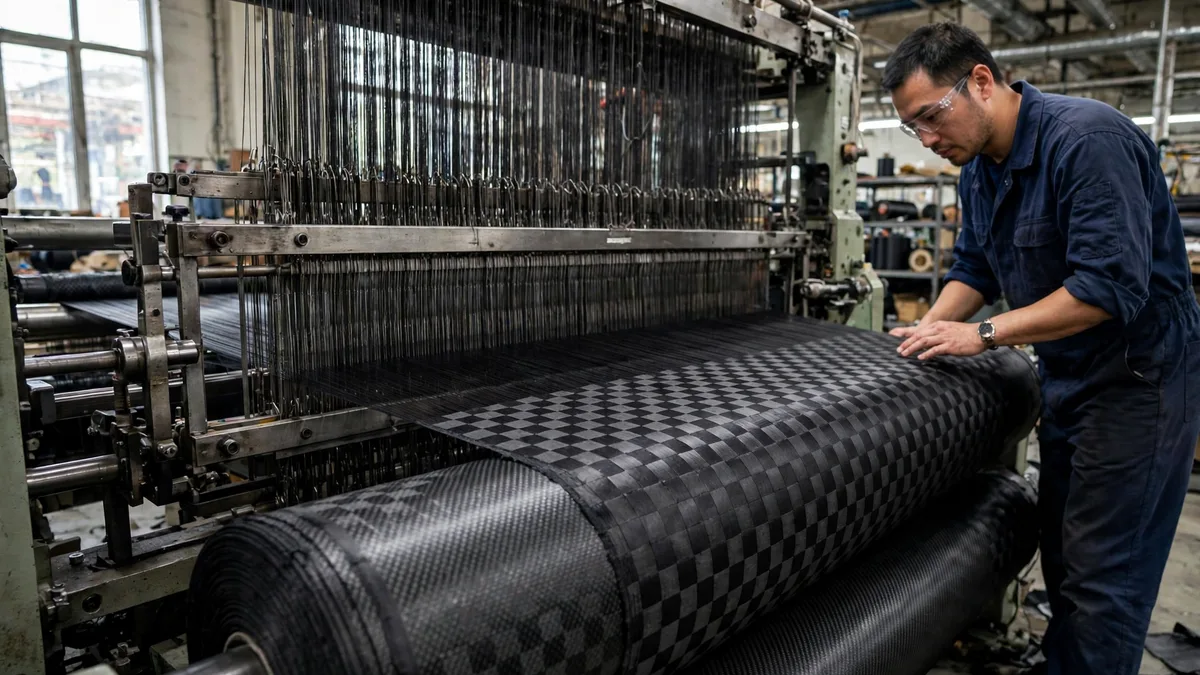
Inside the factory that weaves carbon fibre, the work looks older than the material. Great looms, descended from the machines that wove cotton and wool, clatter away in rows, their shuttles throwing black thread back and forth. But the thread is fragile, the tension must be exact, and the air is kept clean and still. A single broken filament or a loose thread can weaken a whole roll of cloth, so the weavers watch every metre as it comes off the loom.
Inside the Production
Step 1: Making the carbon fibre thread
The story starts before the loom, with a white synthetic fibre called PAN. It is heated in ovens without oxygen until almost everything except carbon burns away, leaving a black thread of pure carbon. That thread is made of thousands of tiny filaments, each one only a few microns wide, bundled together into a tow. The tows are wound onto large spools and delivered to the weaving mill, where they are checked for strength and thickness. A tow that is too thick or too thin would weave unevenly, so only matched spools go onto the looms.
Step 2: Setting up the loom
Each loom is set up for one specific weave pattern. The warp threads — the ones running along the cloth — are threaded through the loom one by one, sometimes thousands of them, and tensioned evenly. The weft threads run across, carried by shuttles or jets of air. The pattern is chosen for the job: a plain weave, with threads crossing over and under one at a time, is stable and easy to cut; a twill weave, with a diagonal pattern, drapes better over curves; a satin weave is smooth and strong in one direction. Changing the pattern means re-threading the whole loom, so a mill plans its runs carefully.
Step 3: Weaving the cloth
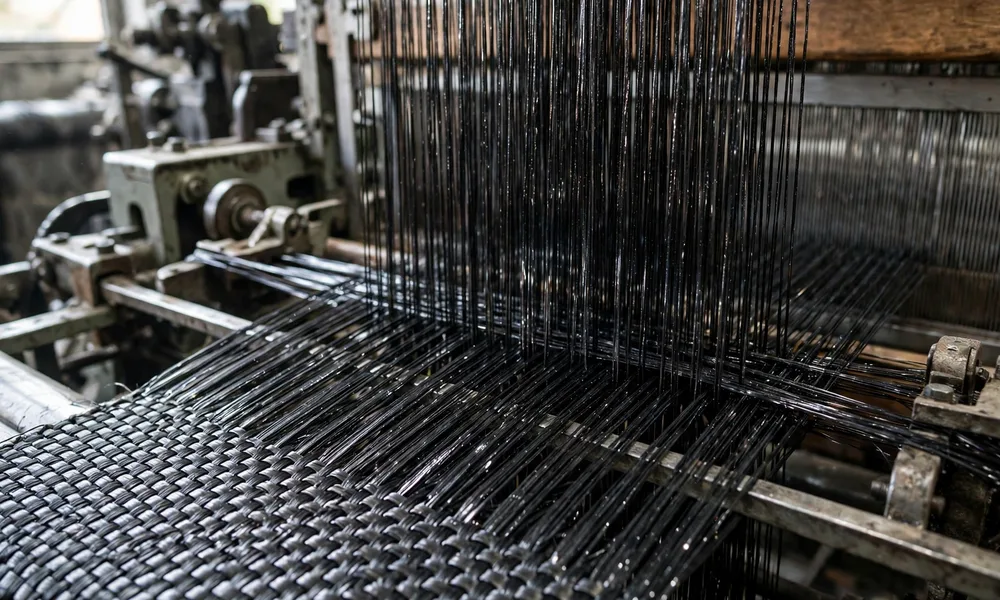
Once the loom is running, the weaving itself is fast — but it is watched constantly. Carbon fibre thread is brittle, and a snapped filament shows up as a fuzzy patch in the cloth. Workers walk the looms with lights, looking for breaks, loose threads, or uneven tension, and stop the machine the moment something looks wrong. The finished cloth comes off the loom in wide rolls, and each roll is marked with its weave pattern, its weight per square metre, and the batch of fibre it came from, so that a part maker can trace any fault back to the exact roll.
Step 4: Inspecting and grading the fabric
Every roll is unrolled and inspected under bright lights before it is sold. Inspectors look for gaps, wrinkles, broken filaments, and any spot where the weave is uneven. Rolls are graded: the best cloth goes to aircraft and racing cars, where a flaw could be dangerous; lower grades go to less demanding parts. A roll with a serious fault is cut down and the bad section removed, so that no customer ever receives cloth with a hidden weak spot. The inspection is slow, skilled work, and it is the last line of defence between the loom and a finished part.
Step 5: Coating and rolling
Some carbon fibre cloth is sold dry, ready to be soaked in resin by the part maker. Other cloth is pre-impregnated — prepreg — where resin is already pressed into the weave in the factory, and the roll is kept cold so the resin does not cure before use. Prepreg cloth is rolled with a backing paper to stop it sticking to itself, sealed in bags, and stored in freezers. The way the woven cloth becomes a hard, finished part is part of what how carbon fibre becomes an e-bike frame describes, and the weave is where that strength begins.
Step 6: Cutting, packing, and shipping
The last step is cutting and packing. Rolls are cut to the width the customer needs, wrapped to keep out dust and moisture, and labelled with everything the part maker needs to know: weave type, weight, fibre batch, and date. Dry cloth is packed in sealed bags; prepreg is packed cold and shipped in refrigerated boxes. Only a roll with a clean inspection record leaves the mill, bound for a workshop where it will be laid into a mould, soaked in resin, and baked into something far stronger than the soft black cloth it started as.

Specs
| Specification | Typical figure |
|---|---|
| Fibre material | Carbonised PAN, over 90 percent carbon |
| Filament width | 5–7 microns per filament |
| Tow size | 1,000–24,000 filaments per tow |
| Weave patterns | Plain, twill, and satin weaves |
| Fabric weight | 100–600 grams per square metre |
| Roll width | 1–1.5 metres wide |
| Cloth types | Dry fabric and pre-impregnated prepreg |
| Inspection | Every roll unrolled and checked by hand |
| Storage | Prepreg kept frozen until use |
Price
Woven carbon fibre cloth is expensive for a fabric, and its price is usually given as an estimate. As an estimate, dry carbon fibre cloth costs roughly $20 to $60 per square metre, depending on weave and weight, while prepreg cloth costs roughly $50 to $150 per square metre. These are estimates, and the real figure varies with fibre grade, volume, and the supplier — but the rule holds: the cloth is only the start, and the resin, the mould, and the labour of laying it up usually cost far more than the fabric itself.
A Rare Fact
A single carbon fibre filament is thinner than a human hair, yet a bundle of them can hold up a car. The trick is numbers: a single tow contains thousands of filaments, and a single square metre of cloth contains kilometres of thread, all pulling together. The fibre is so fine that a weaver can snap a filament just by handling it roughly, which is why the looms run slowly and the air is kept still. It is one of the strangest facts in materials engineering — a cloth woven from threads you can barely see, stronger by weight than steel, made on machines that would look familiar to a weaver from a hundred years ago.
The weave is where carbon fibre strength begins, but it only makes sense alongside the parts it becomes. The numbers behind its patterns are laid out in the carbon fibre weave specs explained guide, and the brakes that use the same material are explained in how carbon-ceramic brakes are made. The next time a racing car flashes past in black and silver, remember the looms, the thousands of threads, and the weave that holds it all together.


