Walk into an e-bike frame factory and the first thing you notice is the smell: a faint, sweet tang of resin, somewhere between a boat yard and a bakery. The second thing is the quiet: no presses slamming, no sparks flying, just workers in gloves laying black fabric into moulds with the concentration of people wrapping a gift that must never come apart. That black fabric is carbon fibre, and the frame taking shape will soon carry a rider, a battery and a motor, weighing less than the aluminium frame it replaces.
A carbon e-bike frame is not welded or bolted together. It is laid up by hand, layer upon layer of carbon cloth soaked in epoxy resin, then baked under pressure until the layers fuse into a single rigid structure. The process is slow, skilled and unforgiving: a wrinkle in one layer, a bubble of trapped air, or a few minutes too long in the oven can scrap a frame worth hundreds of dollars.

The Production Line
E-bike carbon frame factories are organised around moulds, ovens and skilled hands. A frame passes through many stations, and the most important tool on the line is not a machine but a person who has laid up hundreds of frames and can feel a wrinkle through a glove. Production runs are measured in hundreds per month rather than thousands per day, because each frame takes hours of manual work. The motor and battery make the job harder: the down tube must hide a battery, the bottom bracket must hold a motor, and the frame still has to be light.
Step 1: Cutting the carbon cloth
Carbon fibre arrives as rolls of black woven cloth, or as unidirectional tape in which all the fibres run one way. Patterns for each tube are cut from the cloth, by hand with templates or by a computer-controlled cutter that nests the shapes to waste as little material as possible. Fibre direction matters enormously: fibres carry load along their length, so a layer running along a tube makes it stiff in that direction, while a layer at forty-five degrees resists twisting.
Step 2: Laying up the frame
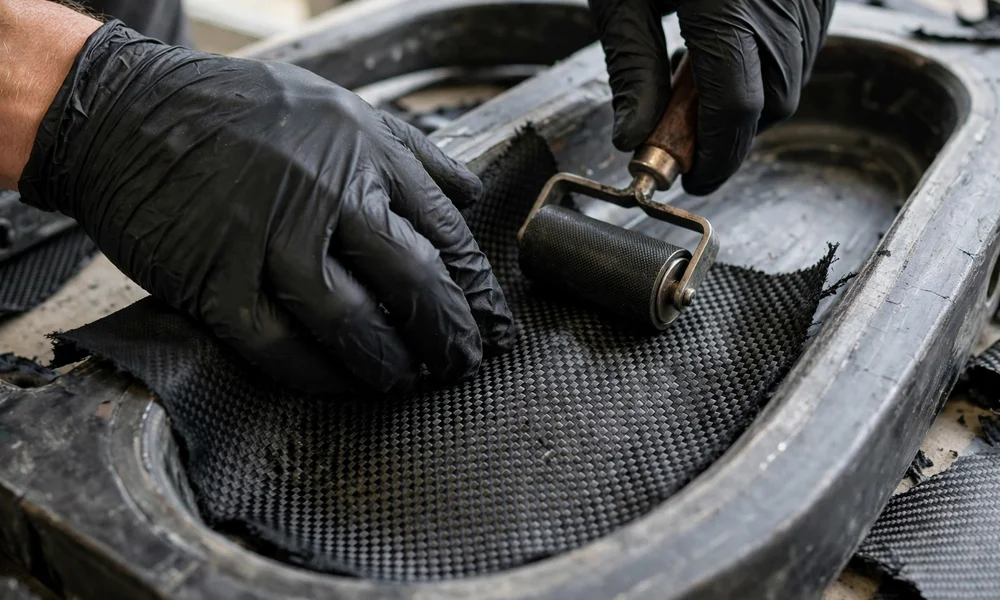
Workers lay the cut pieces into steel or aluminium moulds, one layer at a time, pressing each piece into place and smoothing out air bubbles with rollers. The mould is in two halves, and the frame is built up in sections: the front triangle, the chainstays, the seatstays, and the reinforced areas around the head tube and bottom bracket, where the motor mounts. A typical frame uses a hundred or more pieces of carbon, and the layup alone can take a skilled worker several hours. This is where experience matters most, and where a frame’s quality is truly decided, long before it ever sees an oven. The finished geometry is measured in the specifications of e-bike carbon frames.
Step 3: Fitting the bladder and closing the mould
Before the mould is closed, an inflatable bladder, a tough nylon or silicone bag, is placed inside the hollow frame tubes. When the mould is bolted shut and the bladder inflated, it presses the carbon layers firmly against the mould walls, squeezing out air and excess resin and giving the frame its smooth inner surface. Metal inserts for the bottom bracket, headset and dropouts are positioned in the mould too, so they bond into the frame as it cures rather than being glued in afterwards.
Step 4: Curing in the oven
The closed mould goes into an oven or autoclave, where heat and pressure turn cloth and resin into a solid frame. The temperature rises slowly to around 120 to 150 degrees Celsius, the epoxy flows, then hardens into a rigid matrix locking the carbon fibres in place. The cure cycle lasts one to two hours, the temperature controlled to within a few degrees: an under-cured frame is soft, an over-cured one brittle. When the mould opens, the frame inside is rough, dark and already remarkably stiff, though it still needs finishing.
Step 5: Trimming, bonding and finishing
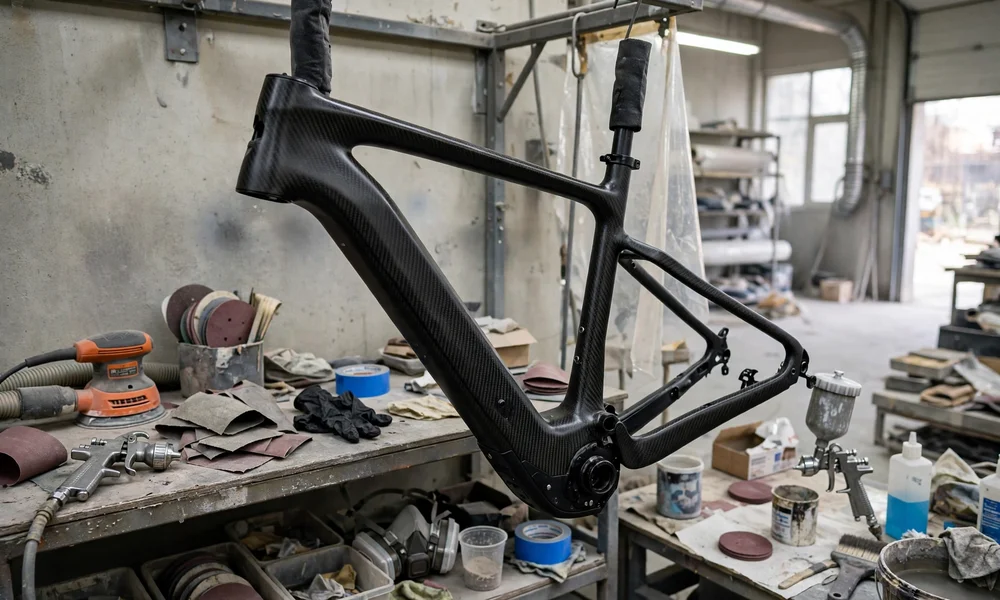
Excess carbon is trimmed from the mould lines, the frame is sanded smooth, and separate sections are bonded with structural adhesive and wrapped with more carbon for strength. The bottom bracket shell, which will hold the e-bike motor, is checked for alignment, because a motor mounted even slightly off-centre will wear its bearings and creak. The frame is then sanded through progressively finer grades, primed and painted, often in a dedicated paint booth.
Step 6: Quality testing every frame
Every carbon e-bike frame is inspected before it ships. Visual checks catch surface defects, tap tests — a technician taps the frame and listens for the dull thud of a hidden void — catch internal ones, and sample frames are cut open or X-rayed to verify the layup. Finished frames are stiffness-tested on rigs that flex the bottom bracket and head tube under load, and fatigue-tested through thousands of simulated riding cycles. A frame that fails any check is scrapped: a cracked carbon frame cannot be safely repaired by patching. The weight savings that make all this effort worthwhile show up in the wider world of light e-bike design, including the materials engineering of lightweight e-bike frames.
E-Bike Carbon Frame Production at a Glance
| Detail | Typical figure |
|---|---|
| Material | Carbon fibre cloth, epoxy resin |
| Pieces per frame | Around 100 or more |
| Layup time | Several hours, by hand |
| Cure temperature | Around 120 to 150°C |
| Cure time | One to two hours |
| Frame weight | Often under 2.5 kg |
| Testing | Visual, tap, stiffness, fatigue |
What Does a Carbon E-Bike Frame Cost?
A finished carbon e-bike frame costs a bike brand an estimated $400 to $900 depending on complexity, and a complete carbon e-bike sells for an estimated $3,000 to $8,000 or more. The factory behind the frame is an estimated $1 million to $3 million of moulds, ovens and cutting equipment — but moulds are the hidden cost. A single frame mould set can cost an estimated $50,000 to $150,000, and it only fits one frame size and design. That is why carbon e-bikes come in fewer sizes than aluminium ones, and why a new frame design is a serious investment. The companion article on how an e-bike carbon frame is made follows the same process from the materials side.
A Rare Fact
Here is something few people outside the factory know: a carbon fibre frame is cured in an oven, but it never stops curing completely. The epoxy keeps hardening very slowly for weeks after the frame leaves the factory, so a brand-new carbon frame is actually slightly softer on its first ride than a month later. Factories account for this by over-curing slightly and letting frames rest before final quality testing, so the frame a customer rides is the one the engineers designed. It is a quiet reminder that a bicycle frame is not just manufactured, it is baked, like bread, and it keeps changing after it leaves the oven.
By the end of the line, a hundred pieces of black cloth, a bladder, a mould and an oven have become a frame weighing less than a bag of sugar, yet carrying a rider, a motor and a battery over rough ground, day after day. It will be built into a complete e-bike, ridden hard, and never once reveal the hours of handwork inside it. That invisibility is the signature of a good carbon frame: it simply works, silently, because someone in gloves took the time to lay every layer exactly right.