Lift a carbon e-bike frame off the rack and the first thing you notice is how little there is of it. The tubes are slim, the joints are smooth, and the whole frame weighs less than a bag of shopping. The secret is not the material alone. It is the way the material is laid down, layer by layer, by hand, in a mould, until a pile of black cloth becomes a bicycle.
An e-bike carbon frame is built from sheets of carbon fibre prepreg, cut into hundreds of precise shapes, laid into a mould in a carefully planned order, then cured under heat and pressure. This is how a carbon e-bike frame is made.

How It Is Made
Building a carbon frame is closer to tailoring than to welding. There is no single piece of metal to shape; instead, the frame is assembled from cloth, and the skill lies in knowing exactly where each piece goes. A single frame can contain three hundred or more individual pieces of prepreg, and the layup schedule, the map of which piece goes where, is the most valuable document in the factory.
Step 1: Designing the layup
Engineers start with computer models of the frame, testing how it will bend and twist under a rider’s weight, a motor’s torque and the jolts of a rough road. Carbon fibre is strong along the direction of its fibres and weak across them, so the layup is designed to put fibres exactly where the loads run: lengthways along the down tube, wrapped around the bottom bracket where the motor sits, and angled across the head tube where steering forces arrive. The battery that powers the motor has its own demanding build, and the making of an e-bike battery follows a similar discipline of layers, testing and care.
Step 2: Cutting the prepreg
The carbon cloth arrives as prepreg, fabric already impregnated with epoxy resin and kept frozen so the resin stays soft and workable. In a clean room, computer-controlled cutters slice the prepreg into the shapes listed in the layup schedule, each piece numbered and labelled. The cut pieces are stored in order on trays, and workers handle them with gloves, because skin oils and dust can weaken the bond between layers.
Step 3: Laying up the frame
This is the heart of the process, and it is done by hand. Workers lay the prepreg pieces one by one into the two halves of a steel mould, following the layup schedule piece by piece, smoothing each layer to push out trapped air. Around the bottom bracket and head tube, where the loads are highest, workers add extra layers and wrap the cloth carefully around the curves. The work is slow and quiet, and an experienced layer can take several hours on a single frame. The same hand-built logic shapes the lighter frames in the range, and the making of a lightweight e-bike frame shows how far the craft can be pushed.

Step 4: Moulding with a bladder
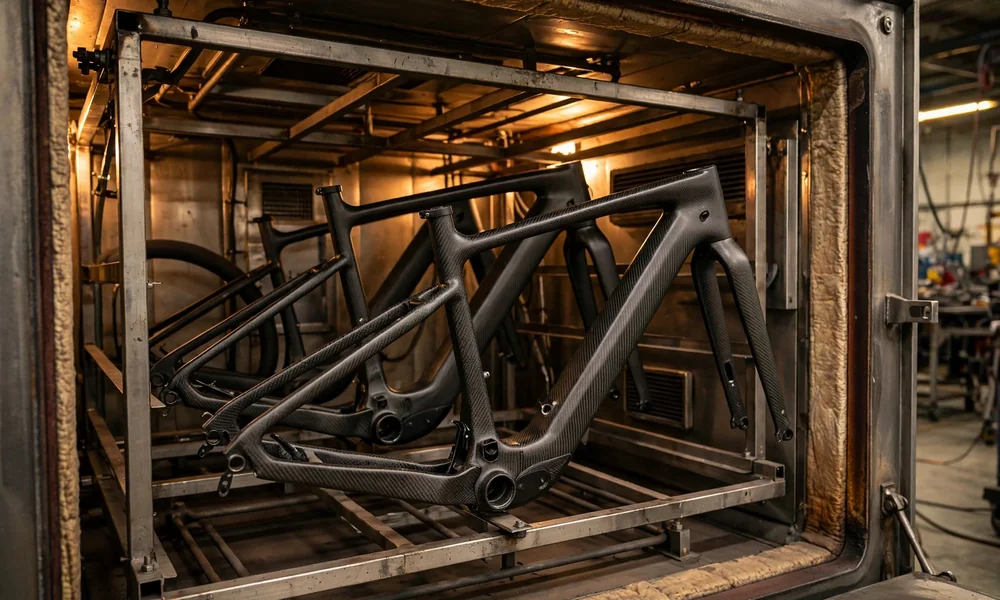
Before the mould closes, an inflatable bladder, a tough nylon bag, is placed inside the frame’s hollow tubes. When the mould is clamped shut and heated, the bladder is inflated with air, pressing the layers of carbon firmly against the mould walls from the inside. This internal pressure is what squeezes out the last air bubbles and compacts the layers into a dense, solid structure. The mould is then heated in an oven or press to around 120 to 150 degrees Celsius, and the resin cures, hardening from a sticky paste into a rigid plastic that locks the fibres in place.
Step 5: Demoulding, trimming and finishing
When the frame has cooled, the mould is opened and the raw frame is lifted out, still rough around the edges. Workers trim away the excess carbon at the joints, drill the holes for cables, the motor and the battery mount, and sand the surface smooth. The frame is checked for defects with ultrasound or by tapping, a technique where a trained ear can hear the dull thud of a hidden void. The finished frame is then painted or clear-coated, a process that protects the carbon from sunlight and gives the bike its colour.
Step 6: Bonding, assembly and testing
Some frames are moulded in one piece; others are built from separate front and rear triangles bonded together with aerospace adhesive and wrapped in more carbon. Either way, the frame is then fitted with its motor mount, battery cradle and cable guides, and every frame is tested. Only frames that pass go to the assembly line, where the motor, battery, wheels and controls are fitted. The fibres that make it possible are woven long before they reach the mould, and the materials engineering of the e-bike carbon frame explains exactly which cloth goes where, and why.
Specifications
| Specification | Typical value |
|---|---|
| Frame weight | 1.8 to 2.5 kg |
| Material | Carbon fibre prepreg, epoxy resin |
| Cure temperature | 120 to 150 °C |
| Layup pieces | 200 to 400 per frame |
| Build time | 1 day or more |
| Motor mount | Mid-drive, bottom bracket |
What It Costs
A carbon e-bike frame alone typically costs between $800 and $2,500 at retail, depending on the quality of the fibre, the complexity of the layup and the brand, with complete carbon e-bikes ranging from around $3,000 to over $10,000. The frame is the most expensive single part of the bike after the battery, and its price reflects the labour: hours of hand layup by skilled workers, plus the cost of the moulds, which can cost tens of thousands of dollars each and are made for one frame size only.
A Rare Fact
The first carbon fibre bicycle frames appeared in the 1980s, and they were so fragile that professional racers were afraid to ride them downhill. Early frames used carbon tubes glued into aluminium lugs, and the glue joints could fail without warning. Modern frames are tested far beyond anything a rider will do to them, and a well-made carbon frame can outlast an aluminium one, because carbon does not fatigue the way metal does: it either holds its strength or it breaks, with no slow weakening in between.
Pick up a carbon e-bike frame and you are holding a piece of tailoring as much as engineering: hundreds of pieces of cloth, laid by hand, pressed by air and baked into a shape that weighs less than a bag of shopping and carries you up a hill.


