An electric car battery is a box full of controlled chemistry, and chemistry has a temper. Charge it too fast on a hot day and the cells heat up, age faster, lose range, and in the worst case, catch fire. Keep them too cold and they refuse to charge at all. Somewhere between those extremes sits a narrow band, roughly 20 to 40 degrees Celsius, where a battery is happy, and the cooling system’s whole job is to hold thousands of cells inside it.
That job falls to cold plates, pipes, pumps and fluids hidden under the floor, a system the driver never sees until it fails. It is one of the most material-sensitive systems in the car: the coolant must carry heat without conducting electricity, the plates must conduct heat without corroding, and every joint must stay sealed for the life of the car.
Here is what the cooling system is made of, and why each material earned its place.
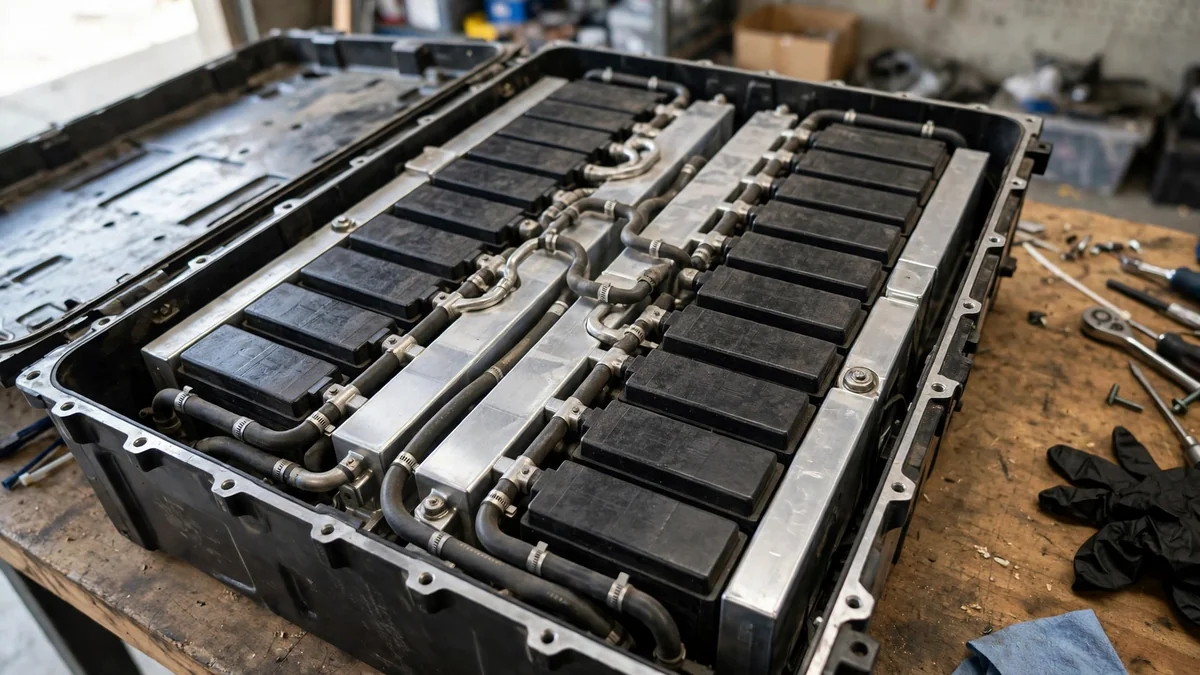
The Materials Behind It
1. Aluminium cold plates, the heat highway
The heart of the system is the cold plate, a flat aluminium plate with coolant channels inside it, pressed against the bottom or sides of the cell modules. Aluminium is the obvious choice: it conducts heat well, it is light, and it can be extruded, stamped or brazed into complex channel shapes. The common alloys are 3003 and 6061, chosen for corrosion resistance and formability. The plate is usually coated or anodised, because the coolant can be mildly corrosive over years of service. The same aluminium thinking runs through the whole pack, as the guide to the EV battery pack shows, where the case, the plates and the structure all have to work together.
2. Glycol coolant, the fluid that carries the heat
The coolant is usually a mix of water and ethylene glycol, the same base as engine coolant, but with a crucial difference: it must be a poor conductor of electricity. If coolant leaks onto live cells, a conductive fluid would short them. So EV coolants are formulated for low electrical conductivity, with inhibitors that keep the aluminium plates and steel fittings from corroding. The mix must stay liquid from minus 30 to well over 100 degrees Celsius, and pump easily when cold, because thick coolant on a winter morning means the battery cannot warm up fast enough to fast-charge.
3. Copper busbars and thermal interface materials, the last millimetre
Heat has to cross from the cell to the cold plate, and the last millimetre matters most. Cells are bonded to the plate with a thermal interface material, usually a filled silicone gap filler or a thermally conductive adhesive, which fills the microscopic air gaps that would otherwise insulate the joint. Copper busbars, which carry the current between cells, are also a heat path, watched by the battery management system. A gap filler that dries out or cracks after years of thermal cycling leaves an air gap, and the cell above it runs hot. It is a small, cheap layer doing a critical job.
4. Steel and polymer pipes, the plumbing that must never leak
Coolant travels from the pack to the chiller and the radiator through pipes and hoses. Rigid runs inside the pack are usually stainless steel or aluminium tube, which resists vibration and heat. Flexible runs are EPDM rubber or fluoropolymer hose, chosen to survive glycol, ozone and a decade of temperature swings without cracking. Every joint is a potential leak, so the industry is moving to fewer, larger connections, sealed with O-rings. A single weeping joint can empty a cooling loop slowly, and the first sign is often a battery that charges slowly on a hot day.
5. The chiller and the pump, the active end
The coolant gives its heat up in a chiller, a compact plate heat exchanger where the glycol loop meets the car’s air conditioning refrigerant, or in a low-temperature radiator at the front of the car. The chiller is usually aluminium, brazed into a stack of thin plates with a huge surface area. The pump is an electric centrifugal unit with a plastic impeller and a brushless motor, designed to run for the life of the car without a service. Together they are why a modern EV can fast-charge at 150 kilowatts or more on a summer day and keep its cells in their happy band, and the wider strategy is covered in the guide to EV thermal management, which ties battery, motor and cabin into one system.
How Battery Cooling Works
- Sensors watch the cells. Temperature sensors across the pack feed the battery management system, which decides when cooling is needed.
- The pump starts. The electric pump pushes glycol coolant through the cold plates under the cell modules.
- Heat moves into the plate. Heat flows from the cells, through the thermal interface material, into the cold plate and then into the coolant.
- The chiller takes the heat. Warm coolant flows to the chiller, where the air conditioning system pulls the heat out, or to the radiator at low loads.
- Cold coolant returns. The cooled fluid loops back to the pack, and the cycle repeats, holding the cells near their target temperature.
- Heating reverses the flow. In winter, the same loop can carry heat into the pack, warming cold cells so they can charge and deliver full power.

EV Battery Cooling Materials
| Material | Where it is used | Why it is chosen |
|---|---|---|
| Aluminium 3003 / 6061 | Cold plates and chiller | Conducts heat well, light, easy to form |
| Ethylene glycol mix | Coolant loop | Carries heat, low conductivity, wide temperature range |
| Silicone gap filler | Between cells and plate | Fills air gaps, carries heat across the joint |
| Stainless steel tube | Rigid coolant pipes | Resists vibration, heat and corrosion |
| EPDM rubber hose | Flexible coolant runs | Survives glycol and temperature swings |
| Copper busbars | Cell connections | Carries current and heat away from cells |

What Does EV Battery Cooling Cost?
The cooling hardware in a typical EV, cold plates, pump, chiller, hoses and coolant, is estimated at roughly $500 to $1,200 as a system, a small share of the pack’s total cost, estimated at roughly $8,000 to $15,000. A coolant change is estimated at roughly $100 to $200. The expensive failure is a leak inside the pack: replacing a damaged cold plate or corroded module is estimated at roughly $1,000 to $3,000. The electronics that control all of this sit nearby, and the EV inverter faces the same heat problem on the power electronics side.
A Rare Fact
Early electric cars, including the first Nissan Leaf, used air cooling, with fans blowing cabin air through the pack. It was cheap and simple, and it worked in mild climates. But in hot places, air-cooled packs aged far faster, and the industry moved almost entirely to liquid cooling. The lesson shaped every EV since: a battery’s life is decided as much by its temperature as by its chemistry.
EV battery cooling is invisible engineering, a loop of aluminium, glycol and rubber that does nothing the driver can see and everything the battery needs. The cold plate carries the heat, the coolant moves it, the gap filler bridges the last millimetre, and the chiller throws it away. Get it right and the battery lasts a decade and charges in minutes. Get it wrong and the most expensive part of the car quietly dies early, a few degrees at a time.