A turbocharger is a small machine with an absurd job: it takes the hot exhaust gas a hypercar engine throws away, spins a turbine with it at up to two hundred thousand revolutions per minute, and uses that spin to force more air into the engine — so the engine can burn more fuel and make more power. It is about the size of a grapefruit, weighs a few kilograms, and can add hundreds of horsepower. It is also one of the hardest parts in the car to build well.
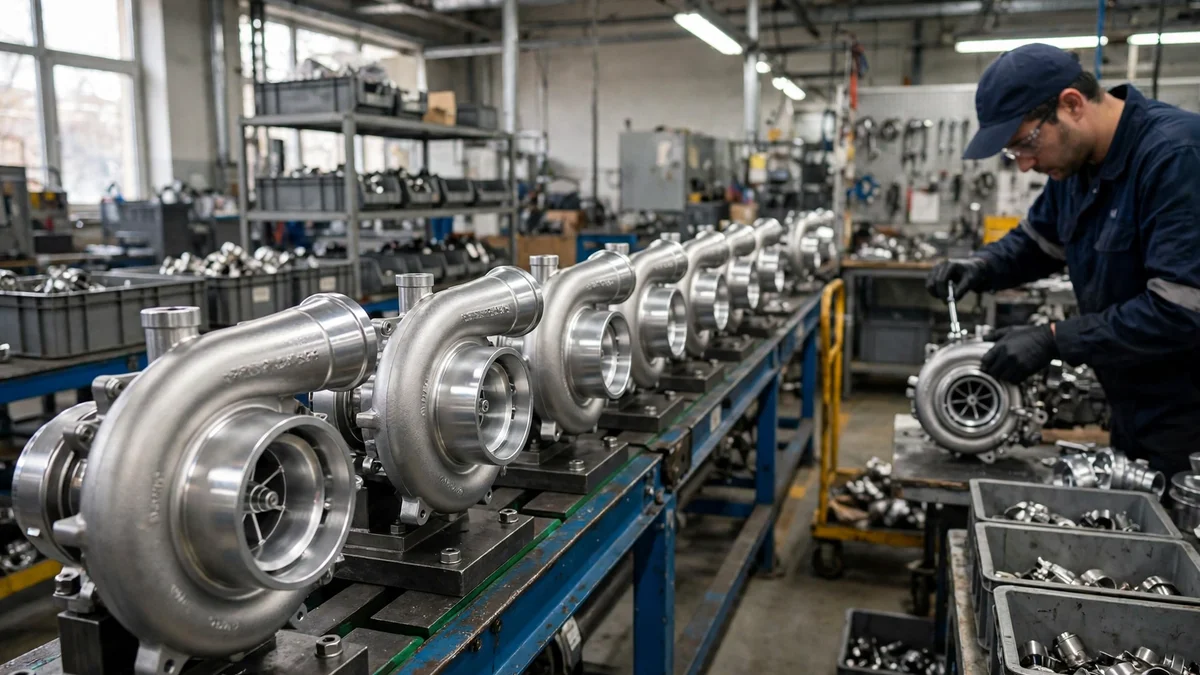
Inside the factory that makes these turbochargers, the work is measured in microns. Turbine wheels are cast and machined to tolerances a human hair would dwarf, rotors are balanced until they spin without a tremor, and every finished unit is run at full speed on a test rig before it is allowed near an engine. A turbocharger that fails at full boost does not just stop working — it can destroy the engine behind it.
Inside the Production
Step 1: Casting the turbine and compressor wheels
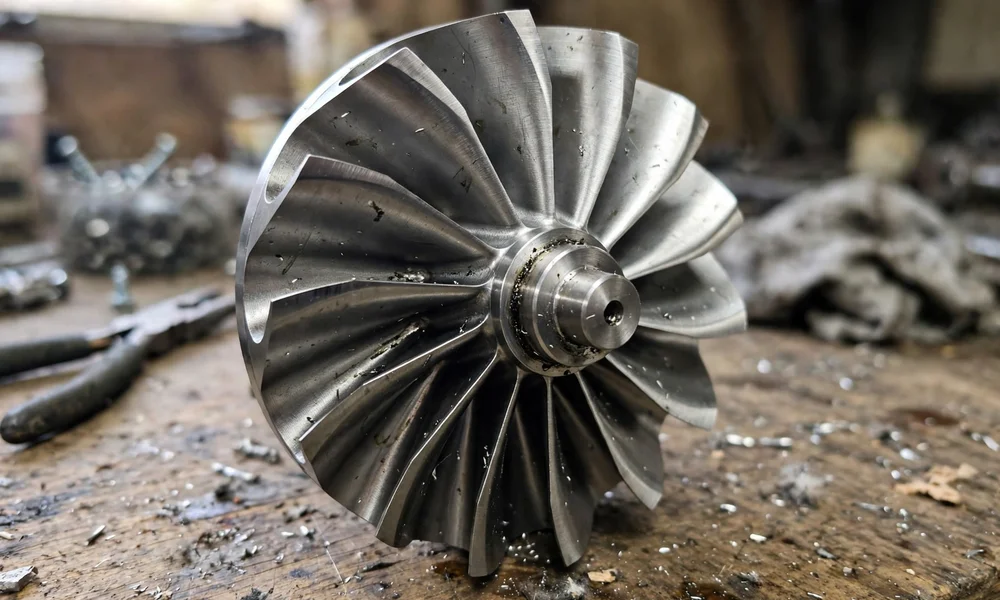
Production begins with the two wheels at the heart of the turbocharger: the turbine wheel, spun by exhaust gas, and the compressor wheel, which pumps air into the engine. The turbine wheel is usually cast from a nickel-based superalloy that can survive exhaust gas hotter than 900 degrees Celsius without softening, while the compressor wheel is cast or machined from aluminium. The casting uses investment casting — a wax pattern is coated in ceramic, the wax melted out, and molten metal poured into the mould — because the curved blades cannot be machined from a solid block at any sane cost. Each casting is X-rayed to check for hidden voids before it goes any further.
Step 2: Machining the housings
While the wheels are cast, the housings are machined. The turbine housing, which channels exhaust gas onto the turbine wheel, is cast from heat-resistant iron or steel, then machined on computer-controlled mills to a precise internal shape. The compressor housing, usually aluminium, is machined the same way, and the bearing housing in the middle — which holds the shaft, the bearings, and the oil and water passages — is bored and honed until its surfaces are true to within a few microns. Every housing is washed and inspected, because a single grain of grit inside a turbocharger can wreck its bearings in minutes.
Step 3: Balancing the rotor
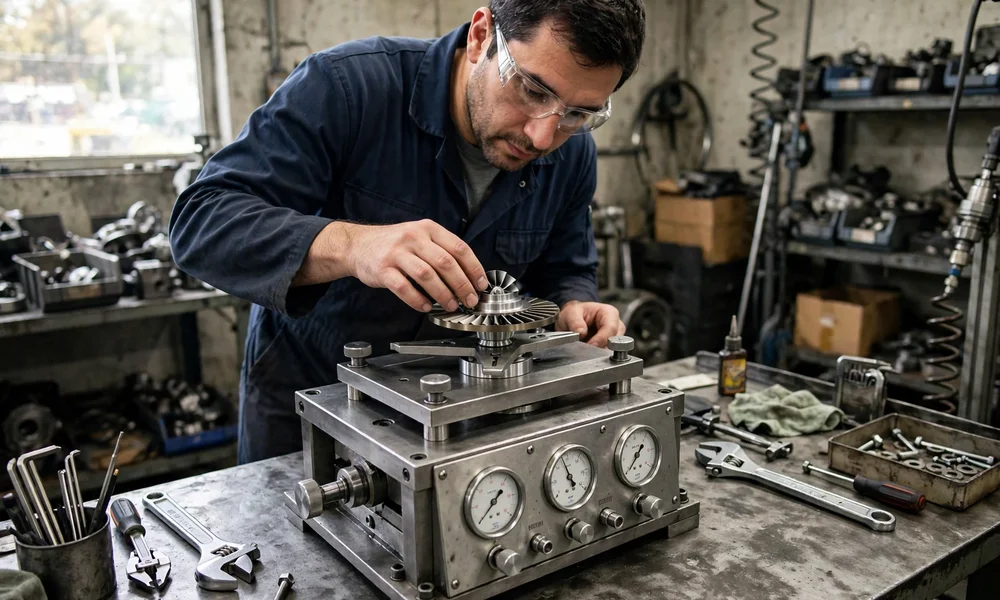
The turbine wheel, the shaft, and the compressor wheel are assembled into a single rotor — one spinning part — and then balanced. A balancing machine spins the rotor at high speed, measures the tiniest vibration, and tells the operator exactly where to remove a fraction of a gram of metal. The process is repeated until the rotor spins smoothly at speeds far beyond what it will ever see in a car. This step decides whether a turbocharger lasts the life of the car or eats its own bearings: at two hundred thousand revolutions per minute, even a tiny imbalance becomes a hammer blow, repeated thousands of times a second.
Step 4: Fitting the bearings and seals
The balanced rotor is fitted into the bearing housing with its bearings and seals. Most hypercar turbochargers use floating journal bearings, fed with pressurised engine oil, though some use ball bearings for a faster response. The bearings must carry the rotor with almost no friction while oil flows around them to carry heat away, and the seals must keep oil out of the exhaust and intake streams. Clearances here are measured in hundredths of a millimetre, and assembly is done in a clean area by gloved technicians, because a fingerprint on a bearing surface is a defect. The actuator that controls the wastegate — the valve that limits boost — is fitted and calibrated at this stage too.
Step 5: Assembling the complete unit
The housings are bolted together around the rotor, the actuator is connected, and the water and oil connections are fitted. Compressor inlet and outlet are checked for smooth airflow, the wastegate is tested for free movement, and the unit gets a final visual inspection. The finished turbocharger is compact and heavy for its size, dense with machined metal, and carries no outward sign of the precision inside it — which is the point. A turbocharger should look simple, because all of its complexity is hidden in the clearances, the balance, and the materials. The engine it will feed is the subject of the Bugatti W16 engine specs explained guide, and the gearbox it works alongside is covered in the dual-clutch gearbox specs explained guide.
Step 6: High-speed testing
No turbocharger leaves the factory untested. Each unit is mounted on a test rig, spun up to full speed with hot gas or compressed air, and run through its whole operating range while sensors record boost pressure, shaft speed, oil flow, and temperature. The rig checks that the turbocharger makes its rated boost, that the wastegate opens at the right pressure, and that nothing leaks or overheats. A unit that fails is stripped down, repaired, and tested again from the start. Only a turbocharger with a clean test record is cleared for the engine line, where it will be bolted to a hypercar and asked to spin at two hundred thousand revolutions per minute, lap after lap.
Specs
| Specification | Typical figure |
|---|---|
| Maximum rotor speed | Up to 200,000 revolutions per minute |
| Turbine material | Nickel-based superalloy |
| Compressor material | Cast or machined aluminium |
| Exhaust temperature | Up to 900 degrees Celsius or more |
| Bearings | Oil-fed journal or ball bearings |
| Boost control | Wastegate with electronic actuator |
| Weight | Typically five to ten kilograms |
| Testing | Full-speed run on a test rig |
Price
A hypercar turbocharger is a small part with a large price, because almost every gram of it is precision work. As an estimate, a single high-performance turbocharger costs roughly $3,000 to $10,000 to build, and a hypercar with two or four carries $6,000 to $40,000 of turbocharging before any other part is counted. These are estimates, and the real figure depends on the size, the materials, and the volume, but the logic is simple: a machine that spins at two hundred thousand revolutions per minute in 900-degree exhaust gas cannot be built cheaply, and nobody sensible would try.
A Rare Fact
The turbine wheel of a hypercar turbocharger can spin so fast that its blade tips travel faster than the speed of sound — well over a thousand kilometres per hour at the rim. At those speeds, the wheel grows measurably as it spins, stretched outward by centrifugal force, so the housing must be machined with a gap that is tight when the turbocharger is cold and exactly right when it is spinning at full speed. Get that gap wrong by a fraction of a millimetre and the blades touch the housing — at two hundred thousand revolutions per minute, that is not a scrape, it is an explosion of metal.
The turbocharger is only one voice in the hypercar’s orchestra. The brakes that slow the car down after all that boost are covered in the carbon ceramic brakes specs explained guide, and the engine that the turbocharger feeds is the same one described in the Bugatti W16 guide above. The next time a hypercar surges forward with a faint whistle behind the roar, remember the balanced rotor, the superalloy wheel, and the factory that spun it to full speed first.


