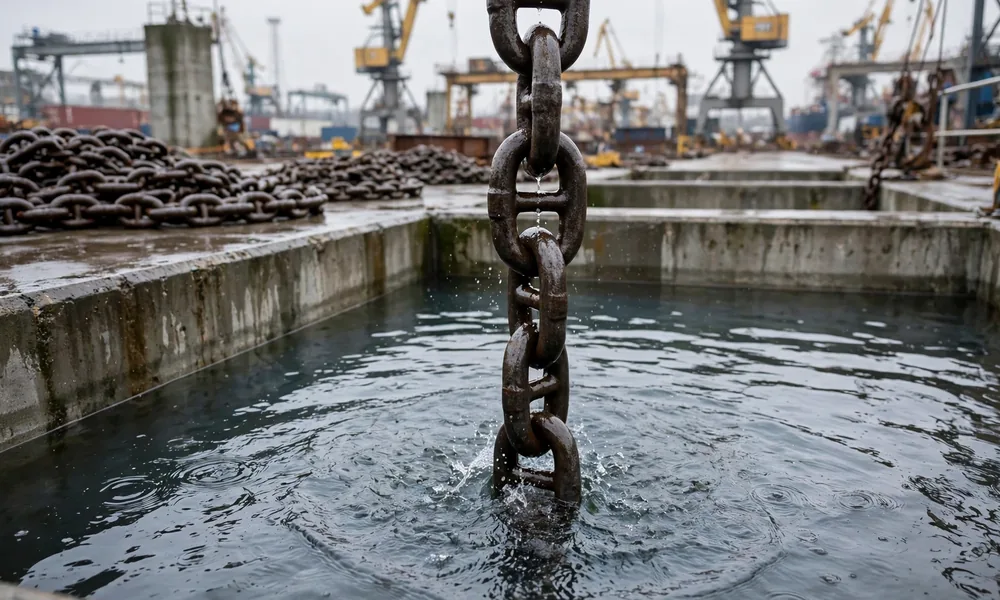
The first thing you notice in the chain yard is the sound. Not the clang of steel on steel, but a low, uneven rumble, like a river of gravel moving slowly across concrete. It is the sound of a ship anchor chain being dragged across the factory floor, link by link, a chain so heavy that a single metre of it can weigh more than a grown man. The pile is a dark, rust-flecked mountain of interlocked steel.
Every link in that pile was a straight steel bar only days earlier. Anchor chain is one of the oldest pieces of marine engineering still in daily use, and one of the most demanding to make. A chain that holds a 300-metre container ship in a storm cannot have a single weak link, in the most literal sense of the phrase. The factory works to tolerances measured in millimetres, because the day the chain is needed, nothing else can take its place.

Inside the Factory: How a Ship Anchor Chain Is Made
The production line is short and heavy: heat, force, and steel. But each step is controlled, measured, and recorded, because classification societies demand a paper trail for every length of chain that goes to sea. The material choices in this chain are explored in more depth in the engineering behind ship anchor chain materials.
1. Choosing the steel bar
Production begins with round steel bar, usually a high-strength low-alloy grade chosen for toughness rather than sheer hardness. The bar arrives in long lengths, and its diameter decides the chain’s grade: common stud-link chain for large ships uses bar from about 40 millimetres up to 120 millimetres thick. Each delivery is checked against its mill certificate and sampled for chemical analysis and tensile testing. A bar with the wrong chemistry is rejected before it is ever heated, because no amount of later forging can fix steel that was wrong from the start.
2. Cutting and heating the bar
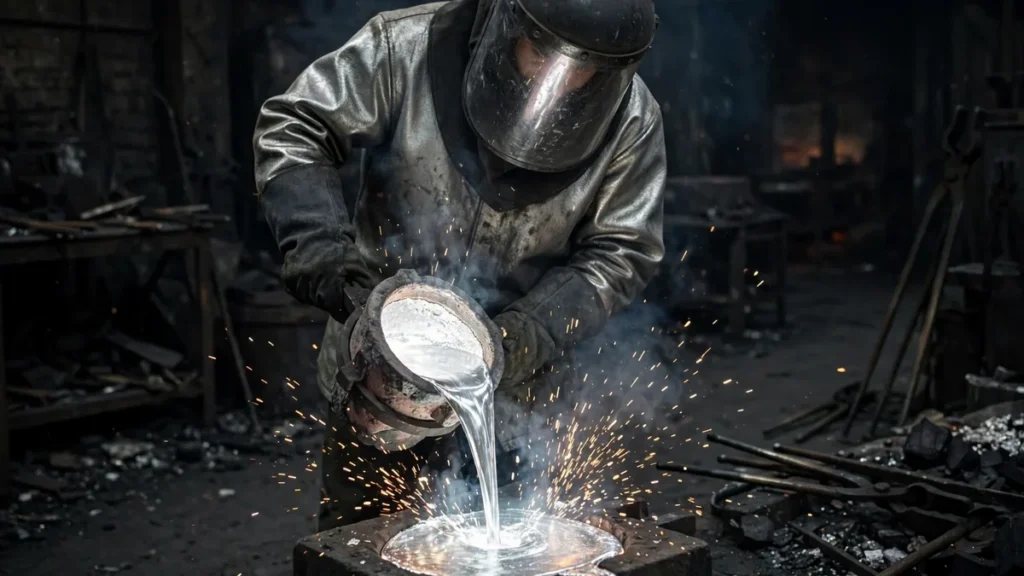
The bar is cut into short lengths, one for each link, and each piece is heated in a furnace to around 1,100 degrees Celsius, until it glows a deep orange and becomes soft enough to bend. Temperature matters enormously: too cool and the steel cracks when it is formed; too hot and its grain structure coarsens, weakening the finished link. Pyrometers record the exact temperature for every batch, and the furnace holds each piece at heat for a set time so the core is as hot as the surface.
3. Bending the link
While still glowing, each bar is bent around a forming mandrel into an oval link, its two ends left slightly apart. A dedicated bending machine shapes the link in a single smooth movement, because a hesitant bend leaves marks that become stress points. The new link is threaded through the previous finished link before its ends are closed, so the chain grows one link at a time. A single link from a large chain can weigh more than 50 kilograms, and workers handle the links with cranes and tongs, never by hand.
4. Flash welding the joint
The open ends of the link are joined by flash butt welding, the defining step of anchor chain production. The two ends are pressed together while a powerful electric current flows across the joint, heating the touching faces to melting point in seconds. The machine then forces the ends together, squeezing out molten metal and impurities as a small burr. Done well, the weld is as strong as the bar itself. The current, pressure, and upset distance are logged automatically for the chain’s records.
5. Fitting the stud
Most large ship chain is stud-link chain, meaning each link carries a crossbar — the stud — across its middle. The stud stops the link from collapsing sideways under load and keeps the chain from kinking when it runs through the windlass. Studs are pressed into the hot link while it is still malleable, then the link is closed around them. The stud must sit exactly centred and tight.

6. Heat treatment
Once a length of chain is complete, it goes back into the furnace for heat treatment. The chain is heated to a carefully chosen temperature and then cooled in a controlled way, a process that refines the grain of the steel and relieves the stresses left by bending and welding. The whole length is treated together so that every link shares the same properties, and thermocouples threaded through the furnace record the temperature at several points along the chain.
7. Proof load and final inspection
The last step is the most dramatic. The finished chain is pulled through a proof-load machine that applies a force far greater than the chain will ever see in service — often around 70 percent of its breaking load — link by link, along its entire length. The machine stretches the chain slightly and holds it, and any link with a hidden flaw stretches too far or breaks outright. Survivors are measured, checked for cracks with magnetic particle inspection, and marked with the manufacturer’s stamp and the classification society’s mark. Only then is the chain coiled, coated against corrosion, and released for delivery. The same discipline governs the steel of the hulls these chains serve, as seen in how a container ship hull is built.
Ship Anchor Chain Specifications
| Specification | Typical Value |
|---|---|
| Chain type | Stud-link anchor chain |
| Bar diameter | 40–120 mm |
| Steel grade | High-strength low-alloy, Grades R3–R5 |
| Link weight | Up to 50+ kg per link |
| Proof load | About 70% of breaking load |
| Breaking load | Several hundred tonnes per chain |
| Finish | Painted or bitumen-coated against corrosion |
What a Ship Anchor Chain Costs
Prices vary sharply with size, grade, and steel markets, so the figures here are estimates, not quotes. A length of large-diameter stud-link chain for a commercial vessel typically costs an estimated $4,000 to $9,000 per tonne, with a single ship’s outfit — chain, anchor, and fittings — often running to an estimated $80,000 to $250,000. Smaller chain for coastal vessels costs less per tonne, but the testing and certification cost per length stays high. Buyers pay for the proof test as much as for the steel.
A Rare Fact About Anchor Chain
Here is the detail most visitors to a chain factory find hardest to believe: the length of anchor chain a ship carries is measured in shackles, and one shackle is 15 fathoms, or 27.5 metres. A large ship may carry 11 or 12 shackles of chain, and the links are painted in a colour code so the crew can tell how much chain is out: the first link of each shackle is painted white, and the last shackle is painted red as a warning that the bitter end is near. In a storm, at night, on a wet foredeck, those coloured links are the only way the crew knows how much chain stands between the ship and the open sea. Ferries carry the same kind of gear on a smaller scale, and their hulls are built under the same regime, as shown in how a ferry hull is produced.
When the chain leaves the factory, it looks unremarkable — dark steel, coiled in a heap, smelling faintly of paint and oil. That is the factory’s job: to make sure there isn’t a weak one.