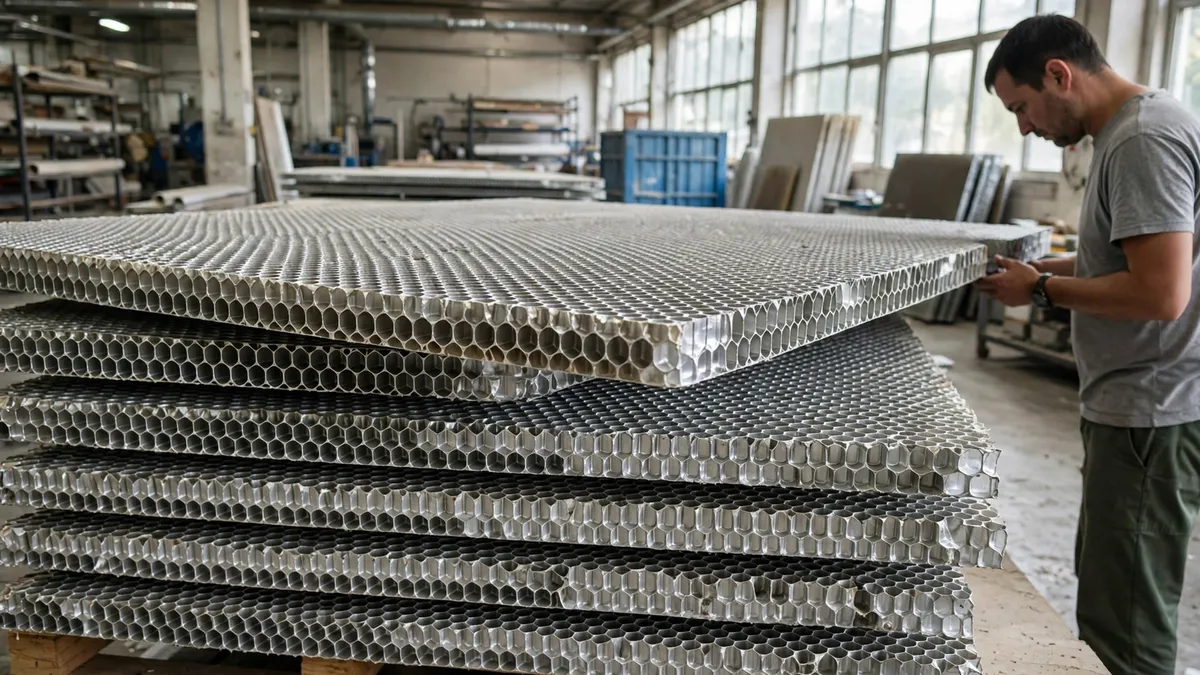
Pick up a piece of honeycomb core and the first thing you notice is how little it weighs. It feels like it should crumple in your hand, a lattice of paper-thin walls with more air in it than material. Then try to crush it flat, and it fights back with a strength that seems impossible for its weight. That paradox is why honeycomb core sits inside aircraft floors, racing car bodies, satellite panels, and yacht decks: it is mostly empty space, and that empty space is exactly what makes it strong.
Making it is a strange, delicate factory process. It starts with sheets of foil thinner than a human hair, glued in a pattern, stretched open like an accordion, and baked into a rigid structure that can hold tons across a panel. One crease in the wrong place or a gram too much glue, and the whole sheet is scrap. Here is how honeycomb core is made.
How It’s Made
Step 1: Preparing the foil
Most honeycomb core starts as aluminium foil, although paper, aramid fibre, and carbon fibre versions exist for special jobs. The aluminium foil is extraordinarily thin, often less than a tenth of a millimetre, and it arrives in huge rolls that must be handled without a single crease. In a clean, dry room, the foil is unrolled and inspected for pinholes, tears, or uneven thickness, because a flaw in the foil becomes a weak cell in the finished core. Some foil is coated with a primer that helps the glue grip, and the rolls are stored at controlled humidity so the metal never picks up moisture before bonding.
Step 2: Printing the glue lines
The secret of honeycomb is the glue pattern. A machine prints thin, parallel lines of adhesive onto the foil at exact intervals, like the stripes on a sheet of paper, and the spacing of those lines decides the size of the finished cells. A second sheet is laid on top, and the glue lines bond the two sheets together only where the stripes are. This is repeated hundreds of times until a solid block is built up, layer after layer of foil glued in stripes, each stripe offset from the last. The block looks like nothing more than a stack of foil, but the pattern hidden inside it is what will become the honeycomb.

Step 3: Expanding the block
Now comes the moment that gives honeycomb its name. The glued block is gripped at both ends and pulled apart, slowly and evenly, and the foil sheets separate everywhere except at the glue lines. As the block stretches, the sheets bow outwards between the bonds and form perfect hexagonal cells, row after row, like a beehive opening up. The expansion has to be perfectly even: pull too fast or unevenly and the cells distort, the walls tear, or the block splits. Operators watch the expansion closely, and the finished honeycomb is measured to make sure every cell is the same size across the whole sheet.
Step 4: Curing and stabilising
The expanded honeycomb is fragile at this stage, so it is cured in an oven to harden the adhesive and lock the cell shape in place. For aluminium core, the heat also relieves stresses in the foil so the cells do not slowly relax and go out of shape. Some cores are dipped or sprayed with a corrosion-resistant coating, because bare aluminium in a damp environment can corrode inside the cells where nobody can see it. The cured core is then checked for cell size, flatness, and bond strength, and any section with crushed or uneven cells is cut away before it can reach a customer.
Step 5: Slicing to thickness
Honeycomb core is used in many thicknesses, from a few millimetres for a small panel to more than a hundred millimetres for an aircraft floor, so the cured blocks are sliced to size. This is done with a large band saw or a precision cutting machine, and it is a delicate operation: the blade must cut cleanly through the thin cell walls without crushing them. After slicing, the faces of the core are checked for flatness. The sliced sheets are then trimmed to their final length and width, labelled with their cell size and density, and packed flat so they cannot be dented in transit.

Step 6: Bonding into sandwich panels
Most honeycomb never reaches a customer on its own. In a final step, it is bonded between two thin, stiff skins, usually carbon fibre, fibreglass, or aluminium sheet, to make a sandwich panel. The skins are glued to the core in a press or an autoclave, where heat and pressure cure the adhesive and force the skins flat against the cell edges. The result is a panel that is enormously stiff for its weight, because the skins carry the bending loads while the core holds them apart. Every finished panel is tested for flatness and bond strength, and some are loaded in a press to prove they can carry their rated weight before they ship.
Specs
| Specification | Typical figure |
|---|---|
| Materials | Aluminium foil, aramid paper, or carbon fibre |
| Foil thickness | About 0.03 to 0.1 millimetres for aluminium core |
| Cell size | About 3 to 25 millimetres across |
| Density | Roughly 30 to 130 kilograms per cubic metre |
| Panel thickness | About 3 to 100 millimetres depending on use |
| Compressive strength | About 1 to 10 megapascals depending on density |
| Skins | Carbon fibre, fibreglass, or aluminium sheet |
| Testing | Cell size, flatness, bond strength, and load testing |
Price
Honeycomb core is sold by the sheet or by area, and the price varies widely with the material. Aluminium honeycomb typically costs roughly $50 to $200 per square metre as an estimate, depending on cell size, density, and thickness, while aramid honeycomb for aircraft interiors can cost $200 to $600 per square metre as an estimate. Carbon fibre honeycomb is more expensive still. A finished sandwich panel costs more again, because the skins and the bonding work are included. These are estimates, and the real price depends on the specification and the order size, but even at the top end, honeycomb earns its cost by replacing solid material that would weigh many times more.
A Rare Fact
Bees worked out the honeycomb shape millions of years before engineers did, and they did it for the same reason: the hexagon uses the least material to enclose the most space, and it shares its walls with its neighbours so nothing is wasted. Engineers tested other shapes, including squares and triangles, and the hexagon won on strength per weight every time. The same geometry now flies in aircraft, sails on yachts, and even sits inside spacecraft, where a panel that weighs a few kilograms can support loads that would crush a solid block many times heavier.
Honeycomb core is a material that only works because of the skins and fibres around it. The woven carbon that often forms those skins is a craft of its own, as how carbon fibre weave is made explains, and the insulation that sometimes fills the cells is stranger still, covered in how aerogel insulation is made. The metal foil at its heart starts life in a very different factory, as how aluminium forging works shows. The next time you step onto an aircraft floor, remember the paper-thin walls holding you up.


