In the frozen dark of the polar winter, a ship the size of a city block drives straight into sea ice a metre thick, and the ice loses. The ship shudders, the ice cracks with a sound like a gunshot, and a channel of black water opens behind the stern. The part of the ship doing the impossible work is its hull, and an icebreaker hull is not just a stronger version of an ordinary ship’s hull. It is a different machine altogether, shaped, plated, and welded to treat solid ice as something to be broken, not avoided.
Building one takes a shipyard that can bend steel plates as thick as a dictionary, weld seams that must never fail in minus forty degrees, and test a structure that will spend its life being rammed into frozen seas. A crack in an icebreaker hull is not a repair job; in polar waters it can be a disaster. Here is how an icebreaker hull is made.

How It’s Made
Step 1: Choosing the steel
Everything starts with the steel, and ordinary ship steel will not do. Icebreaker hulls use high-strength, low-temperature steel that stays tough instead of turning brittle when the temperature drops far below freezing. Some grades are alloyed with nickel to keep them flexible in the cold, and every plate arrives with a certificate tracing it back to the mill that made it. Before cutting begins, samples are tested in a cold chamber, bent and struck at polar temperatures to prove they will bend rather than snap.
Step 2: Cutting and shaping the plates
The hull is built from hundreds of steel plates, each one cut to a precise shape by plasma cutters or lasers guided by a three-dimensional computer model. Then comes the hard part: shaping them. Icebreaker plates are far thicker than normal hull plates, sometimes forty millimetres or more at the bow, and bending them takes enormous hydraulic presses that squeeze the steel into curves over days. The bow plates get the most extreme curves of all, because the shape of the bow is what lets the ship ride up onto the ice and crush it with its own weight. Each curved plate is checked against a template before it is allowed near the hull.
Step 3: Building the frame
Under the plates sits a skeleton of closely spaced frames and stringers, far denser than on an ordinary ship. Where a cargo ship might have frames a metre apart, an icebreaker packs them much closer, so the impact of the ice is spread across many supports instead of one. The frame is assembled upright on the slipway, section by section, and each joint is welded and inspected. This skeleton is what gives the hull its strength: the plates are the skin, but the frame is the bone, and it is built to take repeated hammering for decades without loosening.
Step 4: Welding the shell
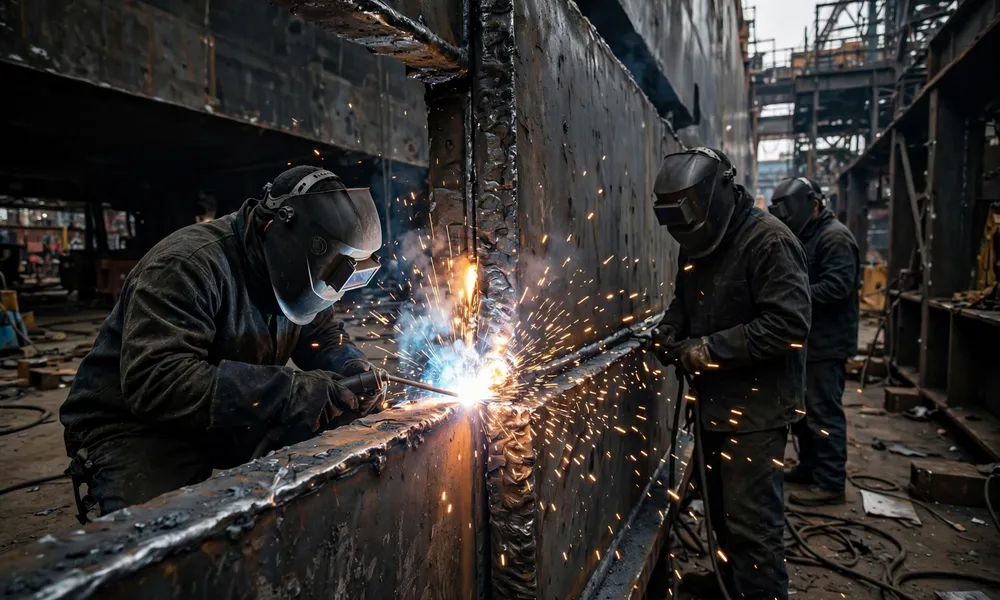
With the frame standing, the shaped plates are lifted into place by crane and welded to it, starting at the keel and working upward and outward. Icebreaker welds are special: they use low-hydrogen electrodes and preheated steel to stop cracks forming as the weld cools, and welders work in carefully controlled conditions because a cold draught across a fresh weld can ruin it. Every critical seam is inspected with ultrasound or X-rays, the same techniques used on aircraft and pipelines, and any weld with a hidden flaw is ground out and redone. On a big icebreaker, the welding alone can take many months.
Step 5: Fitting the ice belt and protection
Once the shell is complete, the yard fits the ice belt, a band of extra-thick plating around the waterline where the hull meets the ice. This is the hardest-working part of the ship, and it is often made from the toughest steel on board, sometimes with a special abrasion-resistant surface. The bow also gets extra reinforcement inside, and the propeller area is protected by a stern shape designed to keep ice away from the blades. The whole hull is then coated with a tough, low-friction paint that helps the ship slide over the ice instead of grinding against it, and anodes are bolted on to fight corrosion.

Step 6: Testing before launch
Before launch, the finished hull is tested compartment by compartment. Tanks are filled with water to check for leaks, and the structure is surveyed by classification-society inspectors who examine the welds, the steel certificates, and the thickness measurements. Many icebreakers also go through model tests first, with a scale hull rammed into a frozen tank to prove the bow shape breaks ice efficiently. Only when the hull passes every inspection is it launched, floated, and fitted out with engines and equipment. Even then, its first real test comes later: its maiden voyage into the ice it was built to beat.
Specs
| Specification | Typical figure |
|---|---|
| Hull steel | High-strength low-temperature steel, often nickel-alloyed |
| Bow plate thickness | About 30 to 50 millimetres at the ice belt |
| Ice class | Built to break first-year ice 1 to 2 metres thick |
| Frame spacing | Far closer than a cargo ship, often under 600 millimetres |
| Hull length | About 100 to 170 metres for a polar icebreaker |
| Displacement | Roughly 10,000 to 30,000 tonnes |
| Coating | Low-friction ice paint plus corrosion anodes |
| Testing | Ultrasound and X-ray weld inspection, tank tests, ice-model trials |
Price
An icebreaker hull is a large part of what makes these ships among the most expensive vessels afloat. A medium polar icebreaker typically costs roughly $300 million to $600 million as an estimate for the whole ship, with the hull structure and its special steel accounting for a large share. A large nuclear-powered icebreaker can cost $1 billion or more as an estimate. Even a small research icebreaker runs to tens of millions of dollars. These are estimates, and the real price depends on size, ice class, and the yard, but the thick steel, the dense framing, and the months of inspected welding are what drive the cost far above an ordinary ship of the same size.
A Rare Fact
An icebreaker does not smash through ice like a battering ram. Its rounded bow is designed to ride up onto the ice sheet, and then the sheer weight of the ship presses down until the ice bends and snaps beneath it. The ship then slides forward and repeats the process, which is why icebreakers move through thick ice in a slow rocking motion rather than at speed. Some modern icebreakers can even break ice by going backwards, using a specially shaped stern that crushes the ice as the ship reverses into it.
The icebreaker hull is the toughest shell on the water, but it shares its shipyard with gentler giants. A cargo ship’s hull is built from the same basic craft, as how a container ship hull is made shows, and the engines that drive these vessels are marvels of their own, covered in how a cruise ship engine is built. For the deepest cold-water work, the hull must also survive crushing pressure, a challenge explored in the making of a deep-sea submersible. The next time a channel opens through frozen sea, remember the steel, the welds, and the weight behind it.


