Stand in front of a hypercar and you are not looking at a car so much as a shape the wind has agreed to. Every curve, every vent, every razor edge exists because air at 350 kilometres per hour is not a gentle breeze — it is a wall. The body that slices through it is not stamped out like a family hatchback. It is laid up by hand, cured in an oven the size of a room, and shaped to tolerances measured in fractions of a millimetre.
Building a hypercar body is closer to building an aircraft wing than a car. The shell is a structural part, not a decoration: it carries loads, channels air to the radiators and brakes, and presses the car into the road with the force of several tonnes. The factory that makes it is quiet, clean and brightly lit, more like a laboratory than a production line. This is the factory floor where aerodynamics stops being a theory and becomes something you can touch.
How a Hypercar Aerodynamic Body Is Made
Step 1: Designing the air
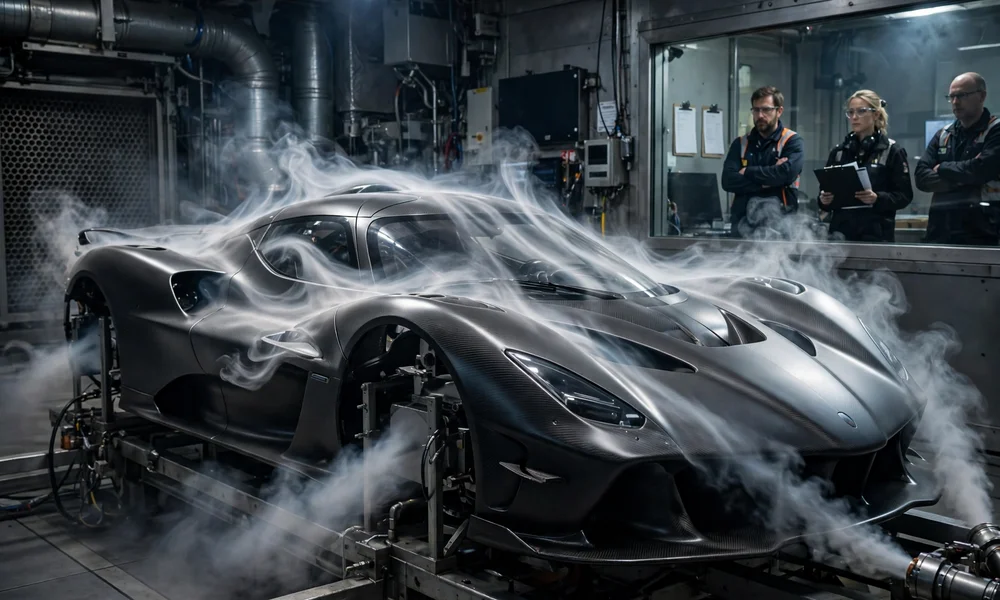
Long before any carbon fibre is cut, the body exists only in software. Aerodynamicists run the shape through computational fluid dynamics, testing thousands of virtual variations to find the one that produces the most downforce with the least drag. Then a scale model goes into a wind tunnel, where smoke streams reveal every swirl and separation the computers predicted — and a few they missed. The final shape is a compromise between the aerodynamicists, who want ever-sharper edges, and the engineers, who must make the shape survive kerbs, heat and crashes. A modern hypercar can generate more than 1,000 kilograms of downforce at top speed.
Step 2: Making the moulds
Each body panel needs a mould, and each mould is a precision tool in its own right. Moulds are machined from aluminium or carbon composite, then polished to a mirror finish, because every imperfection in the mould becomes an imperfection in the panel. A full hypercar body can need dozens of moulds — one for the nose, one for each door, one for the roof, one for the complex underfloor that does much of the aerodynamic work. Making the moulds takes months and costs a fortune — one reason hypercars are built in such small numbers.
Step 3: Laying up the carbon fibre
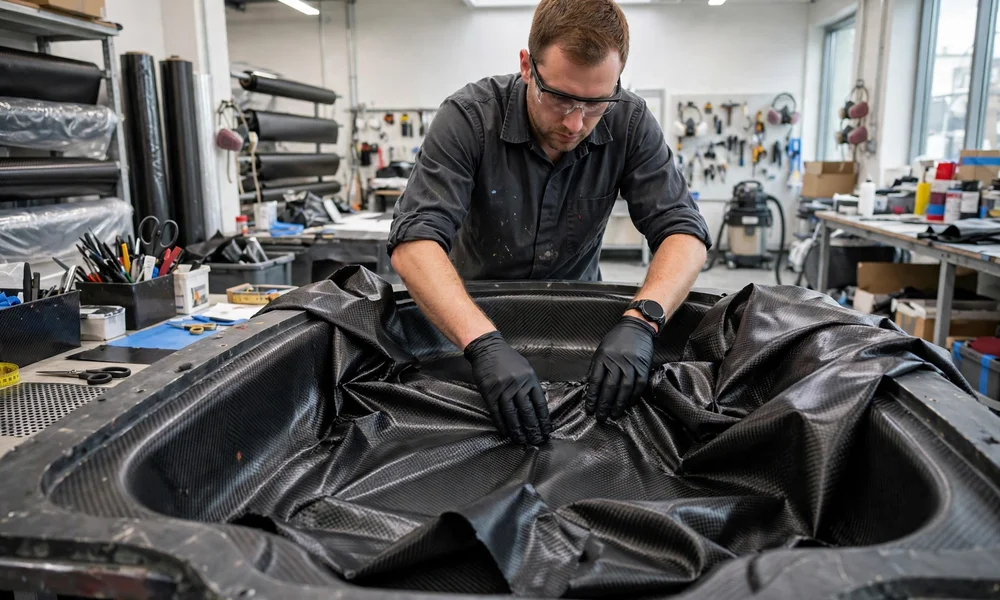
Inside a clean room, technicians lay sheets of carbon-fibre prepreg — cloth already impregnated with resin — into the moulds, layer by layer, each sheet oriented in a different direction. The direction matters: carbon fibre is immensely strong along its fibres and weak across them, so the layup schedule is designed like a structural map, with extra layers where loads are highest and fewer where weight can be saved. Some panels take a single skilled worker an entire day to lay up. The work is slow, deliberate and checked constantly. The same attention to fibre direction that governs carbon fibre curing governs every panel here.
Step 4: Curing in the autoclave
Once the layup is complete, the mould is sealed in a vacuum bag and wheeled into an autoclave — a giant pressurised oven. Inside, temperatures climb past 120 degrees Celsius while pressure squeezes the layers together, forcing out trapped air and curing the resin into a solid matrix. The cycle takes hours, and the part cannot be rushed: heat it too fast and the resin cures unevenly; too slowly and production stalls. When the door opens, the panel that emerges is rigid, feather-light and glossy.
Step 5: Trimming and bonding the shell
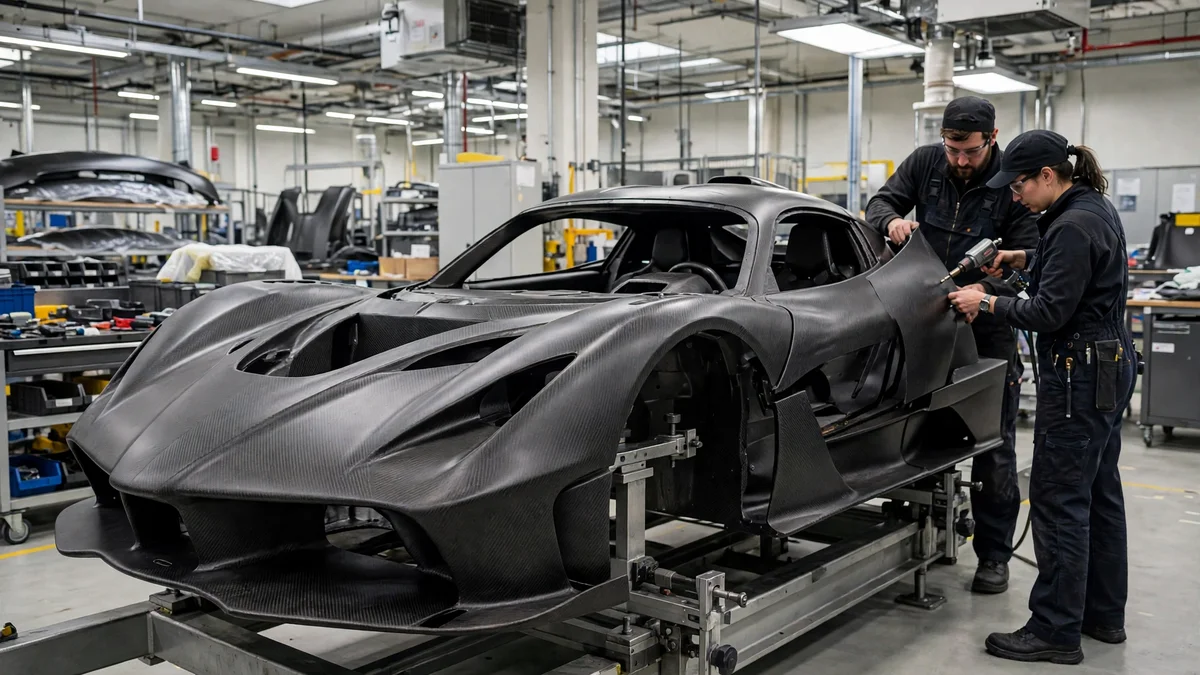
Cured panels are trimmed to their final shape on a five-axis CNC machine, which cuts the carbon fibre with diamond tooling to tolerances finer than a human hair. Then the panels are bonded together into the full body shell using structural adhesives, with rivets and fasteners only where a joint must be removable. The assembled shell is measured against its digital model with laser scanners, and any panel that sits more than a fraction of a millimetre out of place is adjusted or remade.
Step 6: Testing in the wind tunnel
The finished body — or often the complete car — goes back to the wind tunnel for validation. Engineers measure downforce, drag and cooling airflow at speeds that replicate the fastest circuits, and they test the active aerodynamic elements: the wings and flaps that change angle as the car accelerates, brakes and corners. The data from these sessions feeds straight back into the next production run. It is the same loop of design, build and test that defines active aerodynamics, and it never really ends — even cars already delivered can receive aerodynamic updates.
Step 7: Paint, polish and final fit
A hypercar body is painted like no other car. The carbon surface is sealed, primed and sanded by hand, then coated in layers of paint that can take a week to apply and cure. The exposed carbon weave, visible through a clear coat, is a prized option. Finally, every panel gap is measured: on a top hypercar, the gap between a door and a wing is often less than three millimetres, even all the way around. It is a standard no mass-market car could afford, and it is the last thing a customer sees before the car leaves the factory.
Hypercar Aerodynamic Body at a Glance
| Specification | Typical Value |
|---|---|
| Main material | Carbon-fibre prepreg, cured in an autoclave |
| Body weight | About 60–100 kg for the full shell, depending on model |
| Downforce at top speed | Up to 1,000 kg or more on flagship hypercars |
| Drag coefficient | About 0.30–0.40, balanced against downforce needs |
| Panel gap tolerance | Under 3 mm, measured all the way around |
| Cure temperature | About 120–180°C in the autoclave |
| Key advantage | Extreme stiffness at very low weight, shaped for airflow |
What Does It Cost?
A hypercar body is one of the most expensive parts of one of the most expensive cars on Earth. A single replacement carbon-fibre front section can cost $100,000–$250,000 (estimates), and the full body shell represents a large share of a hypercar’s $2–$4 million price (estimates). Most of the cost is labour: hundreds of hours of hand layup, curing, trimming and fitting. It is the opposite of mass production, and that is precisely the point. The body is not just a shape; it is the car’s signature, and the factory treats it that way.
A Rare Fact
Some hypercars generate so much downforce that, in theory, they could drive upside down on the ceiling of a tunnel at top speed — the aerodynamic grip pressing them to the roof would exceed the pull of gravity. No one has ever tried it, for obvious reasons, but the maths checks out: at full speed, the air itself is holding the car harder than the Earth is pulling it down. It is a party trick of physics, but it captures what the factory is really building — not a car body, but a wing that happens to have seats. The same obsession with airflow that shapes the body also drives carbon monocoque production, where the chassis and the aerodynamics are designed as one.


