Open a thin gaming laptop and you will find a processor that can throw off more heat than a small kettle, packed into a machine barely thicker than a paperback book. The answer is a part so flat you could mistake it for a sheet of metal, yet so effective at moving heat that it can outperform solid copper. It is the vapour chamber, and making one is an exercise in precision that borders on the surgical.
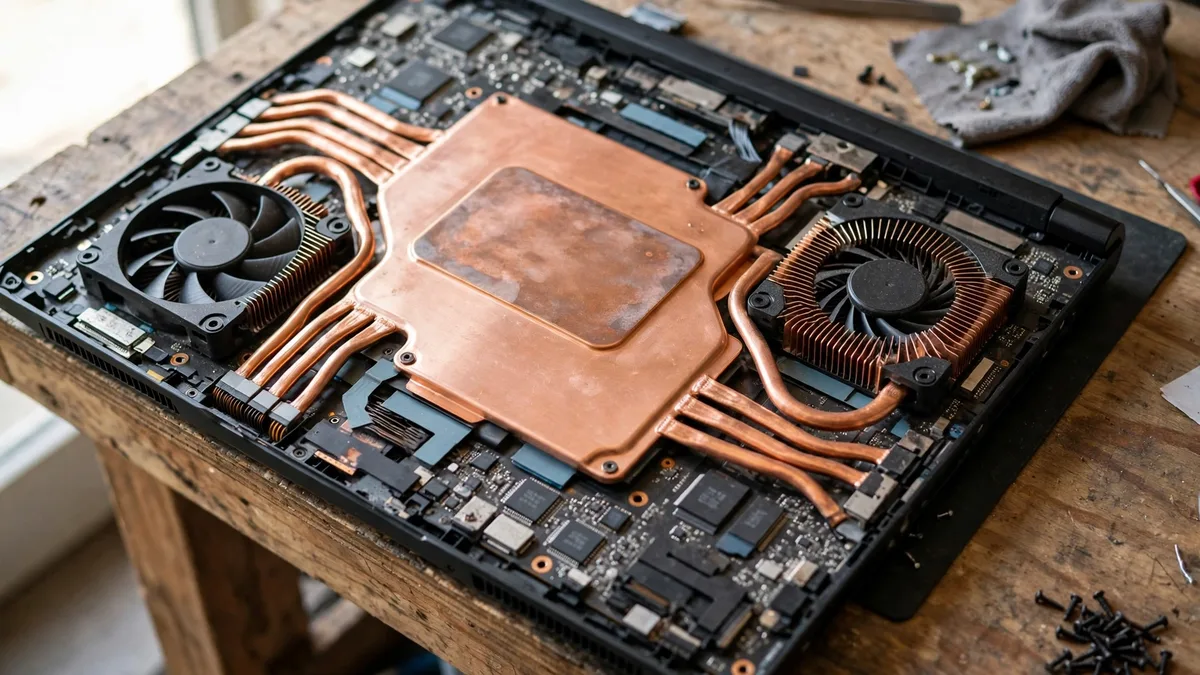
A vapour chamber is a sealed copper envelope, only two or three millimetres thick, lined with a wick and filled with a tiny amount of pure water. Heat from the processor boils the water, the vapour carries the heat across the plate, it condenses at the cooler edges, and the wick pulls the liquid back to start again. The cycle repeats thousands of times a second, silently, with no moving parts. This is how a laptop vapour chamber is made.
How It’s Made
Step 1: Choosing and cutting the copper
It starts with copper, chosen for the simple reason that no common metal conducts heat better except silver, and silver is far too expensive for a laptop part. The factory buys copper in thin sheets, usually oxygen-free copper that has been rolled to a precise thickness. Each sheet is inspected for scratches, dents and impurities, because a flaw in the wall of a vapour chamber can become a leak, and a leak kills the part.
Step 2: Forming the two halves
A vapour chamber is made from two copper shells pressed together, like a sandwich with almost nothing between the slices. Each shell is formed in a stamping press, which pushes the flat sheet into a shallow tray shape with a raised rim around the edge. The depth of the tray is measured in fractions of a millimetre, and the press must repeat the same shape thousands of times without drifting. The formed shells are washed in a chemical bath to strip away oils and oxides, because a dirty surface will not bond, and a bad bond will not hold a vacuum.
Step 3: Building the wick
The wick is the part that makes the whole cycle possible, and it is the most delicate piece of the build. It is usually made from sintered copper powder, tiny copper grains heated until they fuse into a porous layer, or from fine woven copper mesh. The wick lines the inside walls of the chamber and acts like a sponge, pulling condensed water back to the hot spot by capillary action, the same force that draws water up a paper towel. The sintered wick is made by spreading copper powder evenly over the shell, then baking it in a furnace until the grains bond to each other and to the copper beneath. The same heat-moving logic appears in the graphics hardware the chamber cools, where the gaming GPU is built to run hot for hours at a time.
Step 4: Sealing the edges in a vacuum
With the wick in place, the two shells are joined. The rims are pressed together and sealed by brazing or diffusion bonding, a process that fuses the copper at high temperature without melting the whole part. The seal must be perfect around the entire perimeter, because the chamber will spend its whole life under vacuum. One edge of the chamber keeps a tiny copper fill tube, a narrow pipe through which the water will be added.
Step 5: Evacuating the air and adding the water
Now comes the step that gives the vapour chamber its magic. The air is pumped out of the chamber through the fill tube until the pressure inside is a tiny fraction of normal air pressure. At such low pressure, water boils at a far lower temperature than 100 degrees Celsius, which means the heat of the processor alone is enough to turn it into vapour. Then a measured amount of pure, deionised water is injected, far less than a teaspoon, and the amount must be exact. The fill tube is then crimped shut and soldered, sealing the chamber for life. From this moment on, the chamber can never be opened again.
Step 6: Testing the chamber under heat
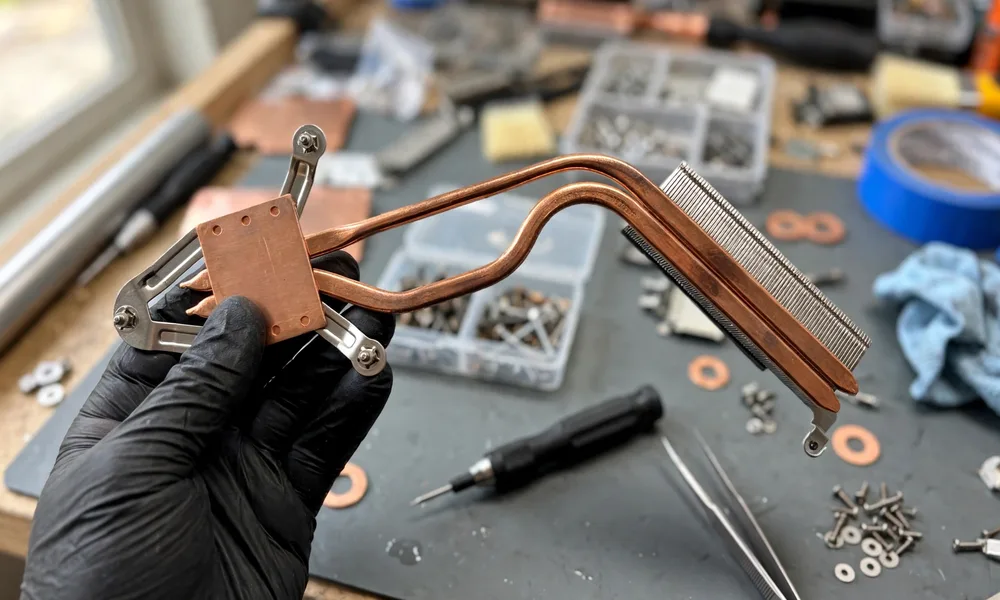
Every chamber is tested before it leaves the factory. It is placed on a heated test block that mimics a processor, and sensors measure how evenly the temperature spreads across the plate and how quickly the heat moves. A good chamber settles at a nearly uniform temperature, with no hot spot over the heater. The numbers that define a good chamber, its thickness, its heat capacity and its limits, are the same kind of figures engineers publish for every thermal part, as in the laptop vapour chamber specs that list what each chamber can carry.
Step 7: Fitting the chamber into the laptop
The final step happens on the laptop assembly line. The chamber is pressed against the processor and graphics chip with a thin layer of thermal paste, then screwed down to the motherboard with spring-loaded fasteners that keep the pressure even as the machine heats and cools. Heat pipes and cooling fins are attached at the chamber’s edges, and the fans are mounted to blow across them. The drive that stores the laptop’s games and files has its own precision build, as how a solid-state drive is made shows, but the chamber stays invisible, doing its job where no one can see it.

Specs
| Specification | Typical figure |
|---|---|
| Material | Oxygen-free copper envelope |
| Thickness | About 2 to 3 millimetres |
| Working fluid | A small amount of pure, deionised water |
| Internal pressure | Near-vacuum, so water boils at low temperature |
| Wick | Sintered copper powder or fine copper mesh |
| Heat transfer | Two-dimensional, across the whole plate |
| Sealing method | Brazing or diffusion bonding, fill tube crimped and soldered |
| Moving parts | None; the cycle is driven by heat alone |
| Used in | Thin gaming laptops, ultrabooks and flagship phones |
Price
A vapour chamber is a component inside a laptop, not a product sold on its own, so there is no retail price for one. As an estimate, a laptop vapour chamber generally costs the manufacturer in the region of $10 to $40, depending on its size and complexity, against a few dollars for a set of heat pipes — these are estimates, and the true figures are commercial secrets. The laptops that carry them are the ones where the cost is justified: thin gaming laptops typically sell for roughly $1,000 to $3,000, also an estimate.
A Rare Fact
The vapour chamber descends from the heat pipe, invented in 1963 by George Grover at the Los Alamos National Laboratory in the United States. Grover was working on cooling nuclear reactors, and he realised that a sealed tube with a little liquid inside could move heat far better than any solid metal. The heat pipe went into spacecraft, then into computers, and engineers later flattened it into a plate to make the vapour chamber.
In a machine where every millimetre is fought over, the vapour chamber wins its space by being the thinnest way to move the most heat.