A hypercar headlight is not a lamp. It is a computer, a cooling system, and a piece of jewellery in one housing, and it has to do two jobs that fight each other: throw a beam far enough to drive at 200 miles per hour at night, and look like nothing else on the road. A single headlight can contain dozens of light-emitting diodes, a laser module, a fan, and a lens shaped to a fraction of a millimetre — all packed into a housing barely bigger than a shoebox. Building one is closer to making a camera than to making a car part.
The headlight is also the face of the car. Designers sketch it first, and engineers spend years making the sketch work, because the shape of the light defines the shape of the whole front end. A headlight that fogs, flickers, or dims is a failed part, so every unit is sealed, tested, and burned in before it is allowed near a car. Here is how a hypercar headlight is built.
How It’s Made
Step 1: Designing the optics
Production starts on a computer, where optical engineers design the beam. They model how each diode’s light will travel through the lens and reflector, shaping a beam that is bright far ahead, wide at the edges, and cut off sharply so it does not dazzle oncoming drivers. The design is simulated thousands of times, and physical prototypes are tested in a dark tunnel with cameras measuring the beam’s shape. A headlight for a car that can exceed 200 miles per hour needs a beam that reaches far further than a normal car’s, so the optics are pushed harder than in any mass-market lamp.
Step 2: Moulding the lens
The clear outer lens is moulded from polycarbonate, a tough transparent plastic, in a process called injection moulding. Molten plastic is forced into a polished steel mould under high pressure, filling every curve of the lens shape in seconds, then cooled until it holds its form. The mould itself is polished to a mirror finish, because any mark on the mould becomes a mark on the lens, and a mark on the lens scatters the beam. Each lens is inspected under bright light for bubbles, scratches, and distortion, and any lens that fails is ground up and recycled.

Step 3: Building the LED and laser modules
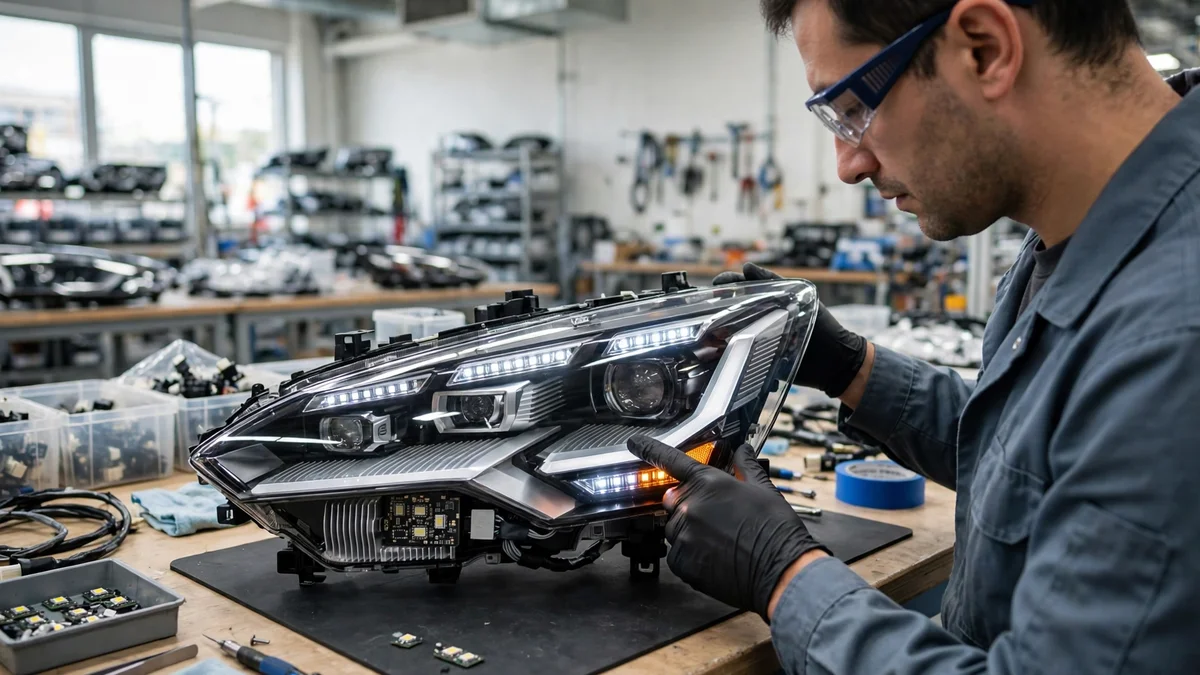
Inside the housing, the light itself is built from modules. High-power light-emitting diodes are soldered onto circuit boards, each one mounted on a small heat sink, and in the most advanced units a laser module is added for the long-distance high beam. The laser fires onto a phosphor plate that turns its blue light white, producing a beam that reaches much further than diodes alone. The modules are tested individually for brightness and colour, because a headlight whose two sides do not match is a rejected headlight, and the colour of the light must be identical across every car.
Step 4: Assembling the housing and cooling
The housing is assembled around the modules, and cooling is built in from the start. High-power diodes generate serious heat in a sealed box, so the housing carries aluminium heat sinks, and many hypercar headlights include a small fan that pulls air through the unit. The wiring, the control electronics, and the motors that steer the beam around corners are fitted at this stage, each one clipped and routed so nothing rattles or chafes. The same attention to heat and precision drives how a hypercar headlight works, where the cooling system is as important as the light itself. The housing is then sealed against water and dust, because a single drop inside the lens ruins the unit.
Step 5: Sealing and aiming the lens
With the modules inside, the lens is bonded to the housing with adhesive and the whole unit is sealed. The headlight is then placed on an aiming rig, where its beam is projected onto a wall and measured. Technicians adjust the modules until the beam’s cut-off line is exactly where the design demands it, to a tolerance measured in millimetres at a distance of many metres. The unit is then run for hours in a burn-in test, checking that the light stays bright and the colour stays stable as the unit heats up, and that no condensation forms inside the sealed housing.
Step 6: Testing the finished headlight
Before a headlight is cleared for a car, it is tested hard. It is shaken on a vibration rig to simulate years of rough roads, sprayed with water to prove the seal, and frozen and baked to check it works from a cold winter morning to a hot summer day. The beam is measured once more, and the unit is checked for flicker, for dimming, and for any fault in its electronics. Only when it passes every test is it cleared for the car, where it is fitted, aimed once more on the finished vehicle, and checked against its twin on the other side.

Specs
| Specification | Typical figure |
|---|---|
| Light source | LED modules, sometimes with laser high beam |
| Lens material | Polycarbonate, injection-moulded |
| High-beam range | Up to around 600 metres with laser assist |
| Cooling | Aluminium heat sinks, often with a fan |
| Beam control | Motors steer the beam into corners |
| Sealing | Sealed against water and dust |
| Build time | Several hours per unit, plus burn-in |
| Testing | Vibration, water, heat, and beam checks |
Price
A hypercar headlight is not sold on its own, but as an estimate, a single unit costs roughly $5,000 to $20,000 to build, depending on the car, the number of diodes, and whether a laser module is included. A pair of headlights can therefore cost as much as a good used car, and replacing one after a minor accident is one of the most expensive repairs a hypercar owner can face. These are estimates, and the real figure is a closely guarded secret for every maker — the optics are custom, the electronics are bespoke, and the testing rejects a large share of finished units.
A Rare Fact
The first electric headlights appeared on cars more than a century ago, and they were so dim that drivers carried spare bulbs and often drove by moonlight instead. The leap to the modern hypercar headlight came from racing, where night stages demanded lights that could pick out a corner at racing speed. Laser headlights, now found on the most advanced hypercars, were first raced at Le Mans, where their long beam let drivers see further down the straights than any lamp before them — and the same technology now lights the road for hypercar owners.
The headlight is the hypercar’s face, and it is built with the same care as everything else on the car. The bodywork around it is shaped by the same airflow — see how a hypercar aerodynamic body is made — and the materials inside the unit are explained in hypercar headlight materials engineering. The next time a hypercar’s lights sweep across a dark road, remember the polished steel moulds, the laser modules, and the hours of beam testing behind that single strip of light.


