Kevlar is the yellow fabric that stops bullets, holds aeroplanes together, and reinforces the tyres of racing cars — yet it starts life as a liquid, spun into a fibre so fine it is almost invisible. The fibre is five times stronger than steel for its weight, it does not melt, and it barely stretches, which is why engineers reach for it whenever something must be light, tough, and heat-resistant at once. Turning that liquid into a finished composite panel is a journey through chemistry, spinning, weaving, and curing, and it happens in factories where the air itself must be kept free of dust.
The composite is not one material but two: the yellow aramid fibre, which carries the load, and the resin that binds it, which holds the fibres in place and spreads the force between them. Getting the two to work together is the whole craft. A panel with dry fibres is weak, a panel with too much resin is heavy, and a panel with trapped air is a panel waiting to fail. Here is how a Kevlar composite is made.

How It’s Made
Step 1: Spinning the aramid fibre
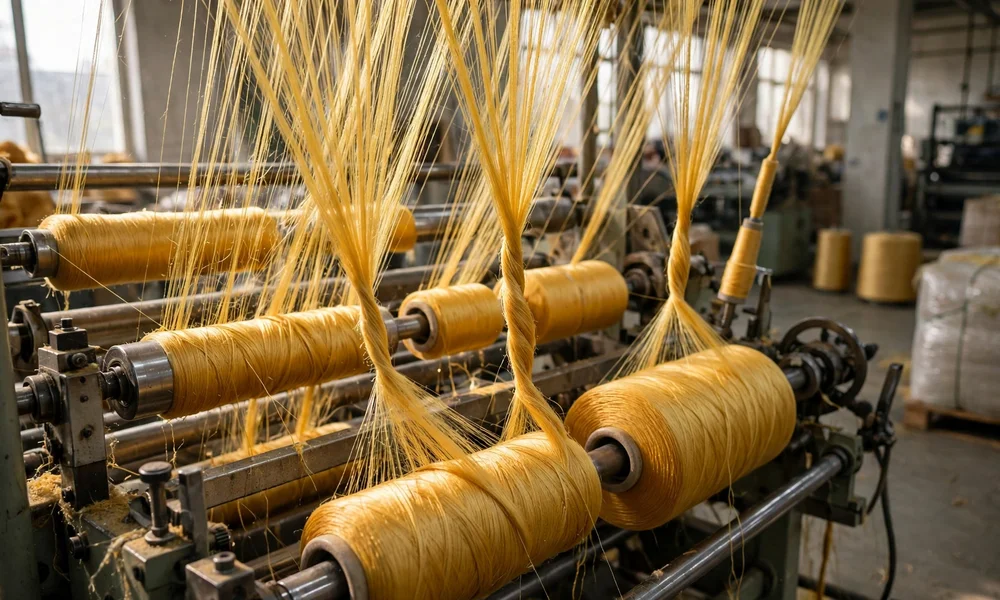
Production starts with a polymer, dissolved in strong acid to form a thick liquid crystal solution. That solution is forced through a spinneret — a plate pierced with tiny holes — and the emerging filaments are drawn out, washed, and dried, aligning the polymer chains along the fibre’s length. That alignment is the secret of the fibre’s strength: the chains lock together so tightly that the fibre resists being pulled apart far better than steel. The filaments are gathered into yarns and wound onto spools, and every spool is tested for strength before it is allowed into the weaving hall.
Step 2: Weaving the fabric
The yarns are woven into fabric on industrial looms, in patterns chosen for the job the composite will do. A plain weave, over and under in a simple grid, gives a stable fabric that is easy to lay up; a twill weave drapes better around curves; a satin weave gives the smoothest surface. The looms run in a clean, humidity-controlled hall, because dust or damp in the yarn becomes a flaw in the finished panel. The woven cloth is inspected as it comes off the loom, and any roll with a broken thread or a stain is rejected.
Step 3: Cutting and laying up the plies
The fabric is cut into patterns and laid into a mould, layer by layer, each ply oriented in a different direction so the finished panel is strong in every direction that matters. Workers wear gloves and clean clothing, because skin oils and dust weaken the bond between fibre and resin. The most stressed areas get extra plies, and the lay-up is checked ply by ply against the design, since a missing or misaligned layer cannot be fixed once the resin has cured. A complex panel can take a team hours to lay up by hand.
Step 4: Infusing the resin
With the dry fabric in the mould, resin is introduced — either by painting it into each layer as it is laid, or by sealing the mould in a vacuum bag and drawing the resin through the fabric under vacuum. The vacuum pulls out trapped air and forces the resin into every gap between the fibres, and the ratio of fibre to resin is controlled precisely: too little resin leaves dry spots, too much adds weight for no strength. The same discipline governs how a Kevlar composite is made at every scale, from a small panel to a whole aircraft part. The mould is then closed and the panel is left to cure.
Step 5: Curing the panel
The panel is cured in an oven or an autoclave, where heat hardens the resin and locks the fibres in place. The temperature and the time are controlled to the degree and the minute, because a panel cured too cool stays soft and a panel cured too hot becomes brittle. Large panels are cured under pressure as well, squeezing out any remaining air. When the panel comes out it is trimmed to shape, its edges are sealed against moisture, and its surface is finished — sanded, coated, or painted, depending on where it will be used.
Step 6: Testing the finished composite
Before a panel is cleared for use, it is tested. Samples from the same batch are pulled apart, bent, and struck to measure their strength, and the panel itself is scanned with ultrasound to find hidden voids or delamination — layers that have separated inside. Panels for armour or aerospace are also shot or impacted in testing, proving they absorb energy the way the design demands. Only when the panel passes every test is it cleared for its job, whether that is stopping a bullet, stiffening an aircraft wing, or protecting a racing driver.

Specs
| Specification | Typical figure |
|---|---|
| Fibre | Aramid (para-aramid) yarn, golden yellow |
| Strength | About five times steel, weight for weight |
| Weave types | Plain, twill, or satin, by application |
| Matrix | Epoxy or phenolic resin |
| Heat resistance | Does not melt; chars above about 400°C |
| Cure method | Oven or autoclave, heat and pressure |
| Build time | Hours to days per panel, mostly by hand |
| Testing | Ultrasound scan, plus impact and strength tests |
Price
A Kevlar composite panel is not sold by the piece in a standard size, but as an estimate, finished aramid composite costs roughly $100 to $400 per square metre, depending on the weave, the resin, and the amount of hand labour in the lay-up. A single armour panel or aerospace part can therefore cost thousands of dollars, and a full set of composite bodywork for a race car can run into the tens of thousands. These are estimates, and the real figure depends on the application — the fibre itself is expensive, the labour is slow and skilled, and the testing rejects a share of finished panels.
A Rare Fact
Kevlar was invented by accident. In the 1960s, a chemist named Stephanie Kwolek was working on a lighter fibre for tyres when a batch of polymer solution turned cloudy and thin — a result her colleagues told her to throw away. She spun it anyway, and the fibre that came out was so strong it surprised everyone in the laboratory. The discovery went on to save lives in body armour, stiffen aircraft and spacecraft, and reinforce everything from racing sails to the brakes of Formula 1 cars — all from a cloudy solution that was nearly discarded.
The yellow fabric is easy to recognise and hard to make, and it sits at the heart of machines that must not fail. The carbon fabric it is often paired with is woven the same way — see how carbon fibre weave is made — and the properties that make aramid special are set out in Kevlar composite materials engineering. The next time you see that unmistakable gold weave, remember the acid, the spinneret, and the loom — and the cloudy liquid that was nearly thrown away.


