The first thing you notice is not the speed. It is the sound. A naturally aspirated V12 at full throttle does not roar the way a turbocharged engine does; it rises, clean and mechanical, through a pitch that seems to climb past where an engine should be able to go, and then it climbs further still.
That sound is the signature of the hypercar V12, the last of the great naturally aspirated engines. They are expensive, thirsty, and gloriously unnecessary — and they are the subject of this guide.
A V12 is not simply a bigger version of a smaller engine. Twelve cylinders arranged in two banks of six give an engine a balance that no other layout can match, and the specifications that describe one — displacement, compression ratio, specific output, redline — tell you more about how it will feel than the headline power figure ever will.

Hypercar V12 Engine Specs Explained
1. Displacement: how big the engine is
Displacement is the total volume swept by all twelve pistons, and on a modern hypercar V12 it usually sits between 5.2 and 6.5 litres. The number matters because a naturally aspirated engine can only burn as much fuel and air as its cylinders can swallow, so displacement sets the ceiling on power before any cleverness is applied. A 6.5-litre V12 inhales roughly a quarter more air per revolution than a 5.2-litre one, and that extra lung capacity is worth roughly a hundred horsepower.
2. Configuration: why twelve cylinders in a V
The V in V12 describes two banks of six cylinders set at an angle, usually 60 degrees, sharing a single crankshaft. Sixty degrees is no accident: it is the angle at which a V12’s firing pulses fall perfectly evenly, one power stroke every 60 degrees of crank rotation, which makes the engine inherently smooth without balance shafts. That smoothness is why a V12 can idle at a whisper and still rev to the sky, and why engineers describe it as the most refined layout ever built. The configuration is the reason the engine sounds the way it does, too: twelve evenly spaced exhaust pulses per two revolutions create a tone no other layout can reproduce.
3. Power and torque: what the numbers really say
Modern hypercar V12s produce between 800 and 1,000 horsepower, with torque typically in the range of 700 to 750 newton-metres. Two things matter more than the headline figures. The first is where the power lives: a naturally aspirated V12 makes its peak power very high in the rev range, often above 8,500 rpm, so the car feels calm at ordinary speeds and explosive only when you chase the redline. The second is specific output — power per litre — which for the best examples now exceeds 125 horsepower per litre without any forced induction, a figure that would have seemed impossible a generation ago. Read power and torque together, and never alone.
4. Redline: how fast it is allowed to spin
The redline is the maximum safe speed of the crankshaft, and on a hypercar V12 it is one of the most exciting numbers on the sheet — typically 8,500 to 9,500 rpm. Reaching those speeds takes extraordinary engineering: titanium connecting rods, pistons light enough to survive the forces, and valve springs stiff enough to close the valves thousands of times a minute. A high redline is not a party trick; it is the whole point of a naturally aspirated engine, because power is torque multiplied by revs, and revs are the one thing a turbocharger cannot give you. The way these engines are assembled to survive that punishment is covered in how a hypercar V12 engine is made, and the materials behind the lightest parts are explained in the materials engineering of the hypercar V12.
5. Compression ratio: squeezing more from every drop
Compression ratio describes how much the fuel-air mixture is squeezed before it is ignited, and on a modern V12 it typically runs between 13:1 and 14:1 — high by any standard. A higher ratio extracts more energy from each combustion event, which improves both power and efficiency, but it also pushes the engine closer to knock, the uncontrolled detonation that can destroy pistons. Managing that edge requires precise fuel injection, carefully shaped combustion chambers, and high-octane fuel.

6. Bore, stroke, and the oversquare question
Bore is the diameter of each cylinder and stroke is how far the piston travels, and their ratio shapes an engine’s character. Hypercar V12s are oversquare — the bore is wider than the stroke is long — which keeps piston speeds manageable at very high revs and lets the valves be large enough to feed the cylinders at 9,000 rpm. A typical example might use a bore near 89 millimetres and a stroke near 78 millimetres. The V12’s twelve small cylinders let engineers have both: each piston is small and light, so it can change direction violently, while the total displacement still delivers the torque a heavy hypercar needs.
7. Weight and specific power: the number that wins races
A complete hypercar V12 typically weighs between 200 and 250 kilograms, and the power-to-weight ratio of the engine alone often exceeds 3.5 horsepower per kilogram. That figure is what the engineers actually chase, because every kilogram saved in the engine is a kilogram that does not need to be accelerated, braked, or turned. Titanium, magnesium, and carbon fibre appear wherever the budget allows, and the bill for those materials is one reason a V12 hypercar costs what it does — a subject covered in why the hypercar V12 engine is so expensive.
Hypercar V12 Engine Specs
| Specification | Typical range |
|---|---|
| Configuration | V12, naturally aspirated, 60-degree bank angle |
| Displacement | 5.2 to 6.5 litres |
| Power output | 800 to 1,000 hp |
| Torque | 700 to 750 Nm |
| Redline | 8,500 to 9,500 rpm |
| Compression ratio | 13:1 to 14:1 |
| Specific output | Over 125 hp per litre |
| Engine weight | 200 to 250 kg |
What Does a Hypercar V12 Engine Cost?
Manufacturers do not sell a hypercar V12 on its own, but the cars around it reveal the scale. A flagship V12 hypercar is estimated at roughly $2 million to $4 million, and a replacement engine is estimated at $300,000 to $600,000 before labour, with a routine service estimated at $10,000 to $25,000. All prices are estimates only and vary widely by model, condition, and market.
A Rare Fact
The first V12 engines were not built for cars at all. In 1904, the Putney Motor Works in London built a V12 boat engine, and early V12s powered airships and aircraft long before they powered road cars. The layout’s perfect balance made it ideal for aircraft, where vibration could shake a machine apart, and it was only in the 1930s that luxury carmakers adopted it for the same reason.
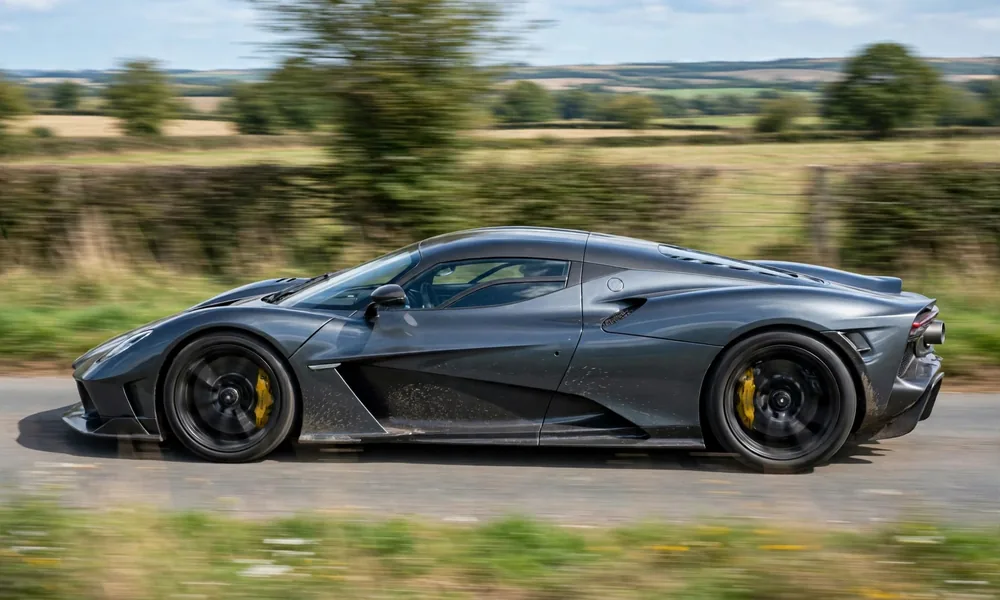
The V12’s numbers will not last forever. Emissions rules and electrification are already pushing manufacturers toward smaller engines with electric assistance, and the naturally aspirated twelve is the most endangered layout on the road. When the last one is built, the spec sheet will be the record of how far a petrol engine could go.


