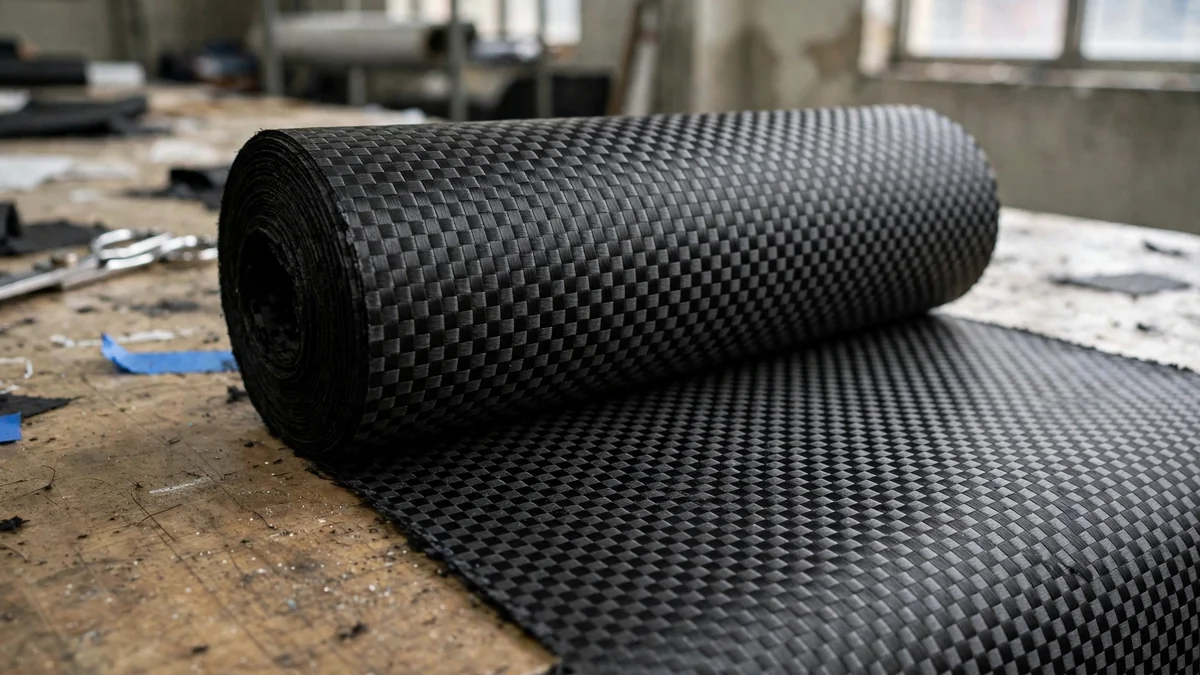
Hold a piece of carbon fibre cloth up to the light and it looks almost like silk, a black fabric with a fine checkerboard shimmer that shifts as you turn it. Pull at it and the illusion breaks. The cloth barely stretches at all. It is stiff, springy and strangely light, and it smells faintly of resin and industry. This is the fabric that holds together racing cars, aircraft wings, bicycle frames and spacecraft, and every square metre of it begins as a thread thinner than a human hair, woven on a loom like cloth for a shirt.
Carbon fibre weave is not a single material but a way of arranging one: thousands of hair-thin carbon filaments, bundled into tows, woven into fabric, then soaked in resin and cured hard. This is how that black checkerboard cloth is made.
How It Is Made
The journey from raw chemical to finished weave takes place in two very different worlds. The first is a chemical plant, where a white acrylic fibre is baked until almost nothing is left of it but pure carbon. The second is a weaving hall, where looms turn that carbon into cloth.
Step 1: Spinning the precursor fibre
Almost all carbon fibre starts life as polyacrylonitrile, or PAN, a white acrylic polymer similar to the fibre in a cheap jumper. The polymer is dissolved and forced through spinnerets, plates pierced with thousands of tiny holes, to form fine white filaments. These filaments are washed, stretched and dried, aligning their long polymer chains along the length of the fibre.
Step 2: Baking the fibre into carbon
The white PAN fibre is then heated in stages in oxygen-free ovens, first to around 200 to 300 degrees Celsius to stabilise it, then to 1,000 degrees or more to carbonise it. In the heat, everything that is not carbon is driven off as gas: nitrogen, hydrogen and oxygen leave, and the remaining carbon atoms lock into tight, layered sheets along the fibre. By the end of the process the fibre is more than 90 percent pure carbon, black, and enormously strong in tension.
Step 3: Bundling filaments into tows
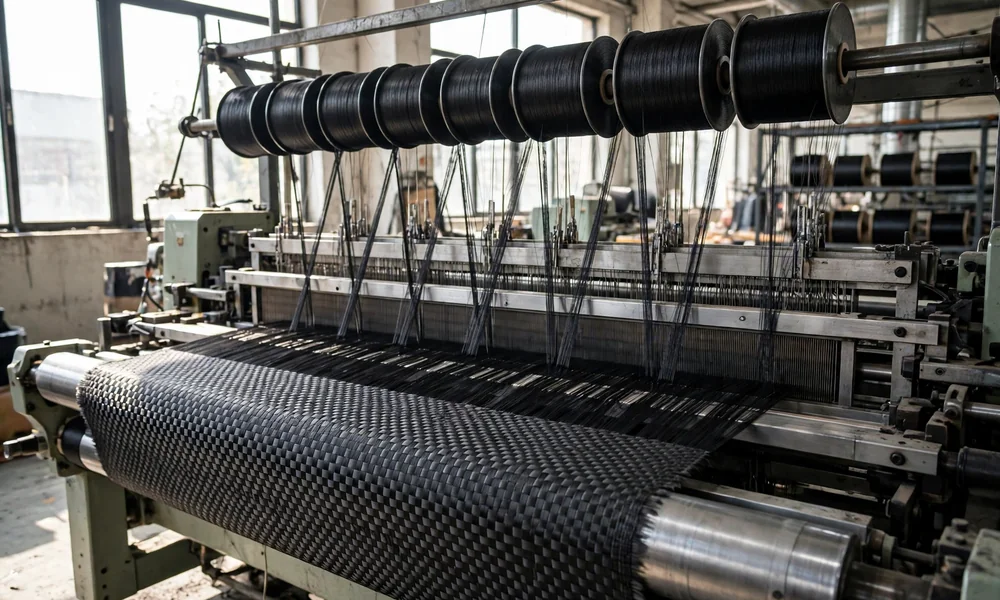
Individual filaments are far too fine to weave, so thousands are gathered into bundles called tows, typically containing 3,000, 6,000, 12,000 or even 24,000 filaments. The tow is coated with a light sizing, a thin chemical layer that protects the filaments from damage and helps them bond with resin later. Tows are wound onto large bobbins, each holding kilometres of fibre, and these bobbins are the raw material the weaver works with. The same care for fibre handling shapes the parts the weave ends up in, including the carbon frame of a modern e-bike, where the layup of the cloth decides how the bike rides.
Step 4: Weaving the cloth
Weaving carbon fibre uses the same principle as weaving cotton: warp tows run lengthways down the loom, weft tows cross them side to side, and the two interlace to form a sheet. The pattern of that interlacing is the weave, and it matters enormously. In a plain weave, each tow passes over one and under one, making a tight, stable checkerboard that resists fraying but crimps the fibres sharply. In a twill weave, tows pass over two and under one, giving the fabric its familiar diagonal pattern, a smoother drape and better handling around curves. In a satin weave, tows float over several others before dipping under, making the most flexible cloth of all, ideal for complex moulds.
Step 5: Inspecting and grading the fabric
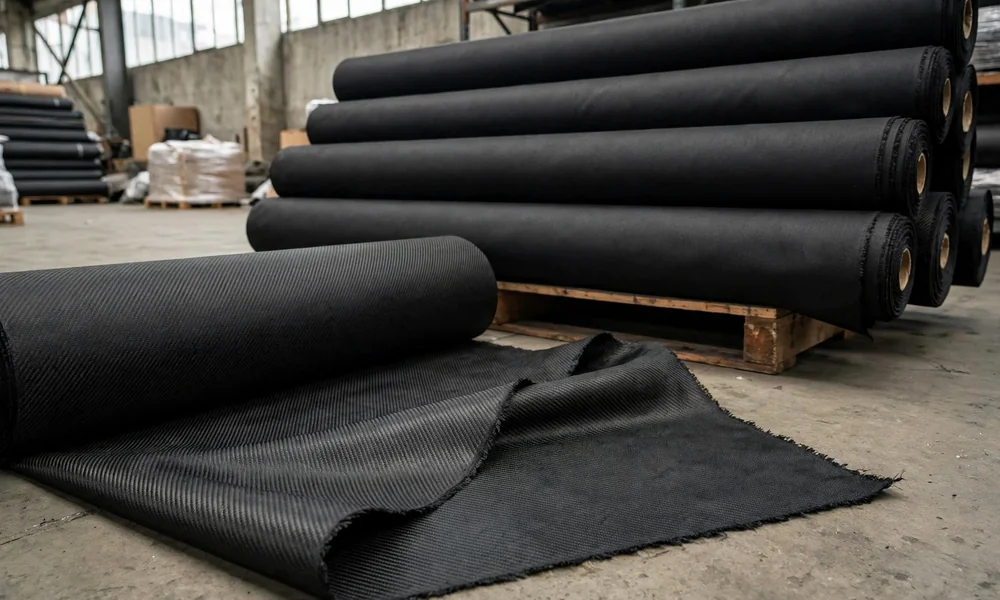
Every metre of woven carbon fibre is inspected, usually by eye and by camera, for broken tows, gaps, misaligned fibres and contamination. Fabric is graded by weight, measured in grams per square metre, and by tow size: a 200-gram plain weave of 3,000-filament tow looks and behaves very differently from a 600-gram twill of 12,000-filament tow. Rolls are labelled with their weave type, weight, tow size and width, and stored in clean, dry conditions, because carbon fibre absorbs moisture and dust that can weaken the bond with resin. The numbers behind each grade, from areal weight to tensile strength, are what the specifications of carbon fibre weave spell out in full.
Step 6: Prepreg and the road to the mould
Most woven carbon fibre leaves the factory as prepreg: the cloth is impregnated with a precisely measured amount of epoxy resin and chilled to slow the curing reaction. Prepreg rolls are stored frozen, shipped in refrigerated trucks, and thawed just before use. When the cloth is laid into a mould and heated in an autoclave, the resin flows, bonds the fibres together and hardens into a rigid composite. This is where the weave earns its keep: the pattern chosen at the loom decides how the finished part carries load, resists impact and looks when the mould opens.
Specifications
| Specification | Typical value |
|---|---|
| Filament diameter | 5 to 10 micrometres |
| Carbon content | Over 90 percent |
| Tow sizes | 3K, 6K, 12K, 24K filaments |
| Fabric weight | 100 to 600 g/m² |
| Weave types | Plain, twill, satin |
| Tensile strength | 3,500 to 7,000 MPa |
What It Costs
Woven carbon fibre fabric typically sells for around $20 to $60 per square metre, depending on weave type, tow size and weight, with aerospace-grade prepreg costing considerably more. A single roll of high-quality twill prepreg can cost several thousand dollars, and a complex part like a car monocoque can consume hundreds of square metres of cloth plus the labour of laying it up by hand. The price is driven by energy, the long high-temperature baking of the fibre, and by quality control: much of the cost is in the inspection and rejection of imperfect cloth.
A Rare Fact
Carbon fibre was invented in Britain in the 1960s at the Royal Aircraft Establishment in Farnborough, and the first practical fibres were made not from PAN but from rayon, the same material as early artificial silk. The breakthrough came when researchers realised that stretching the fibre while it was heated aligned the carbon atoms and multiplied its strength. The weave itself remains a textile art, and the most demanding fabrics are still inspected by human eyes, because no camera yet matches a weaver’s feel for a cloth that is wrong. That marriage of loom and laboratory is also what makes the materials engineering behind carbon fibre weave so unusual: a fabric that behaves like a metal, made on machines that once wove cotton.
Next time you see the checkerboard shimmer on a racing car or a bicycle frame, look closely.


