In a small engine factory in Ängelholm, Sweden, the air smells faintly of cutting oil and the loudest sound is the soft whir of a milling machine. On a bench sits an engine so small you could carry it under one arm, yet it makes more power than the V8 in a family SUV. It has three cylinders, no camshafts, and two turbochargers, and it is called the Tiny Friendly Giant. This is where the Koenigsegg Gemera engine is built, and the factory feels less like a production line and more like a watchmaker’s workshop.
The Gemera is a four-seat hypercar, and its engine is a two-litre, three-cylinder twin-turbo unit that produces around 600 horsepower on its own, before its electric motors add their share. Koenigsegg designed it in-house: a company that builds cars in tiny numbers and engineers almost everything itself. Making it means machining parts to tolerances measured in microns, assembling them by hand, and testing each one as if it were the only engine in the world — in a run this small, it almost is.
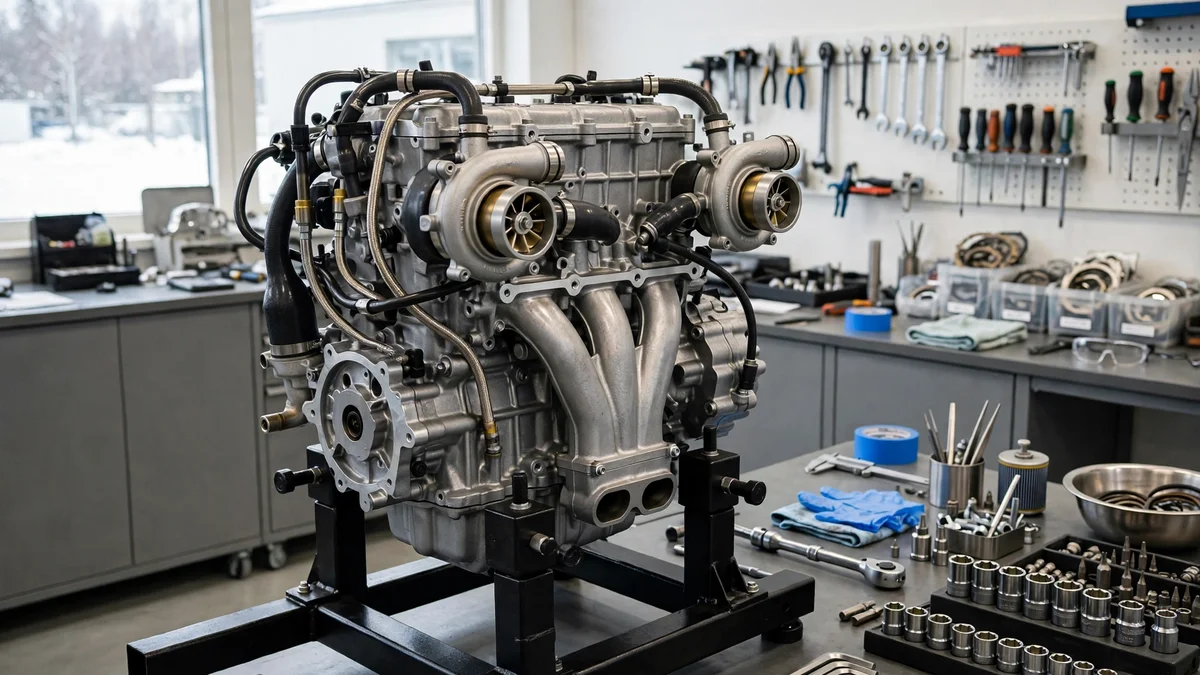
The Production Line
Koenigsegg builds cars in the dozens, not the thousands, so there is no roaring conveyor belt here. Instead, a small team of technicians builds each engine by hand, one at a time, in a clean workshop where every tool has its place and every part is checked before it is fitted. An engine takes days to assemble, not minutes, and the same technician often follows it from the first component to the final test. That slow pace is the point: building so few engines leaves no room for a mistake to hide in volume.
Step 1: Machining the block and head
The block and cylinder head begin as castings and billets of aluminium alloy, machined on computer-controlled mills to tolerances of a few microns. The cylinder bores are honed to a mirror finish, since the piston rings must seal perfectly at pressures far higher than in an ordinary car engine. Every machined surface is measured before approval, and any part outside tolerance is reworked or rejected. There is no batch of spares to dip into: each block is effectively one of one.
Step 2: The camless valvetrain
The Gemera engine’s most famous feature is what it lacks: camshafts. Instead of a mechanical cam opening the valves, Koenigsegg’s Freevalve system uses pneumatic and hydraulic actuators to open each valve independently, under software control. The actuators and valves are assembled in a clean area, because the clearances are tiny and the operating pressures are high. This is the part of the build that looks most like watchmaking: small components laid out in trays, fitted with tweezers and torque tools. Freevalve lets the engine change valve timing on the fly, which is how three small cylinders breathe well enough to make 600 horsepower — a feat that sits alongside the company’s other extreme engines, including the sixteen-cylinder unit described in the specifications of the Bugatti W16 engine.
Step 3: Pistons, rods and crankshaft
The pistons are forged, light and strong, each one weighed and matched so the rotating assembly balances to a fraction of a gram. The connecting rods and compact crankshaft are fitted with bearings whose clearances are measured with plastic gauge strips and micrometers — old-fashioned tools that still beat electronics for this job. The crankshaft is short, with only three cylinders, and the assembly is designed to spin freely to high revs without vibration — a three-cylinder engine with the right balance shaft can be remarkably smooth.

Step 4: Twin turbos and the intake
Two turbochargers sit on the engine, one for each exhaust pulse pattern, feeding compressed air through an intercooler and into the intake. The turbo housings get heat shielding, since the exhaust side runs hot enough to glow, and every clamp, hose and oil line is torqued and paint-marked so a later inspection can see at a glance whether anything has moved. The intake manifold and throttle are fitted last, and the assembly is pressure-tested for air leaks, since even a small boost leak would cost power the engine cannot afford to lose.
Step 5: Wiring, sensors and the engine brain
An engine like this is as much software as metal. Dozens of sensors measure pressure, temperature, knock and position, their wiring looms routed by hand and protected against heat and vibration. The engine control unit is loaded with Koenigsegg’s own software, which manages the Freevalve actuators, the turbos, the fuel injection and the hybrid system together. Every connector is checked twice: a loose sensor plug on a test stand is an annoyance, but in a customer’s hypercar it is a disaster.
Step 6: Dyno testing every engine
No Gemera engine leaves the factory without a session on the dynamometer. The engine is mounted on a rig, plumbed with fuel, oil and cooling, and run through its full rev range while engineers watch power, torque, temperatures and emissions. Each engine must meet its power target and run smoothly, with no knocks, leaks or warning lights. The dyno session is also where the engine is effectively broken in, its first hours spent under the eyes of the people who built it. The engineering story of how these systems work together is told in how the Koenigsegg Gemera engine works.
Koenigsegg Gemera Engine Production at a Glance
| Detail | Typical figure |
|---|---|
| Configuration | 2.0-litre, 3-cylinder, twin-turbo |
| Power (engine alone) | Around 600 hp |
| Valvetrain | Freevalve, camless actuators |
| Block material | Aluminium alloy |
| Build style | Hand-assembled, one at a time |
| Build time | Days per engine |
| Testing | Full dyno run, every engine |
What Does a Gemera Engine Cost?
Koenigsegg does not sell the Tiny Friendly Giant as a standalone engine, so there is no catalogue price. The Gemera itself costs an estimated $1.7 million or more, and the engine, with its camless valvetrain and hand-built assembly, is a large share of that figure. A single replacement engine would cost an estimated several hundred thousand dollars, if one could be bought at all. The factory investment is modest by car-industry standards — an estimated few million dollars of machining and dyno equipment — because volume is so low. What the factory spends instead is time: days of skilled labour per engine, which is the real currency of a hypercar. The companion article on how the Koenigsegg Gemera engine is made follows the same build from the materials side.
A Rare Fact
Here is something few people outside Ängelholm know: the Tiny Friendly Giant is so compact that Koenigsegg’s engineers joke it could fit in an aircraft cabin overhead locker, and the engine’s nickname was earned in part because it weighs so little for its output. Even more surprising, the engine can run on renewable fuels: it was designed flex-fuel capable from the start, able to drink everything from ordinary petrol to carbon-neutral synthetic fuels. An engine small enough to carry, powerful enough for a hypercar, and clean enough to run on fuel made from air and water is a rare combination in any era.

When the dyno run ends, the engine is signed off, crated with the care of a museum piece, and carried across the factory to the car it will power. It will never be one of thousands, and it will never be anonymous. Each Gemera engine carries the fingerprints of the small team that built it, and that is what a hypercar buyer pays for: not just 600 horsepower from three cylinders, but the knowledge that no machine made it alone.


