Open a thin gaming laptop and you will not find a fan the size of a dinner plate or a heatsink like a brick. Instead, tucked between the processor and the fan, there is a flat copper plate barely thicker than a credit card. It feels solid and looks unremarkable, yet it quietly moves more heat than a chunk of solid copper ten times its weight. This is a vapour chamber, and the factory that builds it is one of the most delicate in all of electronics.
A vapour chamber is a sealed, hollow plate with a tiny amount of liquid inside. Heat from the processor boils the liquid, the vapour travels to the cooler edges, condenses back to liquid, and a fine wick carries it home to start again. There are no moving parts and no power draw, just physics, repeated thousands of times a second. Building one means joining two sheets of copper so perfectly that they hold a vacuum for years.

The Production Line
Vapour chamber factories are clean, quiet places, closer to a laboratory than a metalworks. Dust is the enemy, because a single speck inside a chamber can block the wick and kill the whole part. Workers wear gloves and hairnets, the air is filtered, and much of the work happens in sealed machines where hands never touch the inside of a chamber. A line produces thousands of chambers a day, each one destined for a laptop where there is no room for a second chance.
Step 1: Forming the copper shells
Everything starts with copper, chosen because no common metal moves heat better. Two sheets of thin copper are pressed in dies to form the top and bottom halves of the chamber, each with a shallow cavity and a raised rim around the edge. The pressing must be exact: the finished chamber is often under three millimetres thick, and any variation changes how the liquid inside behaves. The sheets are cleaned in ultrasonic baths until they are spotless, because any oil or residue left on the copper will contaminate the working fluid later.
Step 2: Building the wick
Inside the chamber, a wick structure carries condensed liquid back to the hot spot. The most common wick is sintered copper powder: fine copper grains spread inside the shell and baked until they fuse into a porous, sponge-like layer. The pores are tiny, and their size is carefully controlled, because the wick works by capillary action, the same force that pulls water up a paper towel. Some chambers use fine copper mesh instead, or grooves etched into the shell. Getting the wick right is the difference between a chamber that cools brilliantly and one that dries out and fails. The graphics chips these chambers cool are among the hottest components in any laptop, as the specifications of gaming graphics chips make clear.
Step 3: Sealing the chamber
The two copper halves are joined around their rims, usually by diffusion bonding or brazing, forming a single sealed plate with a hollow space inside. This seal is the most critical joint in the product. It must be perfectly airtight and strong enough to survive years of heating and cooling, drops and knocks, without leaking. A leak means air gets in, the vacuum is lost, and the chamber stops working, so every seal is inspected, and many are tested with helium leak detectors sensitive enough to find a hole far smaller than a hair.

Step 4: Filling with working fluid
Through a tiny copper tube left sticking out of the chamber, the factory injects a precise dose of working fluid, almost always purified water. The amount is measured in fractions of a millilitre: too much liquid and the chamber floods, too little and it dries out under load. The water is deionised and degassed, because dissolved gases would form bubbles and block the cycle. Filling happens under vacuum, and the tube is then pinched shut and soldered, sealing the fluid inside for the life of the laptop.
Step 5: Evacuation and final sealing
Before the fill tube is closed, the air is pumped out of the chamber to create a partial vacuum. The vacuum lowers the water’s boiling point, so it can boil at the temperatures a laptop processor actually reaches. This is the step that turns a flat copper plate into a heat-moving machine. The tube is then crimped, soldered and trimmed flush, leaving a small stub that is the only visible sign of how the chamber was filled.
Step 6: Testing every chamber
Every vapour chamber is tested before it ships. Thermal test rigs press a heater against one spot and measure how evenly heat spreads across the surface, comparing the result against a reference curve. A chamber with a blocked wick, a bad seal or the wrong amount of fluid shows up immediately as a hot spot. Failed chambers are scrapped, because there is no way to open a sealed chamber and fix it. Chambers that pass are laser-marked, packed flat in protective trays, and sent to laptop assemblers, where they are fitted alongside the fans and heat pipes that complete the cooling system in gaming laptops like those whose graphics processors are explained in how a gaming graphics processor works.
Laptop Vapour Chamber Production at a Glance
| Detail | Typical figure |
|---|---|
| Material | Copper shells, copper wick |
| Finished thickness | Around 2 to 3 mm |
| Working fluid | Purified, degassed water |
| Wick type | Sintered copper powder or mesh |
| Sealing | Diffusion bonding or brazing |
| Leak testing | Helium detection, every unit |
| Moving parts | None |
What Does a Vapour Chamber Cost?
A single vapour chamber costs a laptop maker an estimated $8 to $25 depending on size and complexity, which sounds modest until you multiply it by millions of laptops a year. The factory behind it is far from modest: clean rooms, vacuum furnaces, helium leak detectors and precision presses represent an estimated $5 million to $15 million of equipment for a full line. That is why vapour chambers appear mainly in premium gaming and workstation laptops, where the cost is justified by the performance. The companion guide to how a laptop vapour chamber works explains the physics that makes that investment worthwhile.
A Rare Fact
Here is something few people outside the factory know: a vapour chamber can be ruined by a fingerprint. The oils from human skin, left on the inside of a copper shell, will contaminate the working fluid and slowly degrade the chamber’s performance over months of use. That is why the inside of a chamber is never touched by bare hands, and why workers handling open shells wear two layers of gloves. A product whose whole job is moving heat can be defeated by something as small and ordinary as a fingertip.
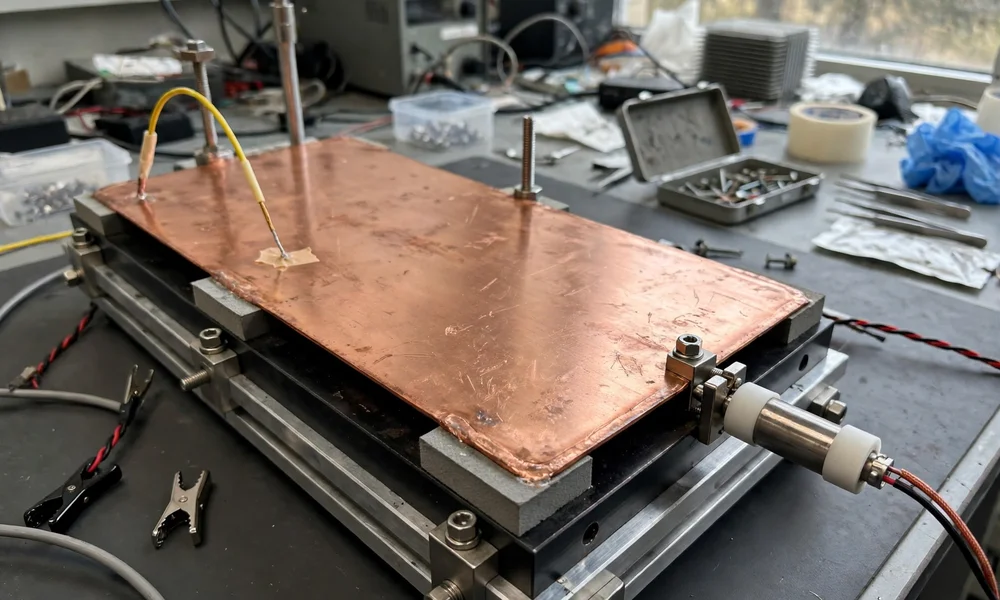
By the end of the line, two sheets of copper, a pinch of copper powder and a few drops of water have become a sealed, silent heat engine that will spend its life hidden inside a laptop, boiling and condensing thousands of times a second without ever being seen. It is one of the most elegant solutions in modern electronics: no fan, no pump, no power — just a vacuum, a wick and boiling water, assembled with the care of a laboratory instrument.


