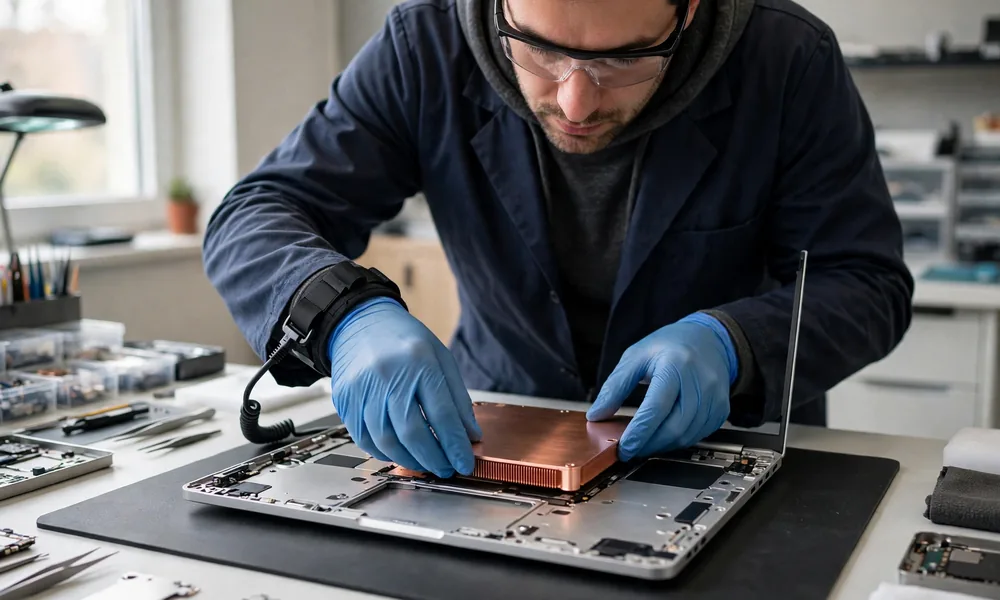
Open a top-end gaming laptop and you will find, spread across the motherboard like a copper blanket, a flat plate that looks almost too plain to be expensive. It has no fan, no wires and no moving parts. It is a vapour chamber, and it is one of the costliest single components inside the machine — sometimes dearer than the memory or the storage.
The job is brutal. A modern laptop chip can throw off more than 100 watts of heat from an area the size of a postage stamp, inside a body barely thicker than a pencil. The heat has to be spread out fast, or the chip throttles and the laptop stutters. A vapour chamber does that job better than anything else that fits, by boiling a tiny amount of water inside a sealed vacuum and letting the vapour carry the heat away.
That is where the money goes. A vapour chamber is a sealed pressure vessel made to tolerances a human hair would ruin, filled with a precise drop of fluid, and tested until it proves it will never leak. The factories that can make them at laptop scale are few, and every chamber is shaped for one specific laptop model. It is a bespoke part, made like a scientific instrument, hiding inside a consumer product.

Why It Costs So Much
Reason 1: The wick is powdered metal, fused in place
The inside of a vapour chamber is lined with a wick — a porous layer of sintered copper powder that pulls condensed water back to the hot spot by capillary action, with no pump at all. Making that wick means spreading fine copper powder evenly inside a thin shell, then heating it in a furnace until the grains fuse into a sponge-like structure. The pore size has to be exactly right: too coarse and the water will not climb back, too fine and the flow chokes. The wick is the most expensive layer of the chamber, and it is hidden inside a part you never see. Anyone curious about how a laptop vapour chamber works will find the wick at the centre of the story.
Reason 2: It is a vacuum vessel thinner than a coin stack
A vapour chamber is a sealed copper envelope with almost all the air pumped out before it is filled. That vacuum is what lets the water inside boil at the temperature of a warm chip instead of at 100 degrees. Holding a vacuum inside a plate only two or three millimetres thick, for the whole life of a laptop, demands a perfect seal. The two copper shells are joined by diffusion bonding or brazing in a clean, oxygen-free environment, and any weak spot becomes a slow leak that kills the chamber months later.
Reason 3: The fluid charge is measured in drops
The water inside a vapour chamber is not poured in; it is dosed with laboratory precision. Too much fluid and the chamber floods, too little and the hot spot dries out and overheats. The correct amount is a fraction of a gram, and it has to be exactly right for that chamber’s size, wick and expected heat load. The filling happens through a tiny tube that is then pinched shut and sealed, all while the vacuum is maintained. A dosing error cannot be fixed afterwards — the part is sealed for good.
Reason 4: Flatness is measured in hundredths of a millimetre
A vapour chamber only works if it sits perfectly flat against the chip it cools. A gap of a few hundredths of a millimetre is enough to trap air, break the thermal contact and send temperatures soaring. So each chamber is pressed, checked on a flatness gauge and, if needed, reworked or scrapped. The copper is soft, the plate is thin, and every handling step risks a dent or a bow. Keeping thousands of chambers flat to this standard is a manufacturing achievement in itself.
Reason 5: Every laptop gets its own shape
Unlike a fan or a screw, a vapour chamber is not a standard part. Each one is cut, bent and pierced to fit one laptop model: around the battery, under the keyboard, past the speakers, with holes for screws and notches for cables. That means a new set of tooling, a new bonding jig and a new test routine for every model, and the cost is spread over that model’s production run alone. The chamber in a flagship gaming laptop is, in effect, a custom-made component.
Reason 6: Leak testing rejects a surprising number
Before a vapour chamber ships, it is tested for leaks with helium or a pressure decay test that can detect a hole far too small to see. A chamber that leaks loses its vacuum, its water boils at the wrong temperature, and the laptop it cools starts throttling within months. The testing is slow and the rejection rate is real — a meaningful share of chambers never leave the factory. Every rejected chamber is wasted copper, wasted wick and wasted furnace time, and the cost is carried by the chambers that pass. The detail in a laptop vapour chamber specifications guide only makes sense once you know how many chambers were thrown away to produce the good ones.

Specifications
| Material | Copper shell, sintered copper powder wick |
| Thickness | 2 to 4 mm in laptops; under 0.5 mm in phones |
| Working fluid | Deionised water, a fraction of a gram |
| Internal pressure | Near vacuum when sealed |
| Effective conductivity | Several thousand W/mK, many times solid copper |
| Weight | 30 to 80 grams, depending on size |
| Heat handled | Typically 80 to 150 watts in a gaming laptop |
| Operating range | About 40 to 100 degrees Celsius at the hot spot |
| Expected life | The life of the laptop, if the seal holds |
| Main drawback | Expensive to make, custom to each model, useless if it leaks |
What Does It Cost?
As rough estimates, the vapour chamber alone in a premium laptop costs around $8 to $25 to make, and the complete cooling assembly — chamber, fans, heat pipes and fins — can cost $30 to $80. Those figures are estimates, not quotes, and they vary with the chamber’s size, the laptop model and the supplier. A replacement cooling module bought as a spare part can cost $60 to $150. Seeing inside laptop vapour chamber production makes the price easier to accept: the part is mostly furnace time, clean-room discipline and rejected chambers, not copper.
A Rare Fact
A vapour chamber moves heat faster than solid copper. Copper is one of the best heat conductors known, at about 400 watts per metre-kelvin, yet a vapour chamber’s effective conductivity can reach several thousand — ten times higher. The trick is that the heat is not conducted through metal at all; it rides on water vapour, which carries far more energy per gram than any solid. The chamber is, in effect, a tiny steam engine running in reverse, moving heat instead of making power.
Vapour chambers cost so much because they are vacuum vessels, precision instruments and custom parts all at once, built to tolerances a hair would ruin and filled with a few drops of water that must last for years. When a laptop stays cool and quiet under a heavy load, with no fan screaming, that silence is the vapour chamber doing its job — and the price is the cost of making something so delicate so reliably, millions of times over.


