Stand in a laser cutting shop at the start of a shift and the first thing that strikes you is how clean it is. There is no shower of grinding dust, no screaming saw, no pile of offcuts the size of a car. There is a flat sheet of steel lying on a bed of steel teeth, a gantry gliding silently above it, and then a point of light so bright you cannot look at it directly. In seconds, that light has drawn a perfect circle through six millimetres of steel, and the disc it cut falls away with an edge so smooth it barely needs finishing. The operator never touched the metal. Light did the work.
Laser cutting has quietly become the default way to shape flat metal. Car body panels, electrical cabinets, kitchen equipment, aircraft brackets and phone frames all start life under a laser head. The process is fast, precise and repeatable in a way that plasma cutting and punching never were, and modern fibre lasers can slice through thick plate at speeds that would have seemed impossible twenty years ago.
How Laser Cutting Metal Is Made
Step 1: Turning a drawing into a cutting path
Every cut begins on a computer, where the part is drawn as a flat pattern and then nested — packed together with dozens of other parts onto a single sheet like pieces of a jigsaw, so as little metal as possible is wasted. The nesting software decides the order of the cuts, placing holes and small details first so the sheet stays rigid while the beam works, and leaving tiny tabs called micro-joints that hold each part in place until the sheet is lifted out.
Step 2: Choosing and loading the sheet
The metal itself arrives as flat sheets, usually mild steel, stainless steel or aluminium, in thicknesses from less than a millimetre to more than twenty. An operator checks the sheet for scratches, rust and warping, because a bent sheet will throw off the focus of the beam, and then loads it onto the cutting bed, a grid of pointed steel slats that supports the sheet while letting the beam pass through the gaps.
Step 3: Setting up the laser and the gas
Before the first cut, the operator sets the power, speed and focus distance for the material and thickness in front of them. A fibre laser works by pumping light through a thin glass fibre doped with rare-earth elements, producing a beam that is focused down to a spot about a tenth of a millimetre wide. That tiny spot concentrates thousands of watts into an area smaller than a pinhead, melting and vaporising the metal instantly. An assist gas blows through the nozzle with the beam, clearing molten metal from the cut and keeping the edge clean.

Step 4: Cutting the sheet
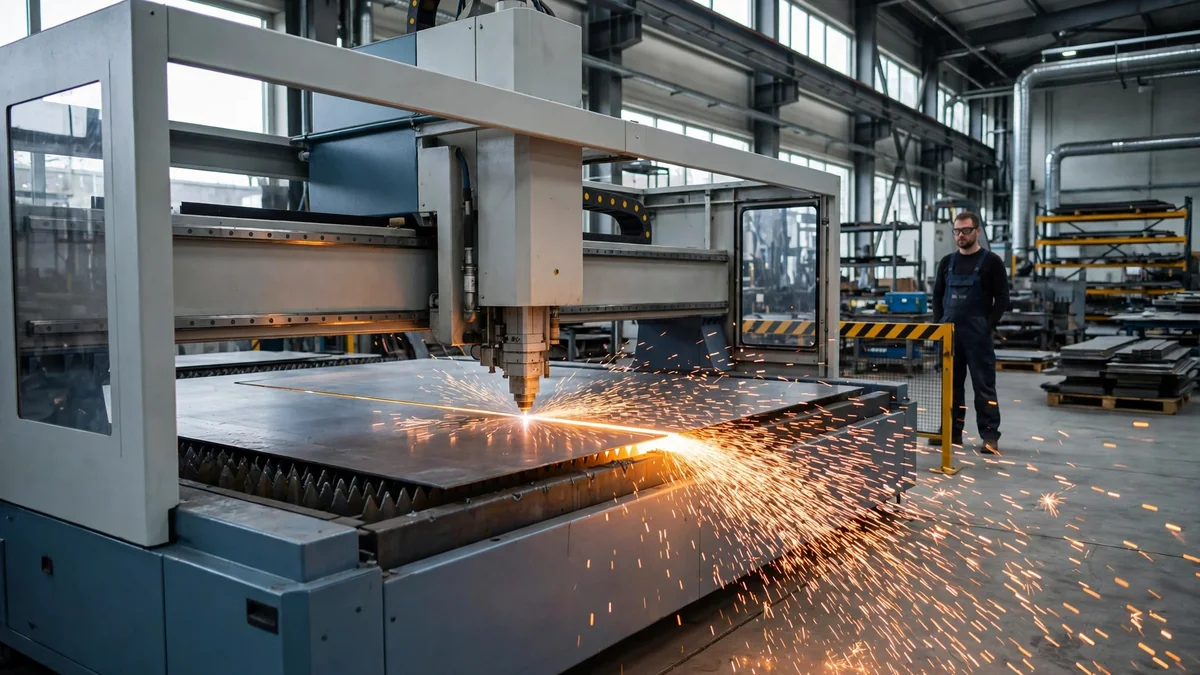
With the program loaded and the enclosure doors closed, the gantry starts to move. The beam traces each outline at speeds that can reach tens of metres per minute on thin material, slowing for corners and tight curves where the heat would otherwise build up and round off the edge. Watching the cut is hypnotic: a bright point of light glides across the sheet, sparks streaming away below, and behind it a clean slot appears. The same obsession with exact movement that drives other precision work — from precision CNC machining to printed metal parts — is what makes a laser cut worth trusting.
Step 5: Removing and separating the parts
When the program finishes, the sheet is lifted out of the machine and laid on a sorting table. Workers tap each part free, breaking the micro-joints by hand or with a rubber mallet, and stack the finished pieces on pallets. The leftover skeleton of the sheet — the web of metal between the parts — goes straight into a recycling bin, and so does the fine metal dust collected by the extraction system.
Step 6: Cleaning and deburring the edges
A laser-cut edge looks finished, but it rarely is. A thin skin of oxidised metal, called dross, clings to the underside of the cut, and the edge itself can be sharp enough to cut a hand. Parts pass through a deburring machine, where abrasive belts or brushes strip the dross away and soften the edges, or a worker does the same job by hand with a file for small batches. Only then is the part safe to handle and ready for the next stage, whether that is bending, welding or painting.
Step 7: Measuring and checking the cut
Before a batch leaves the factory, inspectors measure a sample of parts with callipers, micrometres and sometimes a coordinate measuring machine, checking hole diameters, edge positions and overall dimensions against the drawing. Tolerances of a tenth of a millimetre are routine on a well-set-up laser, and tighter work is possible on thin material. It is a quiet, methodical finish to a process that began with a flash of light — and it is why laser-cut parts fit together the first time, much as metal 3D printing earns its precision through inspection rather than luck.
Laser Cutting Metal at a Glance
| Specification | Typical Value |
|---|---|
| Main laser types | Fibre, CO2, Nd:YAG |
| Typical fibre laser power | 1–20 kW, higher for thick plate |
| Beam spot size | About 0.1 mm |
| Cutting thickness | Up to about 25 mm steel, 30 mm aluminium |
| Typical tolerance | ±0.1 mm on thin sheet |
| Assist gases | Oxygen, nitrogen, compressed air |
| Key advantage | Fast, precise, minimal tooling, low waste |
What Does It Cost?
Laser cutting is priced by the minute as much as by the part. A small industrial fibre laser machine costs roughly $150,000 to $500,000 (estimates), while a high-power system for thick plate can exceed $1 million (estimates). For the customer, a simple bracket might cost $1–$5 per cut piece in volume (estimates), while a large, intricate stainless panel can cost $50 or more (estimates). The biggest cost drivers are material thickness, cutting time and the price of the sheet itself, and that is why nesting matters so much: every square centimetre of sheet saved is money kept.

A Rare Fact
The first industrial lasers cut diamonds, not steel — and the very first laser cutting machines of the 1960s were used to drill holes in diamond dies for drawing wire, because only light could pierce a diamond without shattering it. From that tiny, precious beginning grew a process that now cuts the steel in your car and the frame of your phone. The same light that once shaped gemstones now shapes entire factories, and it still works the same way: a beam narrower than a hair, hot enough to melt steel, guided by a computer that never blinks. It is a reminder that the most violent-looking process in the factory is also the most delicate, and that the discipline of a clean cut runs through everything from laser work to titanium phone frames — different machines, same obsession with the edge.


