There is a room inside a liquefied natural gas carrier that is bigger than a cathedral, colder than the coldest winter on Earth, and built to hold a liquid that would boil away if you so much as looked at it warmly. It has no windows, no doors you would recognise, and walls made of steel so thin you could dent them with a hammer — yet those walls hold back an ocean of fuel worth tens of millions of dollars, and they do it while the ship rolls, pitches and flexes around them.
That room is an LNG carrier tank, and it is one of the strangest structures in shipbuilding. Natural gas becomes a liquid only when it is cooled to about minus 162 degrees Celsius, and at that temperature it shrinks to about one six-hundredth of its volume as a gas, which is what makes shipping it by sea possible at all. The tank’s job is to keep it that cold and that safe, for weeks at a time, in the middle of the ocean.
A large LNG carrier has four or five of these tanks, each one holding tens of thousands of cubic metres, and they are built inside the ship’s hull while the ship itself is still under construction. Our guide to how LNG carrier tanks are made explains the design and the science; this is the production story — the stages a tank goes through, from bare steel hull to a gleaming, insulated, tested container ready for its first cargo.

Building LNG Carrier Tanks
Step 1: Preparing the hull space
The work starts with the space itself. The ship’s inner hull is built first, a steel box with flat floors and sloping sides, and the factory checks every surface for flatness and cleanliness before anything else goes in. The space is measured again after painting, because the insulation panels are cut to the exact shape of the hull, and a millimetre of error here becomes a gap there. The hull steel is painted with a protective coating, and the space is kept dry and covered, because the insulation that follows hates damp more than almost anything.
Step 2: Fitting the insulation
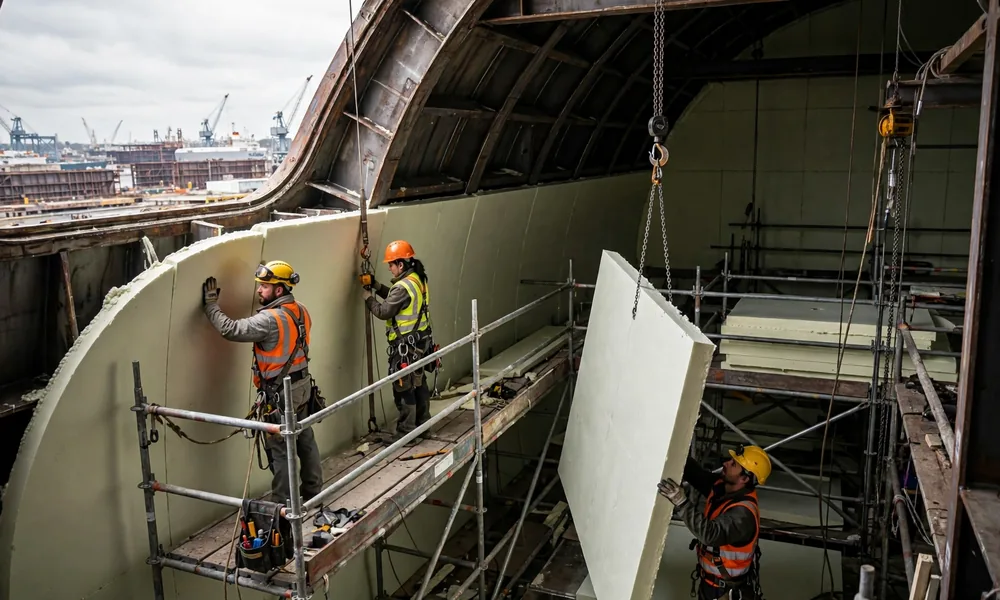
The insulation goes in next, in thick panels of foam and plywood that are glued and pinned to the hull in layers. This is not ordinary insulation: it has to work at minus 162 degrees, stay strong under the weight of thousands of tonnes of liquid, and survive the ship flexing in a storm. The panels are fitted tight, with no gaps, and every joint is sealed, because a gap is a path for heat, and heat is the enemy.
Step 3: Installing the membrane
Over the insulation goes the membrane, the thin skin that actually touches the liquid gas. On the most common design it is made of a special stainless steel alloy, only about a millimetre thick, pressed into a pattern of small raised corrugations. The corrugations are the clever part: the steel shrinks dramatically when it gets cold, and the folds give it room to contract without tearing. Workers lay the membrane in sheets, weld the seams with extreme care, and check every weld, because a leak in the membrane lets liquid gas into the insulation, where it does not belong.
Step 4: Fitting the pump tower and pipes
Once the membrane is in, the pump tower goes up. This is a tall steel column that stands in the middle of the tank, carrying the cargo pumps that will empty the tank at the far end, and the pipes and ladders that serve it. The tower is built in sections, lowered in through the top of the tank, and bolted and welded into place, with its own insulation and guides. The pipes that run from the tank to the deck are fitted at the same time, with expansion loops that let them shrink in the cold without pulling on their joints.
Step 5: Testing for leaks
Before the tank is closed up, it is tested. The factory fills it with a harmless gas and watches for leaks with sensitive detectors, going over every weld and every joint, and the membrane is checked again for damage from the work going on around it. Any weld that fails is cut out and redone, not patched, because a patch is a weak point in a wall that must stay perfect. A tank that passes its cold test has proved it can take the temperature it will live at, and only then is it dried out, sealed and handed over as ready.
Step 6: Final checks and handover
The last step is paperwork and proof. Inspectors from the ship’s classification society walk the tank, review the welding records, the insulation measurements and the leak test results, and sign the tank off for service. When the first cargo of liquefied gas is finally aboard, the tank settles into its working life: cold, quiet, and almost invisible to everyone except the engineers who built it.
LNG Carrier Tank Specs
| Specification | Typical range |
|---|---|
| Cargo temperature | About minus 162 degrees Celsius |
| Tank capacity | About 30,000 to 45,000 cubic metres per tank on a large carrier |
| Number of tanks | Usually four or five per ship |
| Membrane material | Stainless steel alloy, about 0.7 to 1.2 mm thick, corrugated |
| Insulation | Layered foam and plywood panels, about 300 to 500 mm thick |
| Boil-off rate | About 0.1 percent of cargo per day on a modern carrier |
| Ship capacity | About 150,000 to 180,000 cubic metres of LNG in total |
| Build time per tank | Several months, built inside the hull during construction |
What Does an LNG Carrier Tank Cost?
A single LNG carrier tank system, including insulation, membrane, pump tower and testing, is estimated to cost roughly $15 million to $40 million, depending on size, design and yard. A single cargo of LNG can be worth tens of millions of dollars, which is why owners accept the cost of building the tanks properly. A whole LNG carrier, with four or five tanks and the ship around them, is estimated at $200 million to $300 million or more. Prices are estimates only and vary by yard, steel prices, design and the number of ships ordered.
A Rare Fact
Cooling natural gas to a liquid shrinks it to about one six-hundredth of its volume as a gas. Without that shrink, no ship could carry enough gas to make the voyage worthwhile. The trade-off is the cold. At minus 162 degrees, ordinary steel turns brittle as glass, which is why an LNG tank is lined with a special alloy and wrapped in insulation thick enough to keep the ship’s own steel warm.

An LNG tank is a contradiction made of steel: a room that must be colder than anywhere on Earth outside a laboratory, built inside a ship that sails through the tropics, holding a cargo that would rather be a gas. The factory that builds it succeeds by being fussy — clean floors, tight insulation, careful welds, patient cooling — because the cold forgives nothing. The hull around the tanks is covered in our guides to how a container ship hull is made and inside container ship hull production. When the ship finally sails with its tanks full, the cold stays where it belongs, the gas stays liquid, and the strangest room on the ship does its job in silence.


