Natural gas is a ghost. At room temperature it drifts away invisibly, impossible to carry in any useful amount. But cool it to minus 162 degrees Celsius and it shrinks into a clear, cold liquid six hundred times smaller than the gas it came from — and suddenly a single ship can carry enough fuel to heat a city for a month. The ships that do this are LNG carriers, and the heart of each one is a set of enormous tanks that hold that cold liquid for weeks at a time. Building those tanks is one of the strangest jobs in all of shipbuilding.
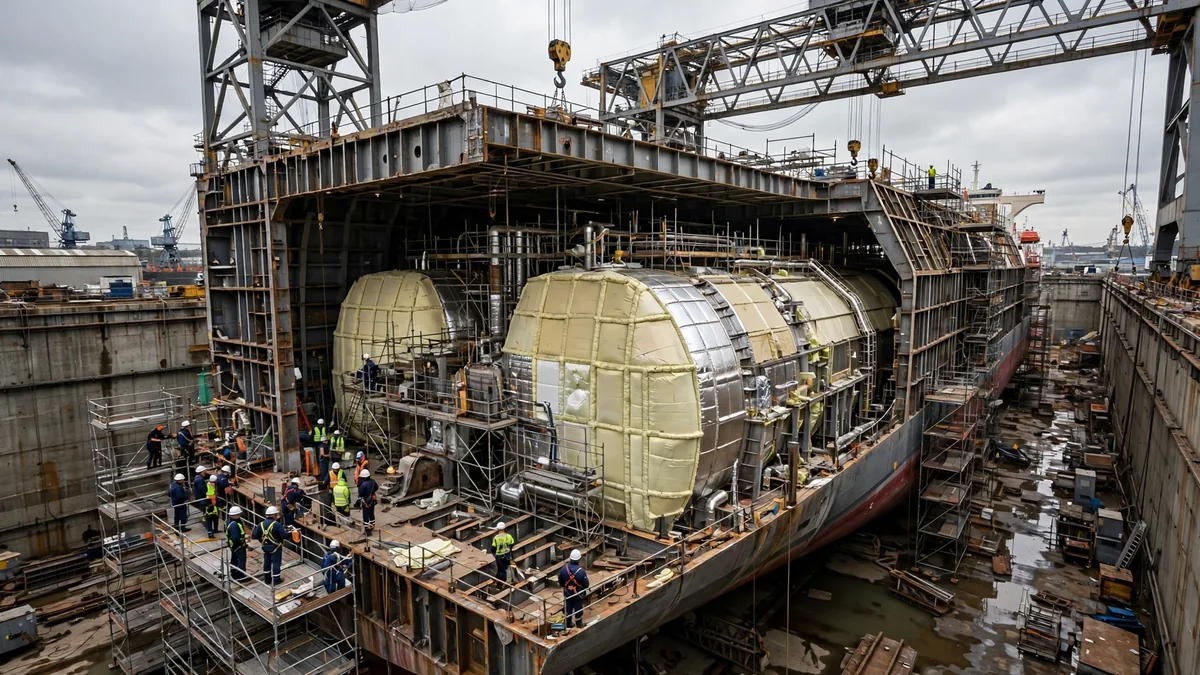
An LNG tank is not a steel box with cold liquid poured in. It is a thermos flask the size of a house, built inside the hull of a ship, layer upon layer of steel, insulation and wood, each layer doing a job the others cannot. The tank must also survive the constant flexing of a hull at sea, and the shock of being filled with liquid cold enough to shatter ordinary steel like glass. This is how that tank is made.
How It’s Made
Step 1: Choosing the tank design
The build begins with a choice. Most modern LNG carriers use one of two designs: the membrane tank, a thin stainless steel skin held against the inside of the hull by layers of insulation, or the spherical Moss tank, a giant aluminium ball that sits in the hull like an egg in a cup. The choice shapes everything that follows, from the steel ordered to the yard that builds it.
Step 2: Preparing the hull and the insulation
Before a single tank panel is fitted, the inside of the hull is prepared. Then the insulation goes in: thick panels of reinforced foam and plywood, laid in two layers, each panel cut to fit and glued in place. The foam is the secret of the whole ship — it is so good at stopping heat that a tank full of liquid gas loses less than a tenth of a percent of its cargo to boiling each day.
Step 3: Building the membrane or the sphere
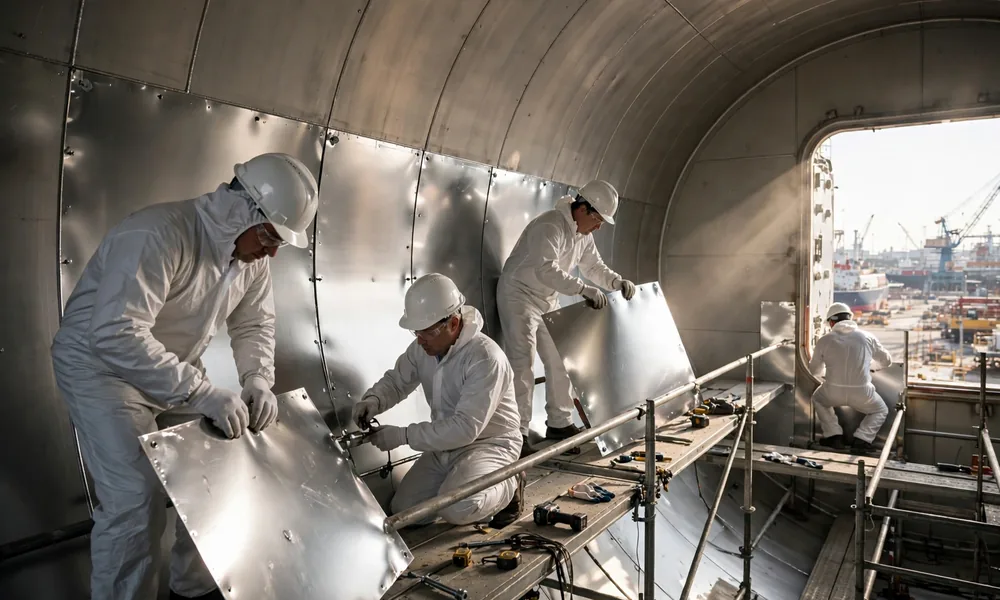
On a membrane ship, the next layer is the primary barrier: thin sheets of stainless steel, or of a special nickel-steel alloy called Invar that barely changes size when it gets cold. The sheets are welded together into a continuous skin only a millimetre or two thick, corrugated like a washboard so it can shrink and stretch as the tank cools down and warms up. On a spherical ship, curved aluminium plates are welded into a ball tens of metres across, then lifted by crane into the hull, where it rests on a single ring. The same yards that build these tanks also build the great hulls that carry them, as in container ship hull construction.
Step 4: Welding and leak-testing every seam
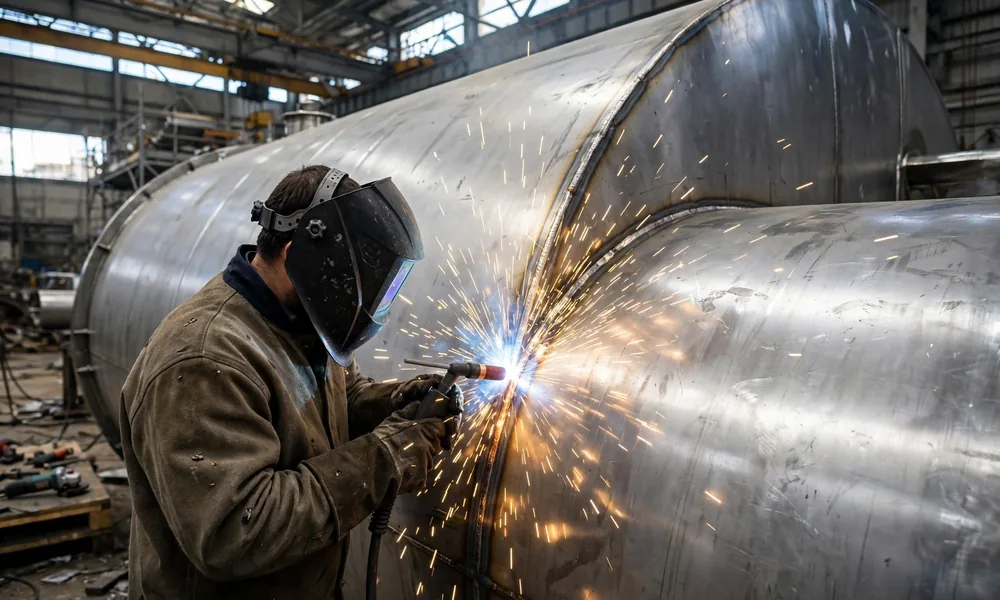
Every weld in an LNG tank is tested. Inspectors run ultrasound and X-ray checks along the seams, and then the whole tank is sealed and filled with a harmless gas to hunt for the smallest leak. On membrane tanks, a second barrier sits behind the first, with sensors between the two layers that can smell a leak of gas long before it becomes dangerous. The tank must be proven tight before it is ever allowed near real cargo.
Step 5: Fitting the pumps, pipes and safety systems
A tank that cannot be filled or emptied is useless, so the next step is the machinery. Deep-well pumps are lowered into the tank on long shafts, reaching down to the very bottom so the last drop of cargo can be pumped out. Pipes run from the tank up through the deck to the loading arms on the jetty, and every pipe is insulated and fitted with valves that close automatically if anything goes wrong. Sensors watch the temperature, the pressure and the level of the liquid, and a gas detection system watches the spaces around the tank around the clock. The fitting draws on the same skills used in cruise ship engine rooms, where pipes and pumps must work for weeks without a stop.
Step 6: Cooling the tank down for the first time
The most delicate moment in a tank’s life is its first cool-down. It cannot simply be filled with liquid at minus 162 degrees: the shock would crack the steel and tear the insulation. Instead the tank is cooled slowly, over several days, first with cold nitrogen gas, then with a spray of LNG that chills the metal degree by degree. The steel shrinks as it cools — a large tank can contract by more than a metre in length — and the corrugations in the membrane, or the flexible skirt of the sphere, take up the movement.
Step 7: The first loading and the maiden voyage
With the tank cold and proven, the ship sails to a loading terminal and takes on its first cargo. Loading is slow and careful: the liquid is pumped in over many hours while the crew watches the temperatures and the boil-off gas, which is captured and used as fuel for the ship’s own engines. The steel hull was shaped by the same heavy fabrication behind superyacht steel hull work, only here the steel must do its job at temperatures that would freeze the sea itself.
Specs
| Specification | Typical figure |
|---|---|
| Cargo temperature | Minus 162°C (liquid natural gas) |
| Tank types | Membrane (stainless steel or Invar) or spherical Moss (aluminium) |
| Tank capacity | About 40,000 to 50,000 cubic metres per tank |
| Ship capacity | Typically 150,000 to 180,000 cubic metres, up to about 266,000 |
| Insulation | Two layers of reinforced foam and plywood, 250 to 500 mm thick |
| Boil-off rate | About 0.1% of cargo per day or less |
| Cool-down time | Several days from ambient to minus 162°C |
| Design life | 30 to 40 years |
Price
An LNG carrier tank is never sold on its own, and shipyards do not publish a price for one. As an estimate, a complete set of tanks and insulation for a large LNG carrier typically costs roughly $50 million to $100 million, within a whole ship costing roughly $200 million to $260 million — these are estimates, and the final figure depends on the tank design, the ship’s size and the yard. The tanks are the most expensive single system on the ship after the hull itself, and they are the reason an LNG carrier costs far more than an ordinary cargo ship of the same size.
A Rare Fact
When the first LNG carriers were designed in the 1950s, many engineers thought the tanks would be impossible: no one believed a ship could carry a liquid colder than the Arctic winter without the steel cracking apart. The breakthrough was Invar, a nickel-steel alloy discovered in the 1890s for clock pendulums, which barely expands or contracts with temperature at all. A membrane of Invar only a fraction of a millimetre thick can sit in liquid gas for decades without tearing.
From a warm steel hull to a floating thermos colder than the coldest place on Earth, the LNG tank is a quiet triumph of insulation and patience.


