Stand on the dock beside a container ship and the hull above you looks less like a machine than a cliff. It is four storeys high, longer than three football pitches, and it carries ten thousand steel boxes across oceans that would tear a lesser structure apart. Yet every square metre of that cliff was once a flat steel plate, cut, bent and welded by hand in a shipyard.
The scale is hard to grasp until you walk inside a hull under construction. The steel is thick enough to stop a truck, the welding seams run for kilometres, and the whole structure must be watertight to the millimetre. A hull that leaks or cracks in heavy weather is a disaster, which is why building one takes months, thousands of workers and a production line that treats a 200,000-tonne ship like a precision instrument.
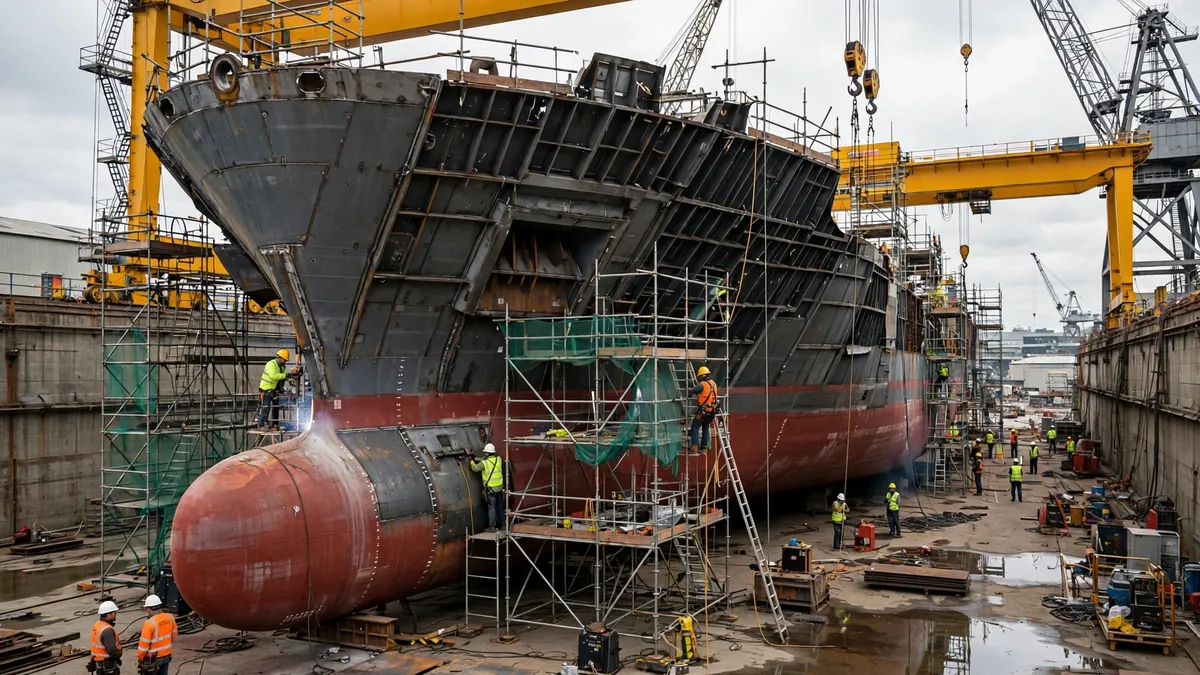
How a Container Ship Hull Is Made
Step 1: Designing the hull
Every hull starts on a computer, long before any steel is cut. Naval architects shape the hull to slice through water with as little resistance as possible, balancing speed against fuel use and cargo space. The bow gets a bulbous shape below the waterline to cancel out the bow wave, and the stern is shaped around the propeller and rudder. The design is tested in towing tanks with scale models and in software that simulates waves and stresses. Then the yard orders thousands of tonnes of steel, in grades chosen for strength and resistance to cracking in cold water. The way the hull is shaped decides how the finished ship behaves at sea, which is why the container ship hull in service performs the way it does.
Step 2: Cutting and shaping the plates
Steel arrives at the yard as flat plates, some as large as a living room and up to 40 millimetres thick. Computer-controlled plasma and laser cutters slice them to exact shapes, following the lines of the design. Then the plates are bent. Thick plates go through giant rollers and presses that curve them into the shapes of the bow and stern, while thinner plates are shaped by line heating, where a flame moved along a marked line makes the steel bend as it cools. Each plate is checked against a template before it moves on.
Step 3: Building the blocks
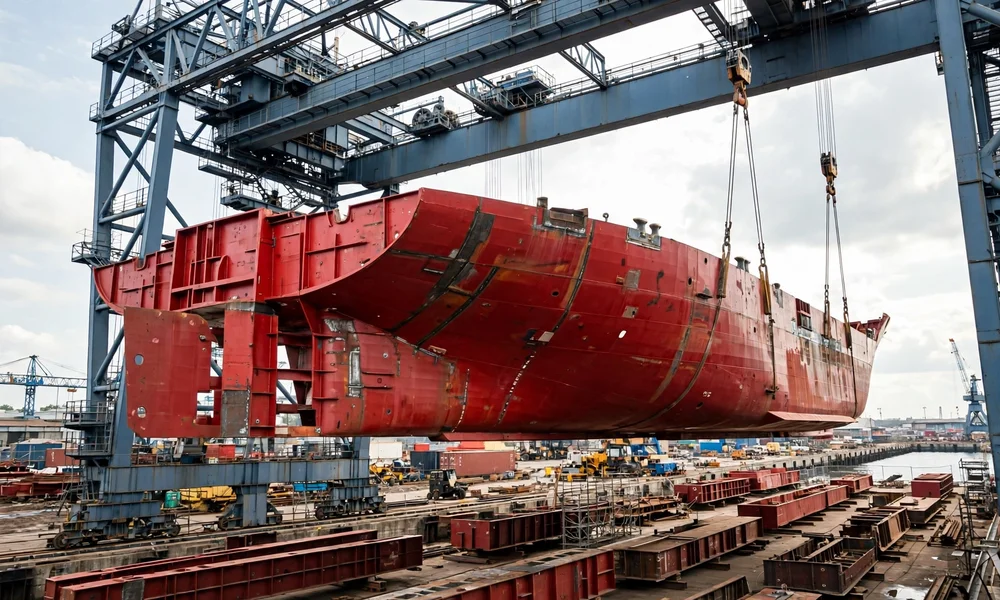
A modern hull is not built plate by plate in the dock. It is built as blocks, each a three-dimensional chunk of the ship weighing hundreds of tonnes, assembled in a covered hall. Inside a block, workers fit frames, stiffeners and deck sections, welding them into a rigid box. Pipes, cable trays and stairways are fitted while the block is still upside down or on its side, where access is easy. Each block is painted inside and inspected before it leaves the hall. Building in blocks lets a yard assemble a giant hull in months rather than years, and most of the welding happens under a roof, in the dry, where quality is far easier to control.
Step 4: Welding the blocks together
When the blocks are ready, the largest gantry cranes in the yard lift them into the dry dock and lower them into place, one after another, like pieces of a jigsaw. The joints between blocks are welded by teams working in shifts, often inside the hull in cramped, hot compartments. Welders use flux-cored wire and submerged arc welding for the long straight seams. The work is checked constantly: ultrasonic testing finds flaws hidden inside the metal, and X-ray checks are used on the most critical joints. A single bad weld in the wrong place can be the difference between a hull that lasts thirty years and one that cracks.
Step 5: Fitting the bow, stern and propeller spaces
With the main hull joined, the yard fits the parts that make the ship steer and move. The bulbous bow is welded on at the front, the stern frame is fitted around the propeller shaft, and the rudder is hung on its bearings. The engine room spaces and the ballast tanks are closed up and tested for leaks. The underwater part is then blasted clean and coated with anti-corrosive and antifouling paint that stops marine growth clinging to the steel. The coating matters: a fouled hull burns far more fuel on every crossing, so the paint thickness is measured panel by panel.
Step 6: Launching and floating out
When the hull is complete and watertight, the dry dock is flooded and the ship floats for the first time. The hull’s weight, balance and draught are measured against the design, and any list or trim problem shows up immediately. Tugs move the floating hull to a fitting-out quay, where the superstructure, cranes and cargo gear are installed while the ship is completed around it. The full dimensions and figures for the finished structure are set out in the container ship hull specifications.
Step 7: Sea trials and delivery
Before the ship is handed over, it goes to sea. Sea trials test everything the hull was designed to do: speed, fuel consumption, turning, stopping and behaviour in waves. Surveyors check for leaks, vibration and noise against the contract. If the ship is slower than promised, the yard pays a penalty; if it is faster, it earns a bonus. Only when the trials pass does the owner accept the ship. From first steel cut to delivery, a large hull takes around a year to build, and the ship it becomes will work for twenty-five to thirty years.

Container Ship Hull at a Glance
| Specification | Typical Value |
|---|---|
| Main material | High-tensile marine steel, up to 40 mm thick |
| Length | About 300–400 m on the largest container ships |
| Deadweight | Up to about 200,000 tonnes fully loaded |
| Build time | Around 12 months from first steel cut to delivery |
| Construction method | Block construction, welded in a dry dock |
| Coating | Anti-corrosive and antifouling paint below the waterline |
| Service life | About 25–30 years of ocean crossings |
What Does It Cost?
A container ship hull is not sold separately from the ship, but the hull structure is the single biggest cost in building one. A large container ship costs roughly $150–$200 million (estimate) to build, and the steelwork accounts for a large share of that, with the steel alone running into tens of thousands of tonnes. The price swings with the cost of steel and the ship’s size: a smaller feeder vessel can cost $30–$50 million (estimate). Spread over thirty years of carrying cargo, the hull is cheap per container — if it is built right the first time. For a closer look at how the structure is put together, see how a container ship hull is made, step by step.
A Rare Fact
The largest container ships are so long that the hull itself flexes as it moves through waves — the bow and stern can rise and fall by metres relative to the middle, and the steel is designed to bend rather than break. Yards measure this flexing, called hogging and sagging, during sea trials, and the hull is built with extra strength where the bending is greatest. A ship that could not flex would crack; one that flexes too much would tear itself apart. The hull is, in effect, a giant steel spring.