Picture two electric cars pulling into the same charging station on a cold morning. Both plug in at the same time. One driver is back on the road in eighteen minutes with most of a battery restored. The other is still sitting there half an hour later, watching the percentage climb slowly. The batteries are roughly the same size. The charger is the same. The difference is invisible, buried in the wiring, the inverter and the pack itself: one car runs on an 800-volt electrical system, and the other runs on 400 volts.
That single number has become one of the most talked-about specifications in the electric car world. Porsche put the first production 800-volt system on the road in the Taycan in 2019. Hyundai made it mainstream with its E-GMP platform, underpinning the Ioniq 5, the Kia EV6 and the EV9. Lucid pushed further still, with a system running above 900 volts.
An 800-volt EV platform is not a bigger battery or a faster charger. It is a decision about the voltage at which the whole high-voltage system operates: the battery pack, the inverter, the motor, the charging port and the cables between them. Double the voltage, and the same power flows at half the current, and that simple trade reshapes almost everything about how an electric car charges, drives and is built.

How It Works
Step 1: Power is voltage times current
Every electrical calculation in an electric car starts with one equation: power equals voltage multiplied by current. To deliver 350 kilowatts of charging power at 400 volts, a system must push about 875 amps through its cables. Do the same job at 800 volts and the current falls to roughly 440 amps. The power is identical. The current is halved. That matters because current is the expensive half of the equation: it is current that heats cables, that forces connectors to be thick and heavy, and that sets the practical limits of a charging plug.
Step 2: Heat falls by three quarters
The heat generated in a cable rises with the square of the current, a relationship engineers write as I squared R. Halve the current and the resistive heating falls to a quarter of what it was. That is the whole case for 800 volts in one sentence. Less heat means the battery can accept high charging power for longer without the thermal management system throttling it back to protect the cells. It means thinner, lighter copper cables running through the car, saving weight that would otherwise eat into range. And it means the charging curve stays flatter: instead of a brief peak followed by a long taper, an 800-volt car can hold near its peak rate deep into the charge, which is what actually shaves minutes off a stop.
Step 3: Twice as many cells in series
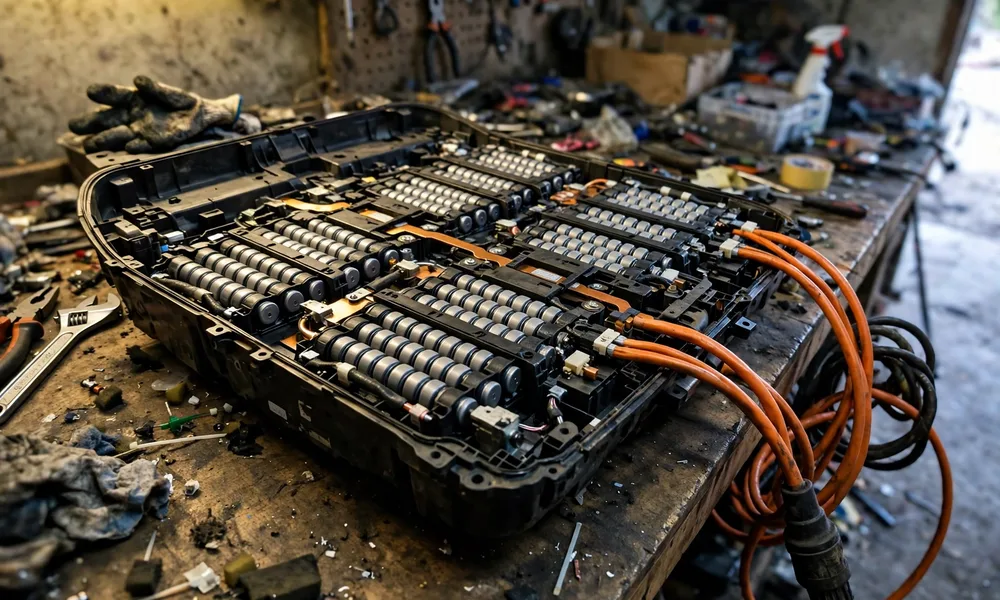
The voltage does not come from nowhere. A single lithium-ion cell produces only about 3.7 volts, so a pack reaches its system voltage by wiring cells in series, one after another, so their voltages add up. A 400-volt pack strings roughly 96 to 108 cells in series. An 800-volt pack strings about twice as many: around 192 cells in the Hyundai E-GMP pack and 198 in the Taycan. The pack is physically rearranged, not just relabelled, and everything downstream is built for the higher class. In practice the labels are approximate. A 400-volt-class pack actually operates across roughly 300 to 500 volts as it charges and discharges, while an 800-volt-class pack runs roughly 600 to 900 volts.
Step 4: The inverter switches faster and cooler
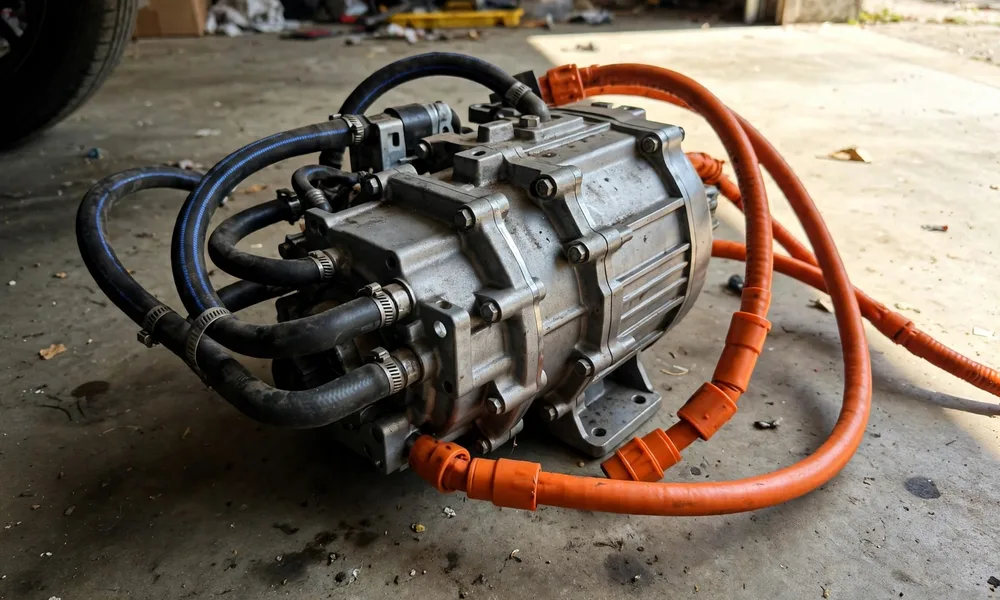
The inverter, which turns the battery’s direct current into the alternating current the motor needs, has to cope with the higher voltage without wasting energy as heat. That job increasingly falls to silicon carbide, a semiconductor material that handles high voltage efficiently and conducts heat far better than ordinary silicon. The parts that switch the current inside the inverter are described in the silicon carbide inverter specs, and they are one of the quiet enablers of the whole 800-volt idea.
Step 5: Charging at 350 kilowatts
At a suitably powerful charger, the difference becomes concrete. Hyundai quoted its E-GMP cars at up to 350 kilowatts, taking the battery from 10 to 80 percent in about 18 minutes. The updated Taycan charges at up to 320 kilowatts, covering the same 10 to 80 percent window in about 18 minutes. But voltage alone does not set charge time. Cell chemistry, battery temperature, the state of charge and the charger itself all matter, and a well-engineered 400-volt car can out-charge a poorly cooled 800-volt one. The cable and the connector also have to keep up, and the hardware that carries the current into the car is explained in the fast charging cable specs, where liquid cooling and thick conductors do the heavy work at the plug.
Step 6: The 400-volt problem
There is a catch, and it is a practical one: most fast chargers in the world were built for 400-volt cars. An 800-volt car arriving at an older 400-volt charger cannot simply plug in and charge at full speed; the charger cannot produce the higher voltage the car expects. Carmakers solve this in different ways. Porsche fitted the Taycan with a charge booster, an extra converter that steps 400 volts up to 800, adding cost and complexity. Hyundai’s solution is more elegant: the E-GMP platform borrows the rear motor and its inverter to step the voltage up, using hardware the car already carries.
Specs
| Specification | Typical value |
|---|---|
| System voltage (nominal) | About 800 volts |
| Operating voltage window | Roughly 600–900 volts |
| Cells in series | About 192–198 |
| Peak DC charging power | Up to about 350 kW |
| 10–80% charge time | About 18 minutes |
| Current at 350 kW | About 440 amps |
| Resistive heating vs 400 V | About one quarter |
| Key semiconductor | Silicon carbide (SiC) |
| First production car | Porsche Taycan, 2019 |
What Does It Cost?
An 800-volt system costs more to build than a 400-volt one, and the premium sits in the components rather than the battery cells. Insulation must be thicker, contactors and connectors must be rated for the higher voltage, and the silicon carbide power electronics cost more than their silicon equivalents. Carmakers accept the cost because it buys something buyers notice every week: shorter charging stops, lighter cabling and a drivetrain that runs cooler and more efficiently. The motors that benefit from the higher voltage are covered in the best electric motors for EVs, where efficiency gains of a few percent translate directly into extra miles from the same battery.
A Rare Fact
Here is the detail most people miss: an 800-volt car can charge more slowly than a 400-volt car, and sometimes does. Voltage is only half of the power equation, and the other half is current, which is limited by the charger, the cable, the battery temperature and the cells themselves. A cold 800-volt battery on a winter morning may accept less power than a warm 400-volt battery on a summer afternoon. The voltage class opens the door to very fast charging, but the battery and its thermal management decide whether the car walks through it.


