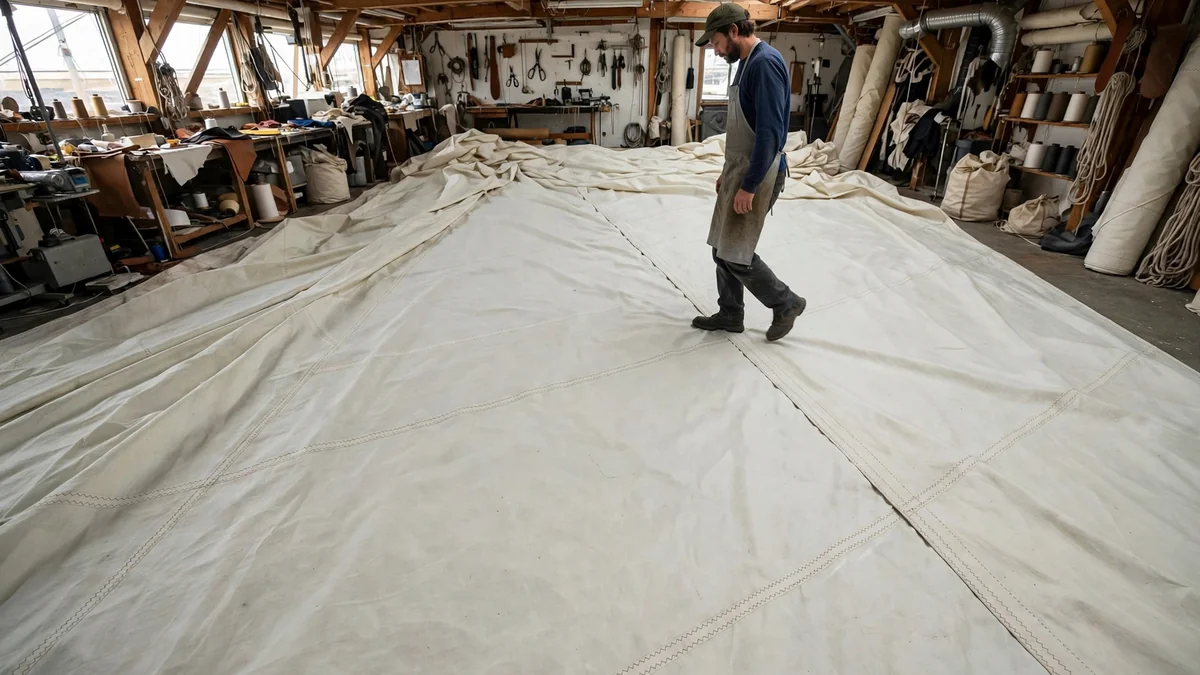
On a still morning in a sail loft, a sail the size of a tennis court lies spread across the floor, and a sailmaker walks its length, checking every seam by hand. The cloth is not white the way a bedsheet is white. It is a pale, technical grey, woven from fibres stronger than steel by weight, When finished, this sail will pull a yacht worth millions across an ocean, silently, with nothing but wind. A luxury yacht sail looks like a simple triangle of cloth, but it is one of the most precisely engineered things on the boat.
The hard part is that a sail is not a flat sheet. It is a wing, and like a wing it has to hold a curved, three-dimensional shape while the wind tries to tear it apart. Get the curve wrong and the yacht is slow; get the cloth wrong and it stretches and loses its shape after one season. Building a sail means choosing fibres, weaving or laminating them into a cloth that stretches in one direction and not the other, cutting dozens of panels, and stitching them into a shape that only exists properly when the wind fills it. This is how a luxury yacht sail is made.
How It’s Made
Step 1: The sail is designed on a computer
Long before any cloth is cut, the sail is designed in software. The designer enters the yacht’s rig, the size of the mast and boom, the expected wind range, and how the owner sails, whether racing hard or cruising gently, and the program shapes the sail in three dimensions. It calculates the curve, called the camber, that the sail should hold at different heights, and it maps the loads, because the forces are not even: the corners take enormous strain, while the middle of the sail takes far less. Only when the digital sail flies correctly on screen does the loft begin cutting.
Step 2: The cloth is chosen and laid out
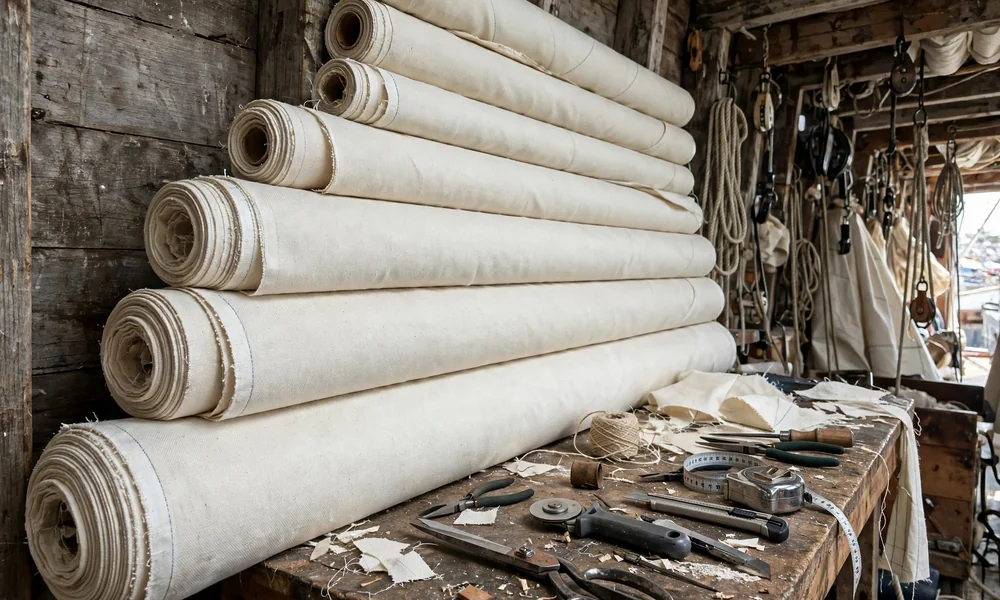
The cloth is the soul of the sail, and a luxury yacht uses materials a long way from the cotton canvas of a century ago. The most common choice is a woven polyester called Dacron, tough, forgiving, and long-lived, while racing and high-end cruising sails use laminated cloths, where layers of film are bonded to fibres of carbon, aramid, or Dyneema that run in the directions the loads travel. The cloth is unrolled on the loft floor in long lengths, and the sailmaker checks it for flaws, marks the panel lines, and plans the layout so the strongest direction of the cloth lines up with the strongest loads.
Step 3: Panels are cut and broadseamed
The sail is made from dozens of horizontal panels, and each one is cut to a slightly different shape. The panels are not rectangles: their edges are curved, so that when they are sewn together the finished sail bulges into its designed three-dimensional shape, a technique called broadseaming. The cutting is done with a computer-guided knife or a hot knife that seals the edge as it cuts, and the panels are laid out in order on the floor like a giant jigsaw.
Step 4: The sail is sewn and glued
Sewing a sail is heavy work. The panels are joined on long-arm sewing machines with strong, ultraviolet-resistant thread, and the seams are sewn two or three times, with the stitching zigzagged so the load spreads across the cloth rather than tearing along a single line. The corners are the critical point: layers of extra cloth are built up at the tack, the clew, and the head, where the sail attaches to the boat, and stainless steel rings or webbing straps are sewn in to take the load.
Step 5: The sail is tested, measured, and delivered
Before the sail leaves the loft, it is laid out flat and measured against the design, corner to corner and seam to seam, and any panel that has pulled out of shape is corrected. Then it goes to the boat, is hoisted for the first time, and the sailmaker watches from the dock or the deck as it fills with wind, checking the shape, the curve, and the way it sets. Sail power itself has a longer story than most owners realise, and there is a good case that it deserves a second look in an age of engines, as argued in why sail power deserves a second chance. The mast that carries all of this is an expensive piece of engineering in its own right, as explained in why the yacht carbon mast is so expensive. The rigging that holds the sail up is a whole engineering subject of its own, as described in yacht sail rigging materials engineering, and sail and rigging must be designed together. Only when the sail sets cleanly and the yacht balances does the loft sign it off.
Luxury Yacht Sail Specifications
| Specification | Typical figure |
|---|---|
| Sail area | About 80 to 300 square metres for a large yacht |
| Cloth weight | About 200 to 400 grams per square metre |
| Cloth fibres | Polyester, carbon, aramid, or Dyneema laminates |
| Number of panels | About 20 to 60, depending on size |
| Battens | Usually 4 to 7, fibreglass or carbon |
| Expected life | About 8 to 15 years with care |
| Build time | Several weeks from design to delivery |
How Much Does a Luxury Yacht Sail Cost?
A sail for a luxury yacht is a major purchase, because the cloth is expensive, the labour is skilled, and the sail is custom-made for one boat. Industry estimates put a mainsail for a large cruising yacht at roughly $20,000 to $80,000 (estimate), while a full suit of sails for a superyacht can cost $150,000 to $500,000 (estimate) or more, depending on size and materials. A racing laminate sail costs far more per square metre than a cruising Dacron sail, but it holds its shape longer and makes the yacht faster.
A Rare Fact About Luxury Yacht Sails
Here is something few sailors realise: a modern sail is deliberately designed to stretch, just in the right places and by the right amount. The cloth is engineered so it gives slightly along the leech in a gust, spilling a little wind and protecting the rig, while staying rock-stiff along the load paths from corner to corner. If it stretched evenly it would bag out and lose its shape, and if it did not stretch at all it would shock-load the mast. The sail is, in effect, a spring tuned by its weave, and that controlled stretch is what lets a yacht sail fast without tearing itself apart.
So the next time you see a yacht gliding across the water with its sail full and silent, remember what is holding that curve: software that shaped it, cloth woven from fibres stronger than steel, dozens of panels sewn with a deliberate bulge, and a sailmaker who checked every seam by hand. A luxury yacht sail is not a sheet of cloth. It is a wing, built to fly on nothing but wind, and it is the oldest and quietest engine a yacht will ever have.