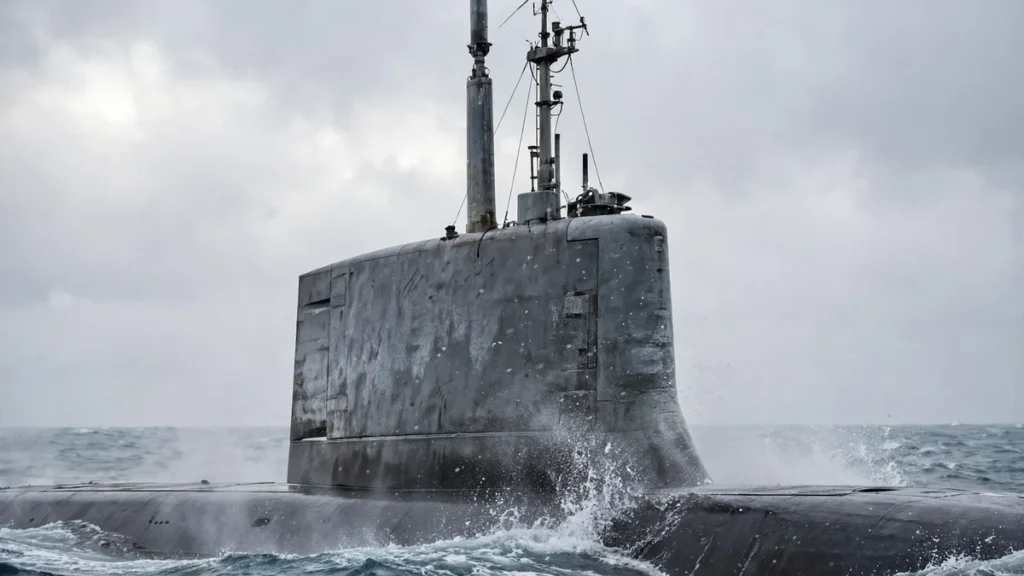
Every ship, from a small ferry to a floating city of a cruise liner, is steered from one room. It sits at the very front of the top deck, wrapped in glass, high above the bow, and from it the captain can see the whole horizon. It is the bridge, and it is the one place on a ship where a mistake is measured in minutes and metres. Yet the bridge begins as an empty steel box in a shipyard, and turning it into the nerve centre of a ship takes months of fitting, wiring and testing.
A modern bridge is a strange mixture of old and new. The windows are still its most important feature, just as they were a hundred years ago, because no screen can replace a captain’s own eyes. But behind the glass sits a forest of electronics: radar, satellite navigation, engine controls and radios, all wired into consoles that must work in a storm, in the dark, and after years of salt air. This is how that room is made.

How It’s Made
Step 1: Building the bridge block
The bridge starts life as part of a much bigger block. In a modern yard, the whole front section of the ship’s superstructure — the bridge, the decks below it and the wings that stick out over the ship’s sides — is built as a single steel unit in a workshop, far from the hull. Steel plates are cut, bent and welded into the shape of the bridge. The block is then lifted by a giant crane and set down on top of the hull, where it is welded into place. The block is a feat of heavy steelwork, close kin to the great deck structures of the largest ships, as in aircraft carrier flight deck construction.
Step 2: Cutting and fitting the windows
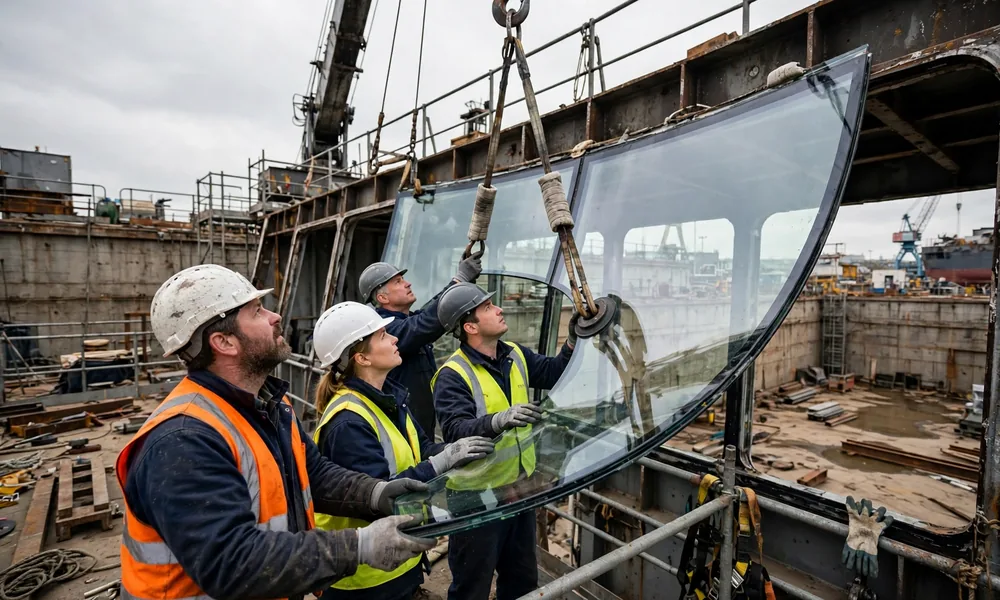
The windows are the soul of the bridge, and they are fitted with enormous care. Each pane is made from laminated, toughened glass, often more than 20 millimetres thick, built to survive a wave breaking over the bow and the glare of the tropical sun. The glass is cut to size, polished at the edges and set into steel frames with rubber seals that keep out wind, rain and salt spray. The windows are tilted back at the top, so reflections from the instruments do not dazzle the watchkeeper at night, and rain runs off instead of pooling.
Step 3: Installing the consoles
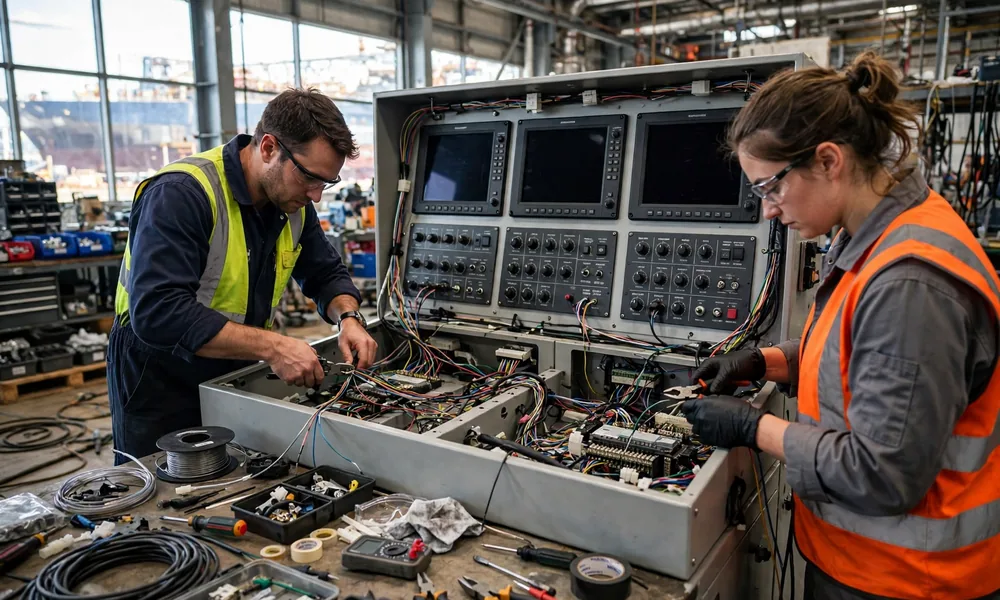
With the shell weather-tight, the consoles arrive. These are the long desks that run across the front of the bridge, carrying the steering wheel or joystick, the engine telegraph, the radar screens, the chart displays and the radios. Each console is built in a factory, wired and tested, then craned into the bridge and bolted to the deck. The consoles are arranged so that one watchkeeper can see every screen and reach every control without taking their eyes off the sea. The same discipline runs through the fitting of any complex control room, as in cruise ship engine installations, where a wrong wire can stop a ship.
Step 4: Wiring the ship’s nervous system
The bridge is only useful if it can talk to the rest of the ship, so the next step is the wiring. Cables run from the bridge down through the superstructure to the steering gear at the stern, the engine room below, the radar mast above and the radios on the roof. The ship’s navigation systems are checked against satellite signals, the compasses are swung and calibrated, and the radios are tested with stations ashore.
Step 5: Fitting out the living details
Once the electronics work, the bridge is finished as a place where people will spend their working lives. The deck is covered in a non-slip surface, the chairs are bolted down but built to swivel and slide, and blackout blinds are fitted so the watch can be kept in darkness at night. Charts, logbooks and emergency equipment are stowed in their places, and the bridge wings — the open walkways over the ship’s sides — are fitted with their own steering and engine controls for docking. The finish on a modern bridge is close to that of a fine yacht, as in superyacht aluminium superstructure work, where light, strong structures are finished to a high polish.
Step 6: Testing every system at the dock
Before the ship moves, the bridge is tested where it stands. Engineers run through a long checklist: the steering responds, the engines answer the telegraph, the radar paints the yard, the radios reach the harbour master, and the alarms sound when they should. The ship is swung on its moorings to check the compasses, and the navigation systems are compared against known positions ashore.
Step 7: Sea trials and handover
The final test is the sea trial. The ship puts to sea with the builders and the owners aboard, and the bridge is worked hard: full-speed turns, crash stops, steering on one system and then the other, navigation through busy shipping lanes at night. When the trials are passed and the last snag is fixed, the bridge is handed over, and the ship sails away under the command of the room that was, a few months earlier, an empty steel box in a workshop.
Specs
| Specification | Typical figure |
|---|---|
| Bridge structure | Steel superstructure block, welded to the hull |
| Window glass | Laminated toughened glass, 20 mm or more thick, tilted to cut glare |
| Field of view | About 225 degrees from the bridge front, plus bridge wings |
| Consoles | Steering, engine telegraph, radar, chart display, radios and alarms |
| Steering | Wheel or joystick, with full redundancy to the steering gear |
| Cabling | Kilometres of cable to engines, steering, radar and radios |
| Build time | Several months from block assembly to sea trials |
| Design life | Life of the ship, 25 to 30 years, with electronics refits |
Price
A ship bridge is never sold on its own, and shipyards do not publish a price for one. As an estimate, the bridge structure, windows, consoles and electronics of a large merchant ship typically cost roughly $2 million to $10 million — these are estimates, and the final figure depends on the ship’s size, the systems fitted and the standard of finish. It is a small share of the ship’s price, but it is the share from which every decision on board is made.
A Rare Fact
The word “bridge” comes from the days when the captain stood on a narrow wooden walkway — literally a bridge — that stretched across the deck between the two paddle boxes of a steamship, so he could see both sides at once. Even today, on the most modern ship in the world, the room where the captain stands is still called the bridge, and the officer on watch is still said to be “on the bridge”, just as they were two hundred years ago.
From an empty steel box to the room that steers a ship through a storm at midnight, the bridge is built in order: steel first, glass second, electronics third, and testing until nothing is left to chance.