A submarine does not sink because it is heavy. It sinks because its crew lets water in, on purpose, in exactly the right places, at exactly the right moment. The ballast tanks are the rooms where that happens. Flood them and the boat grows heavy and slips below the surface. Blow them clear with high-pressure air and it rises again, shedding tonnes of seawater in seconds. Everything about a submarine’s life underwater depends on these tanks working flawlessly, every single time.
That is why a ballast tank is not a simple steel box. It is a pressure vessel built to survive the crushing weight of the ocean, the shock of a depth charge, and decades of salt water trying to eat it from the inside. They must hold air at enormous pressure, vent it in a controlled rush, and seal perfectly when the order comes to surface.
Building one is slow, heavy, unforgiving work. Plates are rolled, welded, tested, and tested again, and a single flawed weld can condemn a whole tank. Here is how a submarine ballast tank is made, from flat steel plate to a vessel trusted with a crew’s life.
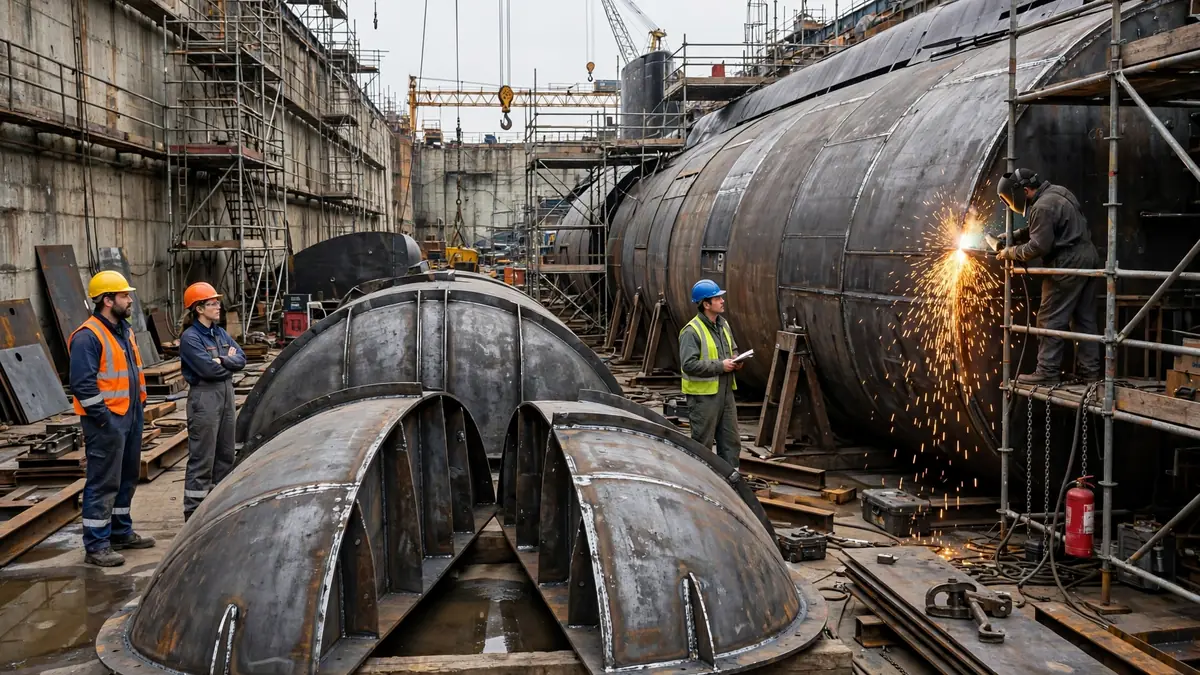
How Submarine Ballast Tanks Are Built
Step 1: Cutting and rolling the steel plates
The tank begins as flat plates of high-strength steel, chosen for toughness at low temperature and resistance to cracking under repeated pressure cycles. Each plate is cut to shape with plasma or laser cutting, then rolled in giant bending machines until it matches the curve of the hull. The curvature matters, because a ballast tank is not a box with corners; it follows the submarine’s rounded form, and every plate must meet its neighbour with a gap narrow enough for a perfect weld.
Step 2: Welding the tank sections
Welders join the rolled plates into tank sections, working in pairs so that heat is applied evenly and the steel does not distort. The welds are full-penetration joints, fused through the entire thickness of the plate, and they are laid down in passes, each one cleaned and inspected before the next begins. Inside the tank, stiffening rings and frames are welded in place to stop the thin shell flexing under pressure. This is hot, cramped, difficult work, often done inside the tank itself, and the welders who do it are among the most qualified in the shipyard, certified for the exact steel and the exact joint they are making.

Step 3: Fitting the flood and vent valves
With the shell complete, the tank’s working parts are fitted. At the bottom sit the flood valves, the large openings through which seawater rushes in when the boat dives. At the top sit the vent valves, which let trapped air escape as the water rises, so the tank fills completely and evenly. Both sets of valves must open and close in seconds, seal tightly against hundreds of metres of water pressure, and keep working after months at sea with almost no maintenance.
Step 4: Installing the high-pressure air system
To surface, the crew blows the tanks clear with compressed air stored in steel flasks at around 200 to 300 bar. The pipework for that air is fitted next: thick-walled steel pipes, bends, and manifolds running from the air flasks to each tank, with a blowing valve for every tank that can be operated from the control room. Every joint is welded or fitted with metal seals, because a leak at that pressure is dangerous and wastes the air the boat needs to rise. The pipes are routed carefully around the tank, clamped at regular intervals so vibration cannot loosen them, and painted or coated to resist the damp, salty air inside the hull spaces.
Step 5: Coating and corrosion protection
Salt water is the tank’s permanent enemy, so the inside and outside of the steel are protected before the tank is closed up. The surfaces are blasted clean to bare metal, then coated with layers of epoxy paint designed for permanent immersion, applied by spray in controlled conditions and left to cure fully. Sacrificial anodes, blocks of zinc or aluminium, are bolted inside the tank as well; they corrode first, sparing the steel, and are replaced during refits.
Step 6: Pressure testing and final inspection
Before a ballast tank is accepted, it is tested harder than it will ever be tested at sea. The tank is filled with water and pressurised, held at pressure while inspectors watch every weld and valve for the smallest weep or drip. The flood and vent valves are cycled open and shut, the blowing system is tested with air, and the whole tank is inspected with ultrasound and dye penetrant to find cracks too small to see. Only when every test passes is the tank signed off and joined to the rest of the boat. The numbers behind the finished tanks are laid out in the deep-sea submersible specs explained, the hull they sit around is covered in how a submarine pressure hull is made, and the larger shipbuilding world they belong to is covered in how a container ship hull works.
Submarine Ballast Tank Specs
| Specification | Typical range |
|---|---|
| Location | Between the pressure hull and the outer hull |
| Main material | High-strength steel plate |
| Main ballast tanks | Usually 2 to 6, fore and aft |
| Blowing air pressure | About 200 to 300 bar in the air flasks |
| Flood valves | Large bottom valves, one or more per tank |
| Vent valves | Top valves to release air as the tank floods |
| Corrosion protection | Epoxy coatings and sacrificial anodes |
| Testing | Hydrostatic pressure test and valve cycling |
What Does a Submarine Ballast Tank Cost?
No navy publishes a price for a ballast tank on its own, because the tanks are built as part of the submarine, not bought separately. The numbers around them still tell the story. A modern attack submarine is estimated at roughly $2 billion to $4 billion, and a large ballistic-missile submarine is estimated at $7 billion or more, with the hull and its tanks accounting for a large share of the steelwork and labour. All prices are estimates only and vary widely by class, country, and programme. The tanks are a small part of the bill, and a vital one.
A Rare Fact
Early submarines had no separate ballast tanks at all in the modern sense. The first practical military submarines flooded their own internal compartments and pumped the water out again, which was slow, dangerous, and left the crew standing in seawater. The breakthrough was the separate main ballast tank with a Kingston valve at the bottom and a vent at the top, a design refined in the early 1900s. Open the vent, water floods in and air escapes, and the boat dives. Close the vent, blow high-pressure air in, and the water is driven out. That simple idea, air in and air out, is still how every submarine in the world dives and surfaces today.

A ballast tank is easy to overlook, hidden between two hulls, full of seawater most of the time, and rarely seen by anyone outside a shipyard. Yet it is the part that makes a submarine a submarine. Without it, the boat is just a steel tube that floats. With it, filled and blown in seconds by valves and air, it becomes a machine that can vanish beneath the waves and return, again and again, for decades.


