The screen in your pocket is thinner than a credit card, brighter than a television, and it makes its own light, pixel by pixel, with no backlight at all. That is an OLED display, and it is one of the most demanding things ever manufactured at scale. The layers that create its light are measured in nanometres, thinner than a soap bubble, and they are laid down in rooms cleaner than an operating theatre, where a single speck of dust can kill a whole panel.
OLED stands for organic light-emitting diode. Each pixel is made of organic compounds that glow when electricity passes through them, in red, green, and blue. Stack those pixels by the millions on a sheet of glass or flexible plastic, add the thin-film transistors that switch them on and off, seal the whole thing against air and moisture, and you have a display with perfect blacks, vivid colour, and a thinness no older screen could match.
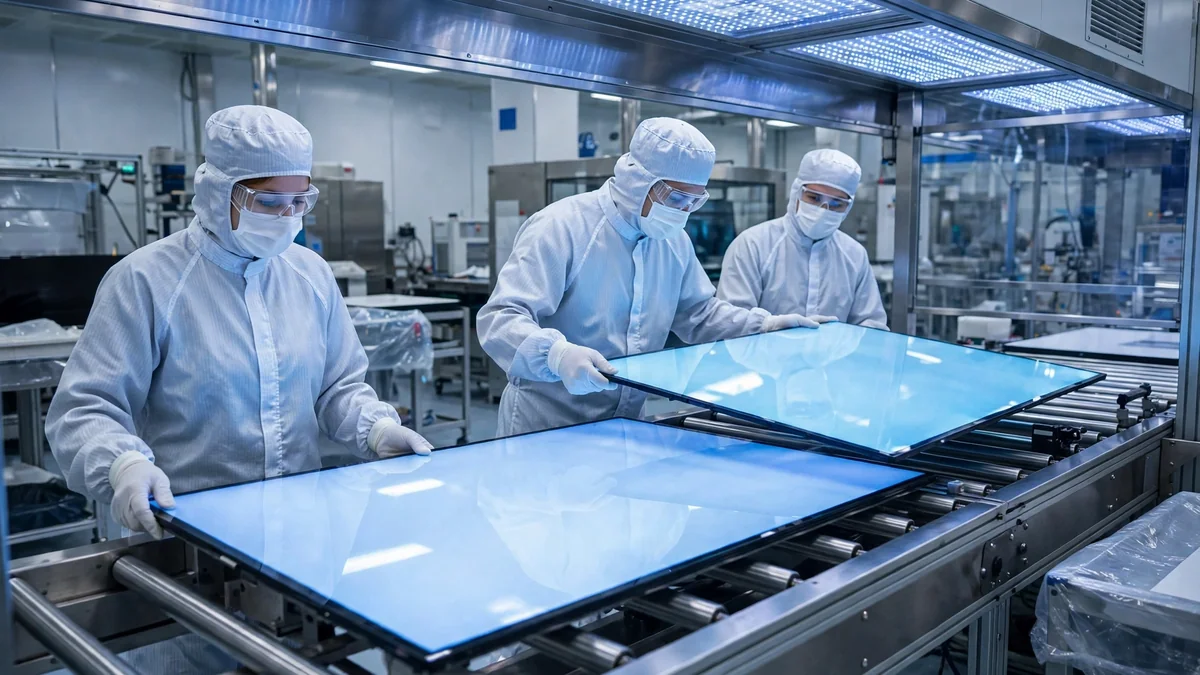
Making one is a journey through vacuum chambers, evaporation, and inspection, where the line moves slowly and the yield, the share of panels good enough to sell, decides whether the factory makes money. Here is how an OLED display panel is made.
How an OLED Display Panel Is Made
Step 1: Preparing the glass substrate
The panel starts as a large sheet of ultra-thin glass, or a flexible plastic film for foldable screens, cut to the size of the production line. The sheet is washed, dried, and inspected for the smallest scratch or particle, because any defect in the glass will show up in every panel cut from it. A single large sheet, called a mother glass, can hold dozens of phone screens or a handful of television panels, and the factory’s economics depend on cutting as many good panels as possible from each sheet.
Step 2: Building the transistor backplane
On the glass, the factory builds the backplane, a grid of thin-film transistors, one for every sub-pixel, that will switch each tiny light on and off. The transistors are made by depositing layers of silicon, metal, and insulating material, patterning each layer with photolithography, and etching away what is not needed. The process repeats for many layers, each one aligned to the last with a precision measured in micrometres, in a sequence that can take days. This backplane is the panel’s nervous system, and a single dead transistor means a dead pixel in the finished screen.

Step 3: Depositing the organic layers
Next comes the heart of the OLED, the organic layers that actually make the light. In a vacuum chamber, organic materials are heated until they evaporate and settle onto the glass through a fine metal mask, forming the red, green, and blue sub-pixels in turn. Each layer is only tens of nanometres thick, and the mask must be aligned to within a few micrometres, or the colours will bleed into each other. The chamber is kept at a hard vacuum throughout, because oxygen and moisture destroy the organic layers on contact.
Step 4: Adding the cathode and encapsulation
With the organic layers in place, a thin metal cathode is deposited on top, completing the electrical circuit that will drive each pixel. Then the panel is sealed, because the organic layers are desperately sensitive to air and water. A glass lid or a stack of thin-film barrier layers is bonded over the panel, with a seal around the edge that must keep moisture out for years. A panel that is not sealed properly will develop dark spots as the organic material degrades, starting at the edges and spreading inward. Encapsulation is the step that decides whether a beautiful panel stays beautiful, or slowly dies in the customer’s pocket.
Step 5: Cutting, bonding, and testing
The mother glass is cut into individual panels, a process done with lasers or scribing wheels so the glass breaks cleanly along the lines between screens. Each panel is then bonded to its driver chip and flexible circuit, the electronics that will feed it images, and put through its first electrical test. The panel is powered up and shown test patterns, while cameras and software hunt for dead pixels, uneven brightness, and colour errors. Panels that fail are marked and discarded, and panels that pass move on.
Step 6: Ageing, calibration, and final inspection
Before a panel ships, it is aged, run for hours at high brightness so that the organic materials settle and any early failures show up in the factory rather than in a customer’s hands. It is then calibrated, its colours measured and corrected so that whites are white and reds are red, panel after panel, to the same standard. A final visual inspection checks the glass, the edges, and the finish, and the panel is packed in protective trays for the journey to the phone or television factory. The display family this panel belongs to is covered in foldable display materials engineering, its closest rival is covered in how a micro-LED display is made, and an older screen technology is covered in e-ink display materials engineering.
OLED Display Panel Specs
| Specification | Typical range |
|---|---|
| Panel type | OLED, organic light-emitting diode |
| Substrate | Glass, or flexible plastic for foldables |
| Pixel structure | Red, green, and blue sub-pixels per pixel |
| Organic layer thickness | Tens of nanometres per layer |
| Backplane | Thin-film transistors, one per sub-pixel |
| Peak brightness | About 1,000 to 3,000 nits for flagship phones |
| Contrast | Effectively infinite, pixels switch fully off |
| Main weakness | Organic layers are sensitive to air and moisture |
What Does an OLED Display Panel Cost?
OLED panels are expensive to make, and the price falls as factories learn to raise their yield. A flagship smartphone OLED panel is estimated at roughly $70 to $120, depending on size, resolution, and refresh rate, while a large television OLED panel is estimated at several hundred dollars. The factory itself is the real cost: a single OLED production line is estimated at $5 billion to $10 billion to build, with vacuum chambers, cleanrooms, and evaporation equipment that have no other use. All prices are estimates only and vary widely by size, specification, and order volume. The screen is often the most expensive single part of a phone, and the hardest to make.
A Rare Fact
The first OLED was an accident of curiosity. In 1987, researchers at Kodak, Ching Tang and Steven Van Slyke, were working on solar cells when they noticed that an organic material they were testing glowed when electricity passed through it. They built a simple device, two organic layers sandwiched between electrodes, and it lit up at low voltage with a greenish glow. Thirty years later, that glow lights the screens of hundreds of millions of phones, watches, and televisions, and the researchers’ names are still cited in almost every OLED patent.
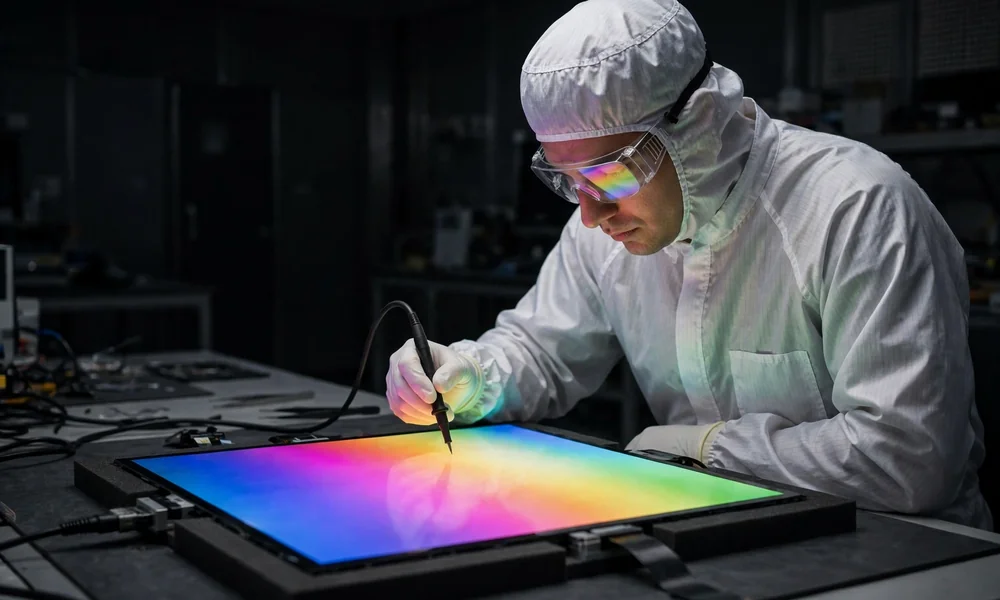
An OLED panel is a strange object: layers of organic chemistry, thinner than a hair, sealed in glass, driven by millions of transistors, and expected to survive years of daily use. It is made in a factory that looks more like a laboratory than a production line, where the air is filtered, the workers are suited, and the robots do the touching. The result is a screen that makes its own light, and in doing so, changed what a display could be.


