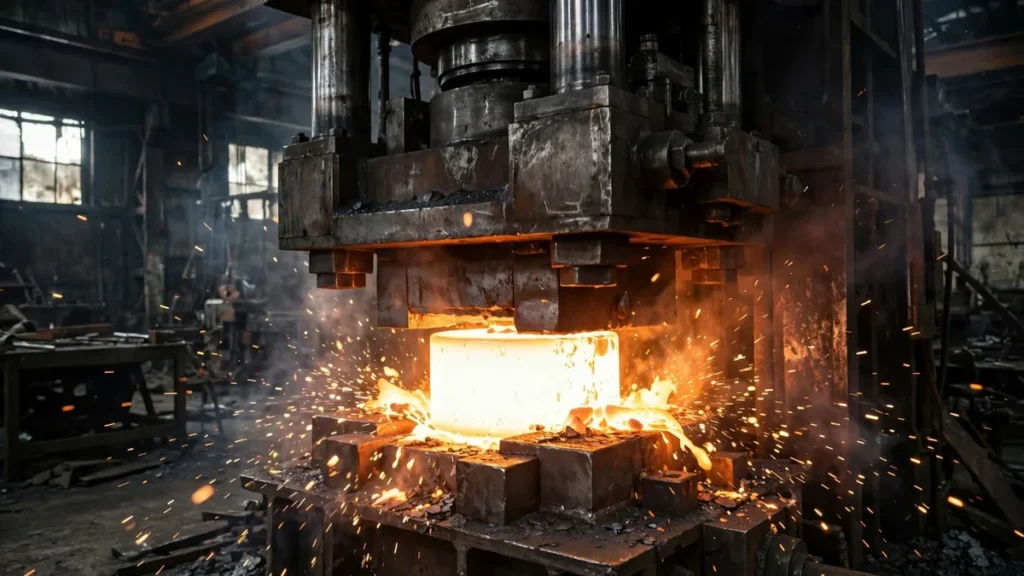
Titanium is the metal engineers reach for when nothing else will do. It holds jet engines together, frames smartphones, and carries the landing gear of airliners. But titanium is also stubborn. It is hard to cut, hard to weld, and it seizes and tears if it is worked cold. The way to shape it is to forge it, squeezing a glowing billet between dies under thousands of tonnes of force until the metal flows into the shape it needs to be.
A titanium forging is not cast and it is not machined from a block. It is beaten into shape while it is hot, and that beating does more than change its outline. It refines the grain of the metal, lines the fibres up with the direction of the load, and leaves the finished part stronger than the billet it started from. A forged titanium disc can spin inside a jet engine at thousands of revolutions per minute, at temperatures that would soften most metals, and hold together for decades.
The factory where that happens is a place of heat, noise, and enormous machines. Here is how a titanium forging is made, from raw billet to a finished part ready for machining.
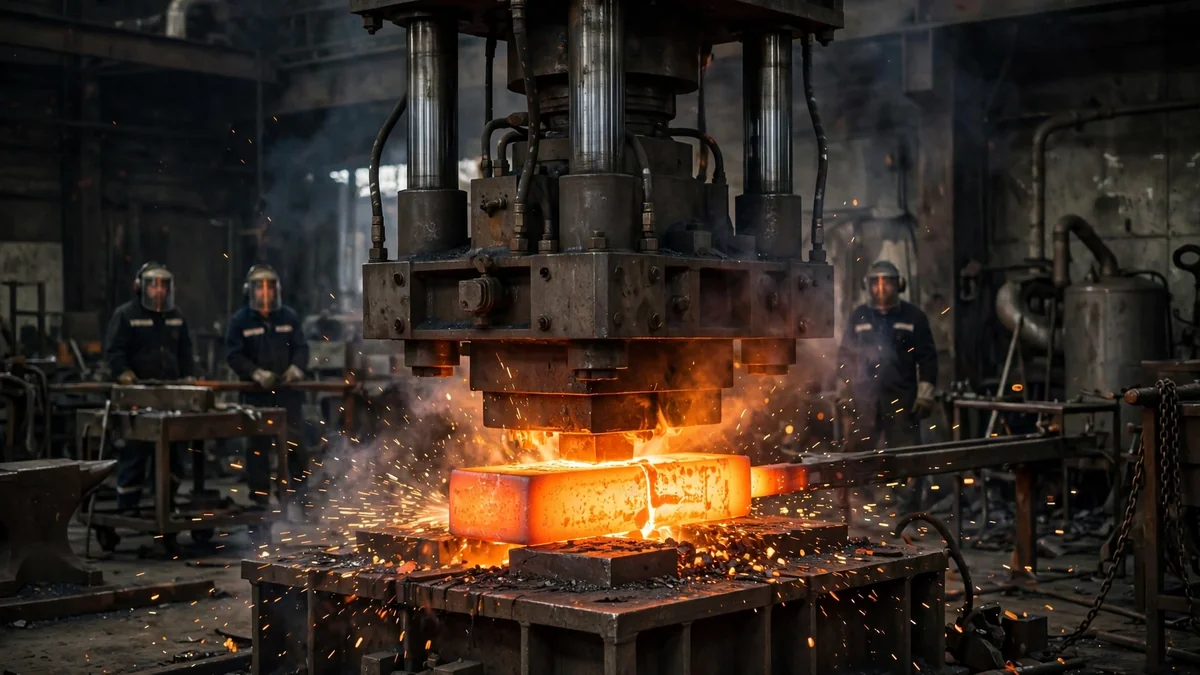
How a Titanium Forging Is Made
Step 1: Choosing and cutting the billet
The process starts with a billet, a solid bar or cylinder of titanium alloy, most often Ti-6Al-4V, the workhorse grade that mixes titanium with aluminium and vanadium. The alloy is chosen for the part’s job: strength at high temperature for an engine disc, toughness and fatigue resistance for a landing-gear beam. The billet is cut to length on a saw, weighed, and checked for surface defects and chemistry, because any flaw in the starting metal will survive the forging and show up later, in the finished part.
Step 2: Heating the billet
Titanium must be forged hot, usually between about 850 and 950 degrees Celsius, hot enough for the metal to flow but below the temperature where its grain structure changes for the worse. The billet is heated in a gas or electric furnace, soaked until the temperature is even all the way through, and then moved to the press as quickly as possible, because it cools fast in air and the forging window is short. Heating is done in a controlled atmosphere or with protective coatings where needed, because hot titanium reacts hungrily with oxygen and nitrogen, forming a hard, brittle skin that must be removed later. The timing of this step is everything, and the furnace crew watches it closely.

Step 3: Forging under the press
The hot billet is placed between the dies of a hydraulic or screw press, machines that can deliver thousands of tonnes of force, and squeezed in a series of blows. Each blow spreads the metal a little further, and the operator turns or repositions the billet between blows so the grain flows in the right direction. The press hall shakes with every blow, the billet glows orange and fades as it cools, and the whole sequence is timed in minutes, because a billet that cools too far must go back to the furnace.
Step 4: Trimming and removing the scale
When the forging leaves the press, it carries a rough edge of excess metal, called flash, where the metal squeezed out between the dies, and a dark, hard skin of oxide, called scale, from its time in the heat. The flash is trimmed off in a press or by cutting, and the scale is removed by blasting, pickling in acid, or machining, leaving clean metal underneath. This is also the first real look at the finished shape, and the forging is measured against its drawings to check that the press did its job. Parts that are undersize or misshapen are scrapped, because a forging cannot be stretched back into shape.
Step 5: Heat treatment
Forging leaves the metal strong but stressed, so the part is heat-treated to set its final properties. It is heated again in a furnace, held at a precise temperature for hours, and then cooled in air, water, or oil, depending on the alloy and the part. Some parts are aged afterwards, held at a lower temperature to harden them further. The exact recipe is a closely guarded part of the specification, because a few degrees or a few minutes can change the strength and fatigue life of the metal.
Step 6: Inspection and final machining
The last step is proof. The forging is inspected with ultrasound to find hidden cracks and voids, checked with dye penetrant for surface flaws, and measured on a coordinate machine to confirm every dimension. Titanium forgings for aircraft and engines are then machined to their final shape, a slow and expensive process in its own right, because the metal is so hard on cutting tools. Only after inspection and machining is the part certified, with paperwork tracing it back to the original billet, the furnace, and the press. The wider world of forged metal is covered in how aluminium forging is made, the engineering behind the alloys is covered in aluminium forging materials engineering, and a smaller titanium part is covered in how a smartphone titanium frame is made.
Titanium Forging Specs
| Specification | Typical range |
|---|---|
| Main alloy | Ti-6Al-4V, titanium with aluminium and vanadium |
| Forging temperature | About 850 to 950 degrees Celsius |
| Press force | Thousands of tonnes, up to 50,000 tonnes or more |
| Density | About 4.43 grams per cubic centimetre |
| Tensile strength | About 900 to 1,100 MPa for Ti-6Al-4V |
| Key advantage | High strength at low weight, corrosion resistant |
| Main uses | Jet engine discs, landing gear, airframes, medical implants |
| Inspection | Ultrasound, dye penetrant, dimensional checks |
What Does a Titanium Forging Cost?
Titanium is expensive before anyone touches it. Raw titanium alloy is estimated at roughly $30 to $60 per kilogram, several times the price of aerospace aluminium, and the forging itself adds the cost of huge presses, furnaces, dies, and skilled labour. A small forged titanium bracket is estimated at a few hundred dollars, a jet-engine fan disc is estimated at tens of thousands of dollars, and a large landing-gear forging is estimated at $100,000 or more before machining. All prices are estimates only and vary widely by size, alloy, and order volume. The metal costs more than steel, and it earns its price in weight saved and life gained.
A Rare Fact
Titanium was named after the Titans of Greek mythology, and for a long time it lived up to the name only in theory. The metal was discovered in 1791, but it took until the 1940s for the Kroll process to make it in useful quantities, by reducing titanium tetrachloride with magnesium. The first real breakthrough came in jet engines in the 1950s, when designers needed a metal that was light, strong, and heat resistant all at once. Titanium forgings went into the first supersonic fighters, and the metal has never left the front line of aviation since.

A titanium forging looks unremarkable when it leaves the forge, a dull grey shape with rough edges, waiting for the machine shop. But inside that grey shape is a grain structure aligned by force, a metal that has been squeezed, heated, and proven at every step. It is the difference between a part that merely fits and a part that can be trusted at thirty thousand feet, spinning at full power, for thousands of hours.