Sixty metres below the surface, in a steel tube lit by red light, a submarine’s captain puts his eye to a periscope and sees the sky. A ship on the horizon, a coastline, the sun glinting on the waves — all of it reaches him through a column of glass and mirrors barely wider than a dinner plate, folded and bent inside a tube that runs the full height of the boat. The periscope is the submarine’s only window, and it has to work perfectly, every time, in total darkness, under crushing pressure, after months at sea.
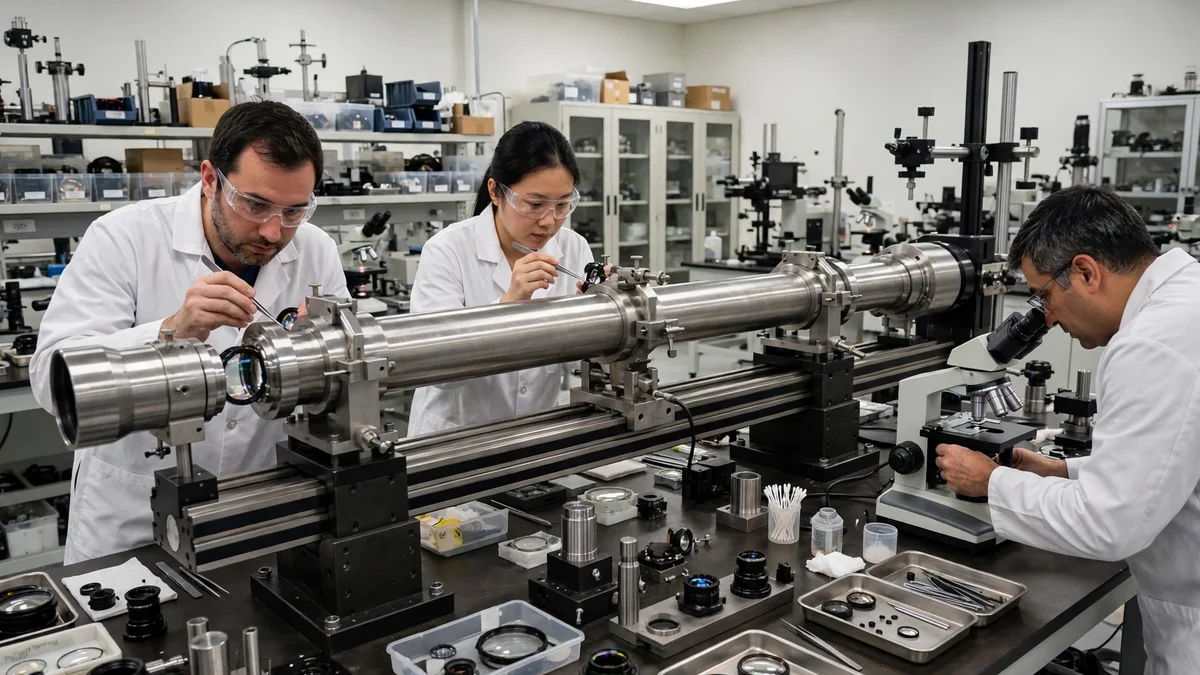
That reliability is built in a factory that looks more like a laboratory than a shipyard: clean rooms, white coats, and optical benches where lenses are polished to a smoothness measured in nanometres. A periscope is not one lens but dozens, arranged in a precise line, and a single speck of dust or a lens a fraction of a degree out of alignment will blur the whole image. Modern periscopes are even more remarkable: many no longer use eyepieces at all, but carry cameras and sensors, and the captain watches the surface on a screen.
This is a look inside the factory that builds the submarine’s eyes.
How a Submarine Periscope Is Made
Step 1: Grinding and polishing the lenses
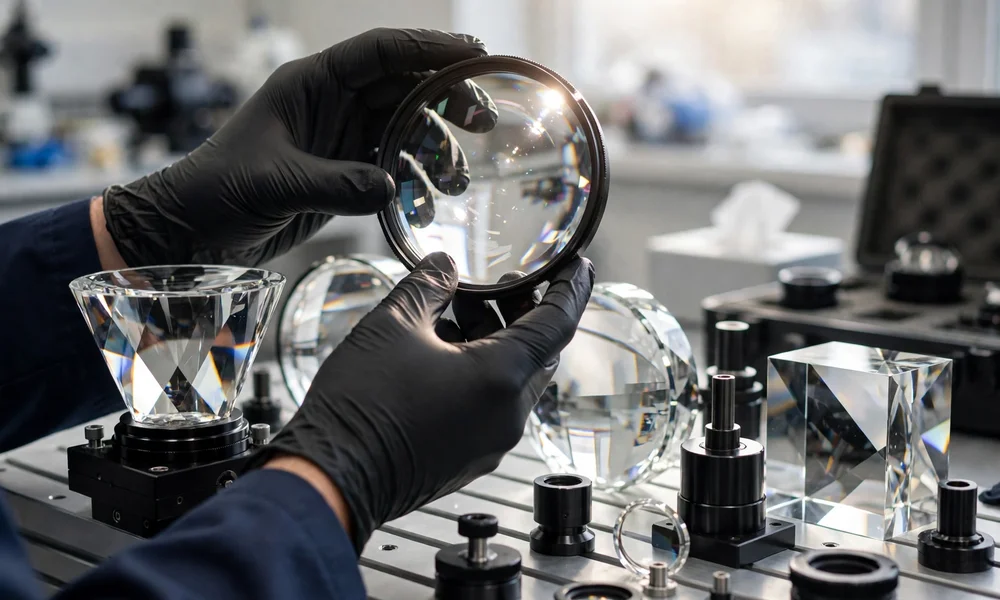
Production begins with blanks of optical glass, chosen for clarity and for resistance to the pressure and temperature changes of the deep sea. Each blank is ground and polished on machines that remove glass a few atoms at a time, until the surface is smooth to within a fraction of the wavelength of light. The lenses are then coated with thin films that reduce reflections and protect against salt and moisture. A single periscope can contain dozens of lenses, and each one is inspected under magnification: a scratch invisible to the naked eye is enough to reject it.
Step 2: Building the tube and the mirrors
The periscope’s tube is made from high-strength steel or titanium, machined to be perfectly straight over a length that can exceed ten metres. Inside it, at the top and bottom, sit the prisms and mirrors that bend the light through ninety degrees — down the tube from the surface, and then into the captain’s eye or a camera. These optical elements are mounted in precision housings and aligned with lasers. The tube must also be pressure-tight: it passes through the submarine’s hull, and any leak at depth would be catastrophic, so its seals are tested to pressures far beyond anything the boat will meet.
Step 3: Fitting the sensors
A modern periscope is far more than a telescope. Its head carries daylight cameras, thermal imaging sensors that can see a ship’s heat at night, and laser rangefinders that measure distance to a target. Some carry electronic warfare antennas that can detect radar signals without giving the submarine away. Each sensor is fitted into the periscope head — the part that breaks the surface — and sealed against seawater. The head is designed to be as small and as hard to spot as possible: a thin mast that barely disturbs the water.
Step 4: The raising and training mechanism
A periscope must rise smoothly out of its housing, rotate to scan the horizon, and lower again — all without shaking the optics. The raising mechanism is a hydraulic or electric drive, built with the same precision as the lenses: any vibration in the drive would blur the image. The rotation system uses sealed bearings and encoders that report the periscope’s direction to a fraction of a degree, so the captain knows exactly where a target sits relative to the boat. The whole mechanism is tested through thousands of raise-and-lower cycles before it leaves the factory.
Step 5: Optical alignment and calibration
Once assembled, the periscope is mounted on a test rig and aligned. Engineers look through it at a test chart placed far away, checking that the image is sharp from edge to edge, that the magnification is correct, and that the crosshairs sit exactly where they should. The cameras and thermal sensors are calibrated against known targets, and the laser rangefinder is checked against measured distances. If any element is out of alignment, the periscope is taken apart and the offending lens or prism is re-seated — a job that can take days.
Step 6: Pressure and sea trials
Before delivery, the periscope is pressure-tested in a chamber that simulates the crushing force of deep water, and then it is fitted to a submarine for sea trials. The crew raises it in rough weather, in rain, and at night, checking that the image stays clear and the seals stay dry. Only when it has passed at sea — in the conditions it was built for — is the periscope signed off and delivered.
Submarine Periscope Specs
| Specification | Typical range |
|---|---|
| Length | About 8 to 15 metres |
| Tube diameter | About 150 to 200 millimetres |
| Magnification | About 1.5x to 6x, plus digital zoom |
| Field of view | About 30 degrees at low magnification |
| Sensors | Daylight camera, thermal imaging, laser rangefinder |
| Operating depth | Pressure-tested beyond the submarine’s rated depth |
| Raise and lower time | About 5 to 10 seconds |
| Head exposure | Only the mast head breaks the surface |
What Does a Submarine Periscope Cost?
Periscopes are military equipment and are not sold on the open market, so prices are rarely published. A modern optronic periscope mast for a military submarine is estimated to cost roughly $1 million to $5 million per unit, depending on the sensors fitted, with the most advanced masts — carrying thermal imaging, laser rangefinding, and electronic sensors — estimated at the higher end. Prices are estimates only, based on reported defence contract figures, and vary by country, supplier, and configuration. The periscope is part of a much larger machine, and its story continues in how a submarine pressure hull is made — the steel shell that keeps the crew alive at depth. Its ears are covered in submarine sonar array specs explained, and the deep-diving craft that first proved titanium could survive the abyss is Alvin’s titanium pressure sphere.
A Rare Fact
The periscope has a secret history in the sky as well as the sea: during the Second World War, periscopes were fitted to tanks, so crews could see out without opening a hatch, and the same optics were used in early trench periscopes in the First World War. But the strangest periscope of all flew in space: the Apollo lunar module had a small periscope-like device called the alignment optical telescope, which the astronauts used to sight stars and align the spacecraft’s guidance system. And on the ocean floor, the deepest periscope ever built belonged to the bathyscaphe Trieste, which carried its crew to the bottom of the Mariana Trench in 1960 — nearly 11 kilometres down — looking out through a tiny window of glass so thick it could withstand pressure of more than a thousand atmospheres.
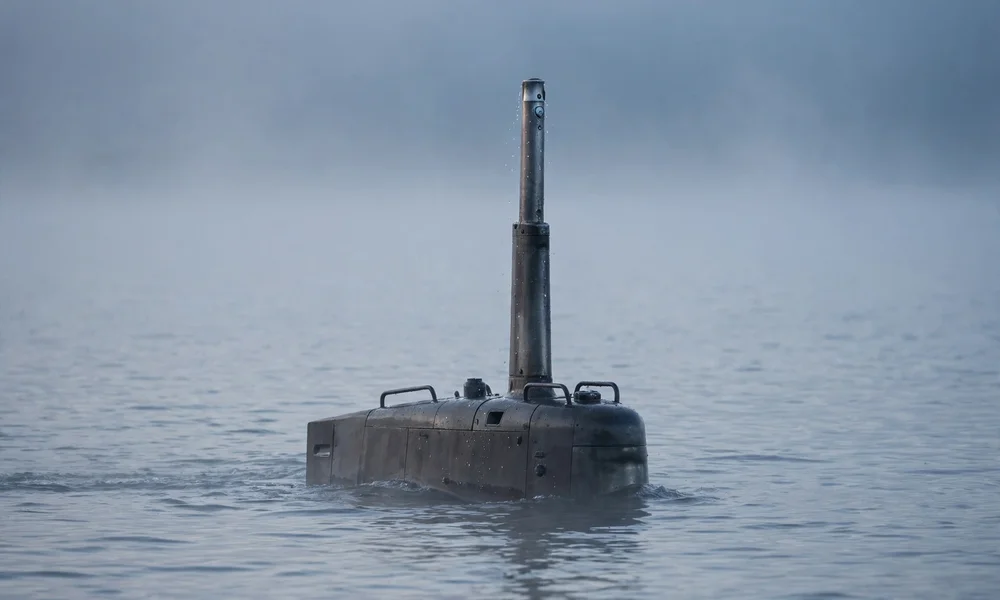
A submarine periscope is the quietest kind of engineering: it does not roar, it does not glow, and most of the time it is hidden away inside the boat. But for the few seconds it breaks the surface, it is the crew’s only connection to the world above — and the factory that builds it treats those few seconds with the seriousness they deserve.