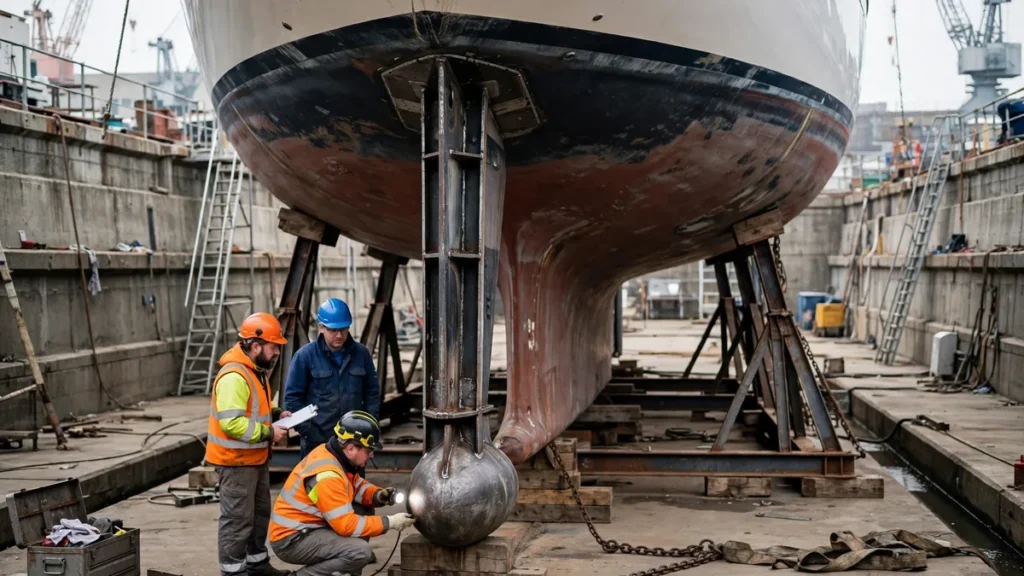
Run your hand along the side of a finished yacht and the surface feels like glass. There is no ripple, no bump, no hint of the mould, the fibreglass or the filler underneath — just a perfect curve that catches the light and throws it back in one clean sheet. It looks effortless, as if the hull had been poured that way. It was not. That mirror finish is the result of fairing, one of the slowest, dustiest and most skilled jobs in boatbuilding, where workers spend weeks chasing a surface true to within a fraction of a millimetre.
Fairing is the art of making a hull fair — smooth, true and free of unfair bumps and hollows. A hull comes out of its mould close to the right shape but never perfect: seams, slight ripples, places where the laminate cured a little proud or a little low. Left alone, those flaws would show through the paint as waviness, and worse, they would disturb the water flowing past the hull. Fairing fills the lows, sands down the highs, and checks the result again and again until the whole surface reads as one unbroken curve.
How Yacht Hull Fairing Is Done
Step 1: Reading the hull
Fairing starts with measurement, not sanding. The team runs long flexible battens — thin strips of wood or plastic — along the hull in every direction, watching for gaps where the batten bridges over a hollow and rocking where it sits on a high spot. A bright light held at a low angle throws every ripple into shadow, and the hull is marked up with pencil: highs to cut down, lows to fill. On the best yards, a laser scanner maps the whole hull and prints a colour map of deviations, showing the team exactly where to work. The goal is a surface true to within about half a millimetre over several metres.
Step 2: Grinding the high spots
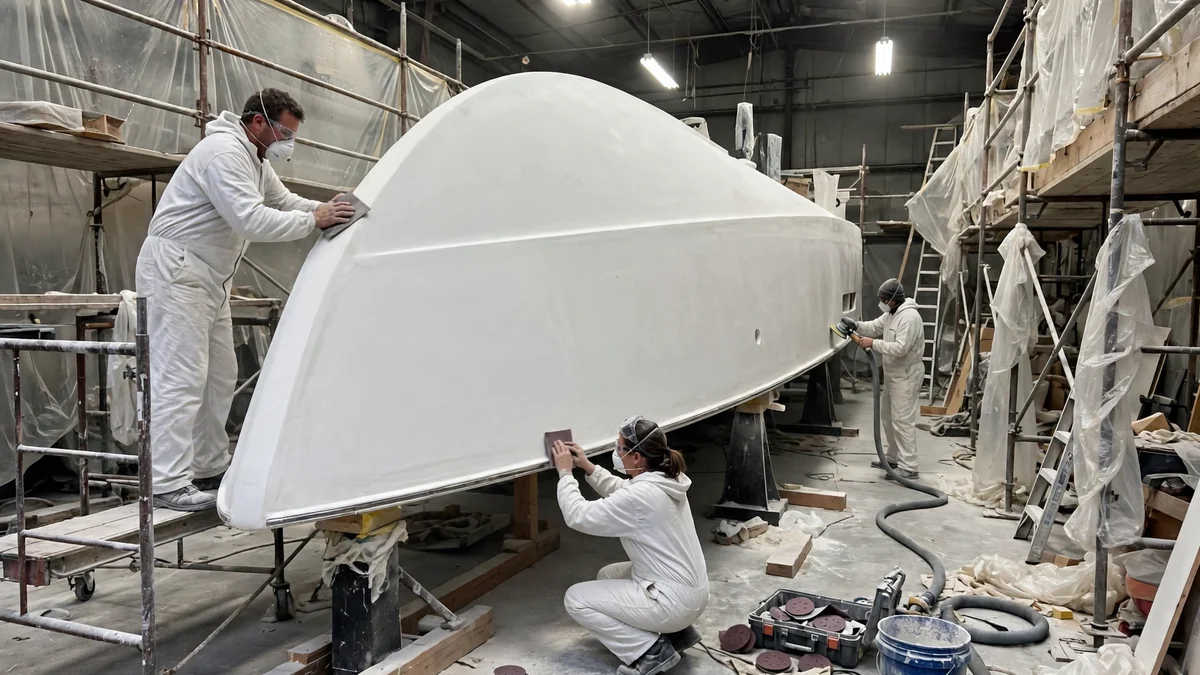
High spots are ground back first, with long-board sanders and power grinders fitted with coarse paper. This is dusty, physical work in protective suits and respirators, and it takes a steady hand: grind too deep and you cut into the laminate itself, creating a low spot where a high one was. The team works in sections, checking constantly with the batten, and vacuums the dust away as they go so they can see what they are doing. It is slow progress — a large hull can take days of grinding before a single gram of filler is mixed.
Step 3: Filling the low spots
Low spots are filled with fairing compound, a lightweight epoxy or polyester filler mixed with microscopic hollow spheres that make it easy to sand. The filler is troweled on in thin layers, never thick, since thick filler cracks and adds weight. Each layer is left to cure, then sanded before the next goes on, building the surface up gradually toward the true shape. A good fairer knows the filler by feel: too wet it sags, too dry it drags. The same patience with layered materials shapes superyacht steel hull work, where the structure underneath must be right before the surface can be.

Step 4: Long-boarding the whole hull
Once the filler is on, the whole hull is sanded with long boards — sanding blocks a metre or more long, worked in sweeping diagonal strokes. A long board cannot follow a small bump; it bridges across it and cuts it down — exactly the point. The team works in a rhythm, two or three people to a section, moving the boards in overlapping passes and checking their work with the batten after every round. The dust gets everywhere, the arms ache, and the hull gets smoother with each pass. This stage alone can take a week on a large yacht.
Step 5: Priming and finding the last flaws
When the hull feels true, it is coated in a high-build primer, a thick paint that fills the finest scratches and gives the surface a uniform colour. The primer is the truth-teller: sprayed on and sanded back, it reveals every remaining flaw as a dark line or a dull patch. The team marks these up, fills the last pinholes, sands again and primes again. Some hulls need three or four rounds of priming before anyone is satisfied. It is at this stage that the paint system takes over, and the primer must bond perfectly with the topcoat, as superyacht paint systems demand, or the finish will fail at sea.
Step 6: Final sanding and inspection
The last sanding uses ever-finer paper, down to grades so fine the paper feels smooth to the touch, and the hull is washed down between passes so no grit is carried over. Inspection is done with raking light and by hand: an experienced fairer can feel a flaw of a tenth of a millimetre with a bare palm, and will run their hand over the whole hull before signing it off. Any spot that fails gets one more round of filler and sanding, however late it is. The teak decks get a similar obsession with surface and feel, as yacht teak deck craftsmen know, where every seam must be perfect to the touch.
Step 7: Handover to paint
When the hull is finally fair, it is cleaned, masked and handed to the paint team, who spray the topcoat that will make it gleam. The fairing team’s work is invisible in the finished yacht — nobody admires filler — but it is why the paint looks like glass instead of orange peel. The yard records the fairing in the build file: the compounds used, the number of priming rounds, the final measurements. A hull faired well will hold its finish for years; a hull faired badly will show its flaws the first time the sun hits it in a marina.
Yacht Hull Fairing at a Glance
| Specification | Typical Value |
|---|---|
| Target fairness | Within about 0.5 mm over several metres |
| Filler type | Lightweight epoxy or polyester fairing compound |
| Main tool | Long board, 1 m or more, plus battens |
| Primer rounds | Usually 2 to 4, sanded between coats |
| Time for a large yacht | Several weeks of fairing alone |
| Final check | Raking light and a bare hand |
| Key advantage | Glass-smooth finish, cleaner water flow, faster hull |
What Does It Cost?
Fairing is labour, almost entirely, and it is expensive labour. Fairing a yacht hull professionally typically costs $15,000–$80,000 (estimates) depending on size and condition, and on a large superyacht the fairing bill alone can pass $200,000 (estimates). The money goes into weeks of skilled handwork, the filler and primer, the scaffolding and the dust extraction. It is often a fifth of the total paint job, yet it decides whether the paint looks like a mirror or a mistake. Owners who try to save money here always regret it.
A Rare Fact
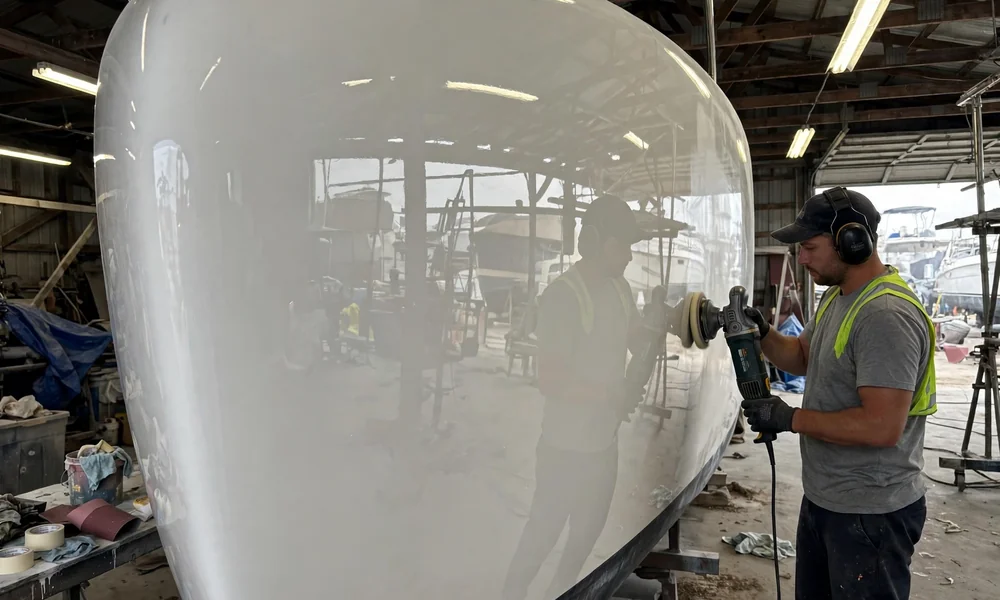
A faired hull is not just prettier — it is measurably faster. Tiny ripples in a hull’s surface trip the water flowing past it into turbulence, adding drag, and naval architects estimate a poorly faired hull can cost a yacht several percent of its speed. On a racing yacht that is the difference between winning and trailing, which is why grand-prix race boats are faired to tolerances tighter than a luxury yacht’s, sometimes within a tenth of a millimetre. The smoothest hulls in the world are not built for beauty at all; they are built for speed, and the beauty is a side effect.