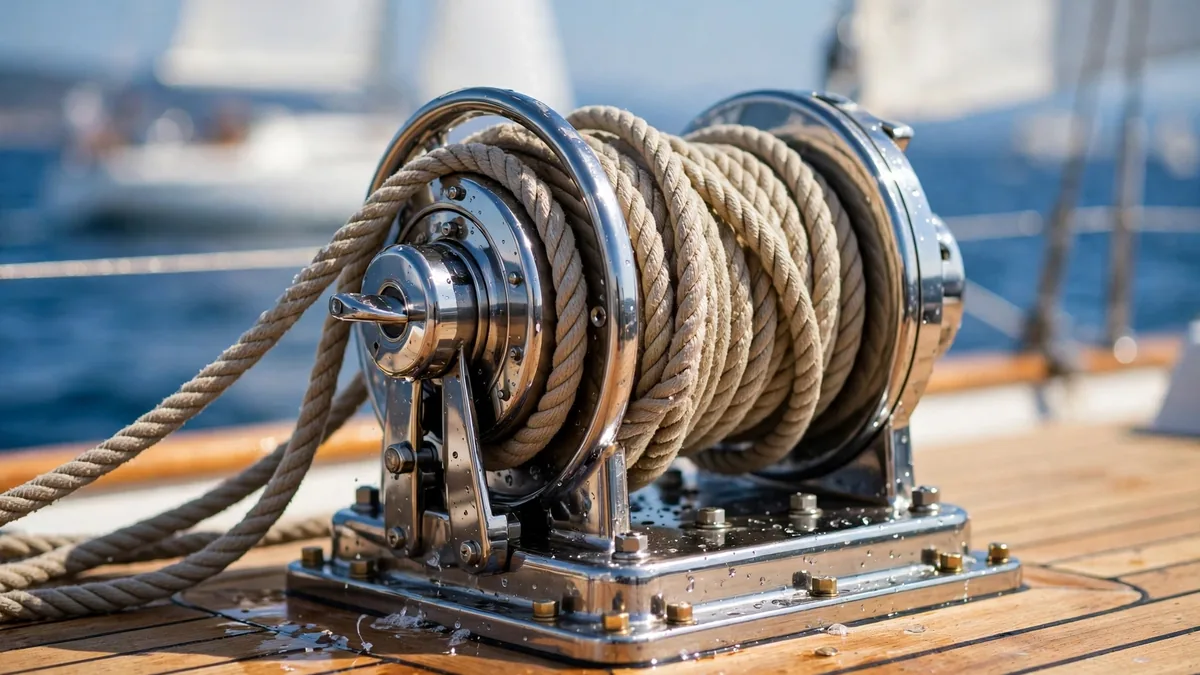
It weighs less than a suitcase, sits on the deck like a polished piece of jewellery, and holds the entire power of a sailing yacht in its drum. When the wind fills a genoa the size of a tennis court, the load on the sheet can reach several tonnes, far more than any sailor could ever hold by hand. The winch is what stands between the crew and that force: a small, patient machine that turns human muscle into tonnes of pulling power, one click of its gears at a time.
Every sailing yacht carries them, from weekend day-sailers to round-the-world racers, and the best winches are built like precision instruments. Inside a drum no bigger than a dinner plate sit layers of gears, pawls, and bearings, machined to tolerances a watchmaker would respect, then sealed against salt water and asked to work flawlessly for decades. This is how a yacht winch is made, from raw bronze and stainless steel to a deck fitting a sailor can trust with their life.
How It’s Made
Step 1: Casting and forging the body
A winch begins as metal: usually a marine-grade bronze or stainless steel body, with an aluminium or stainless drum. The base and the gear housing are cast in sand moulds, the molten metal poured and left to cool into rough shapes that already carry the winch’s curves. Forged parts, such as the central spindle, are hammered or pressed from solid bar, giving them a grain structure that resists the bending loads of a sail under strain. Every casting is inspected for porosity, tiny air pockets that would weaken the part, and any casting that fails is melted down and poured again.
Step 2: Machining the drum and gears
The rough castings go to the machine shop, where computer-controlled lathes and mills cut them to their final shape. The drum is turned true to within a fraction of a millimetre, its gripping ribs cut in a pattern that holds rope without chewing it, and its surface polished until it shines. The gears are cut from hardened steel or bronze, their teeth shaped to mesh smoothly under load, and the spindle is ground to a mirror finish so it spins without friction. A winch that turns roughly is a winch that wastes a sailor’s strength, so the machining is the heart of the whole build.

Step 3: Building the gear train
Inside the drum, the gear train is assembled by hand. Most yacht winches have two or three speeds: a fast gear for hauling in slack rope quickly, and a slow, powerful gear for the final hard pull. The gears sit on needle bearings, and the pawls, small spring-loaded fingers of hardened steel, click into a ratchet ring so the drum can turn one way and lock the other. The assembler works with gloves and a torque wrench, setting each gear’s backlash by feel, because a gear train that is too tight will bind under load and one that is too loose will clatter and wear. It is watchmaking at sea-going scale.
Step 4: Sealing against the sea
A winch lives in salt spray, so sealing is a build step in its own right. Seals and O-rings are fitted at every joint where water could enter, and the gear chamber is packed with a marine grease that stays put in heat and cold alike. Stainless fasteners are used throughout, and dissimilar metals are kept apart with insulating washers, because bronze and stainless steel in salt water will eat each other alive through galvanic corrosion. The finished winch is washed down and left overnight in a test tank, and any sign of water inside sends it back to the bench.
Step 5: Fitting the self-tailing jaw
On a modern winch, the top carries a self-tailing jaw, a spring-loaded ring of shaped jaws that grips the rope so the sailor can let go of the sheet without losing it. The jaw is machined from stainless steel and fitted with a stripper arm, a small angled finger that lifts the rope off the drum as it is eased out. Getting the jaw’s grip right is delicate work: too tight and the rope jams, too loose and it slips under load. Each jaw is tested with the exact rope diameters the winch is rated for, and adjusted until it holds firm and releases cleanly, every time.
Step 6: Testing under load
Before a winch leaves the factory, it is bolted to a test rig and pulled against a measured load, sometimes to twice its rated working load. Engineers listen for clicks, measure the handle force, and count the turns, checking that the gears shift cleanly and the pawls hold without slipping. The drum is spun thousands of times to bed the bearings in, then stripped, inspected, and re-greased. Only a winch that survives the rig without a mark is polished, boxed, and shipped to a boatyard, where it will be bolted through the deck to the structure below, ready for its first gale.

Specs
| Specification | Typical figure |
|---|---|
| Body material | Marine bronze or stainless steel |
| Drum material | Stainless steel or anodised aluminium |
| Typical size range | 30–80 mm drum diameter for yachts |
| Working load | 500–5,000 kg depending on size |
| Gear ratios | Two or three speeds, up to about 60:1 |
| Power options | Manual, electric, or hydraulic drive |
| Rope capacity | 8–18 mm diameter, by model |
| Design life | 20 years or more with servicing |
Price
A yacht winch is one of the most expensive pieces of deck hardware per kilogram, and the price is mostly machining. As an estimate, a good manual self-tailing winch for a 40-foot yacht typically costs $1,500 to $4,000, while a large electric winch for a superyacht can cost $10,000 to $25,000 or more — these are estimates, and the final price depends on size, materials, and whether the winch is manual, electric, or hydraulic. The bronze and stainless steel are costly, but the real money is in the hours of precision machining and hand assembly inside the drum.
A Rare Fact
The winch’s gear ratio is so powerful that a child turning the handle can hold a sail that would drag a strong adult clean off the deck. On the largest racing yachts, a single winch handle can generate several tonnes of pull, and the limiting factor is not the winch but the deck it is bolted to: yards reinforce the deck under each winch with solid laminate and steel backing plates, because a winch that rips out of the deck in a gust is a catastrophe. The little drum is stronger than the boat around it.
From bronze casting to polished deck fitting, the winch is a pocket-sized feat of engineering, and it works alongside the rest of the deck gear, from the yacht anchor system to the yacht sail rigging that carries the loads it controls. It sits on a deck built with the same obsession as how a yacht teak deck is made, bolted down and ready. Small, silent, and stronger than it looks: that is the winch.


