Under every moving yacht, spinning in water nobody can see, is a sculpture that is also a machine. Usually bronze, with three or four blades, it is the only thing converting the engine’s power into forward motion. A yacht propeller is small enough to lift with two hands, yet it decides whether the boat does eight knots or eleven, whether the engine strains or purrs, and whether the stern vibrates.
Propellers look like they are simply cast and bolted on. In reality each one is designed for a single yacht, cast from a bronze alloy that must survive cavitation — tiny explosions of collapsing water bubbles that can eat through metal — and machined and polished to watchmaker tolerances. Here is how the factory makes one.
How It’s Made
Step 1: Designing the propeller for one yacht
No two yacht propellers are alike, because no two yachts are alike. The designer starts with the yacht’s displacement, engine power and gearbox ratio, and its target cruising speed, then calculates the diameter, the pitch — the distance the propeller advances in one turn — and the blade area. A heavy yacht wants a large, slow-turning propeller with wide blades; a light performance yacht wants a smaller, faster one. The blades are drawn as twisted foils, their pitch changing from root to tip so every part works at the same angle to the water. The design is tested in software that models the water flow around each blade, and the factory receives a three-dimensional model, because a propeller is a shape no flat drawing can fully describe.
Step 2: Making the mould
Most yacht propellers are cast in sand moulds, made from a pattern — a full-size model, usually machined from wood, resin or aluminium. The pattern is pressed into bonded sand to form the mould cavity, then removed, leaving a perfect negative of the propeller, complete with the twist of every blade. Runners and risers are cut into the sand: channels for the molten bronze to flow in, and reservoirs that feed the casting as it cools. The mould is made in two halves, and the parting line is chosen carefully, because any flash of metal there must be ground away without damaging the blade shape. For high-performance propellers, the factory may use a lost-wax process instead, building a ceramic shell around a wax model.
Step 3: Casting the bronze
The alloy is the propeller’s secret. Most yacht propellers are cast from nickel-aluminium bronze, a golden alloy strong, tough and highly resistant to corrosion and cavitation. The metal is melted in a furnace at over 1,100 degrees, checked for composition, and poured in a single continuous stream. The pour is tense: too slow and the metal cools before it fills the thin blade tips, too fast and it traps air that becomes a hidden hole. The casting is left to cool slowly, sometimes overnight, before the sand is broken away and the rough propeller is revealed — dull, heavy and oversized, with runners still attached like scaffolding. It looks nothing like a propeller yet.
Step 4: Machining the blades and hub
The rough casting is cut free of its runners, then mounted on a five-axis CNC milling machine, which moves its cutter in five directions at once, following the twist of each blade. The mill removes millimetres of metal, bringing the blades to their designed thickness and profile, and bores the hub to fit the shaft, cutting the keyway or taper that locks the two together. This is the most expensive step, because a five-axis machine running for hours on one propeller costs real money, and there is no fixing a blade machined too thin. The bronze alloy machines cleanly but wears tools fast, and the factory budgets for it.
Step 5: Balancing and polishing
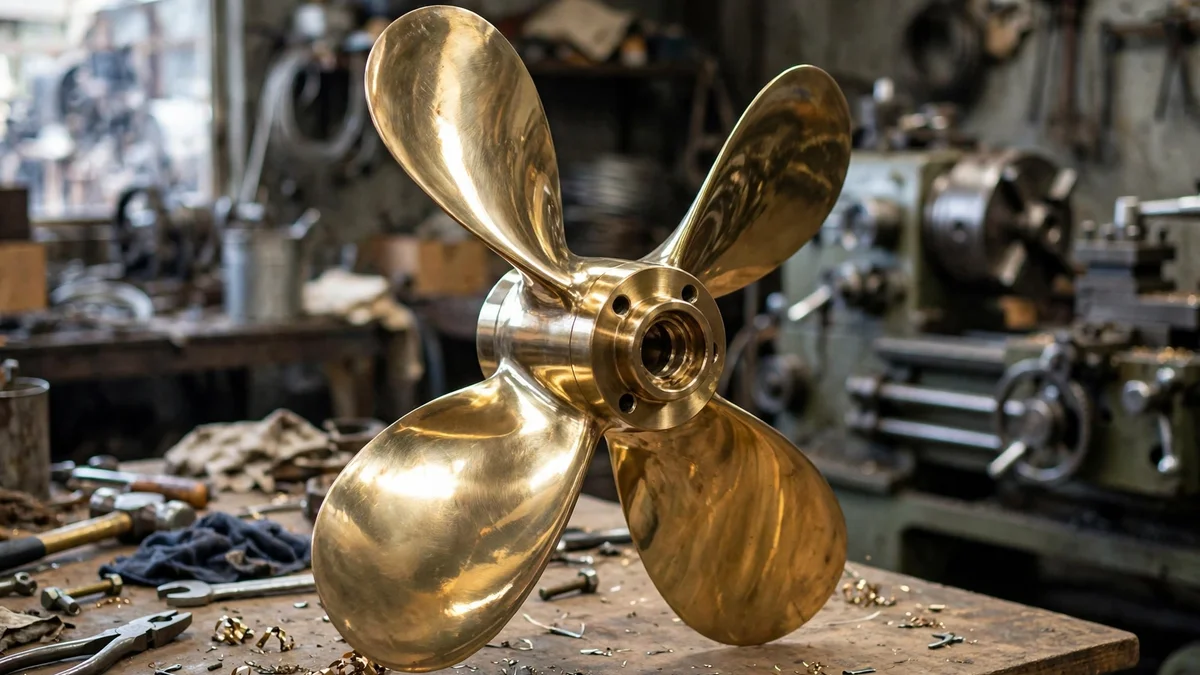
A propeller even slightly out of balance will shake the whole yacht, so it is mounted on a balancing machine that spins it and measures vibration. Material is ground from the heavy blade until the propeller spins true, often to within a few grams across a 20-kilogram casting. Then comes the polish: each blade is ground, sanded and buffed by hand until it shines, because a smooth blade slips through the water with less drag and resists cavitation. The hub is checked against the shaft taper with a blue dye test, and the fit must be near-perfect, since the propeller is held on the shaft by friction alone. The way a propeller is made is inseparable from its finish: the polish is not cosmetic, it is performance.
Step 6: Testing and fitting to the yacht
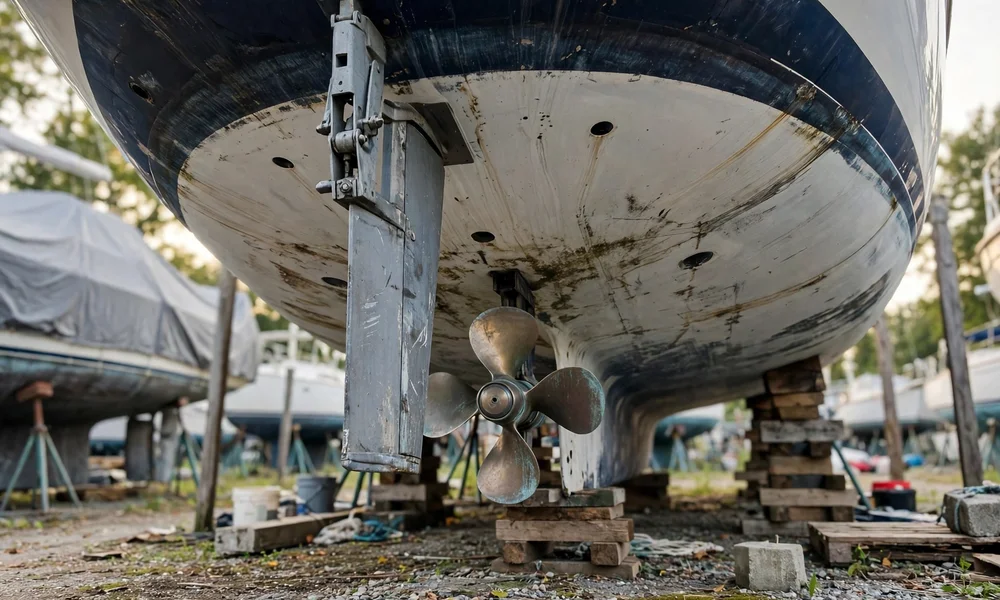
Before delivery, the propeller is checked blade by blade: pitch measured at several radii, thickness checked against the design, and the unit inspected for flaws with dye penetrant. The propeller is matched to its shaft, the nut torqued to specification, and the assembly sent to the yard. On the yacht, the propeller slides onto the shaft taper under the stern, the key is fitted, and the nut is tightened with a large torque wrench. The yard then runs the engine in gear at the dock, checking for vibration, and the propeller’s real test comes on the sea trial: the yacht is run at full throttle, its speed measured against the design target, and the engine’s revs checked. The keel below the hull and the propeller were designed together, and on the trial they prove it — or the propeller goes back for a pitch adjustment.

Yacht Propeller Specifications
| Specification | Typical Value |
|---|---|
| Material | Nickel-aluminium bronze (NiAl bronze) |
| Blades | 3–4 (5 on some large yachts) |
| Diameter | 400–900 mm |
| Pitch ratio | 0.8–1.2 × diameter |
| Weight | 15–60 kg |
| Manufacturing method | Sand casting + 5-axis CNC machining |
| Balance tolerance | Within a few grams |
| Efficiency | 55–70% in open water |
| Service life | 15–25 years with regular polishing |
What a Yacht Propeller Costs
Prices are estimates and vary with size, blade count and the foundry. A standard three-blade bronze propeller for a 12-metre yacht costs an estimated $1,500–$4,000, while a four-blade for a 15-metre yacht runs an estimated $3,500–$7,000. A custom five-axis-machined propeller for a large yacht can cost an estimated $8,000–$20,000, and a superyacht propeller an estimated $30,000–$80,000. Fitting, shaft work and sea-trial checks usually add an estimated $500–$2,000. A folding or feathering propeller, which cuts drag under sail, costs roughly double a fixed propeller. The cheapest propeller is a false economy: the wrong diameter or pitch can cost a knot of speed.
A Rare Fact
A propeller can destroy itself with nothing but water. When a blade spins fast enough, the pressure on its back drops so low that water boils at ambient temperature, forming bubbles that collapse violently against the metal. This is cavitation: each collapsing bubble hits the bronze like a microscopic hammer blow, and over time it can chew pits into a propeller. The cure is not harder metal but smarter blade design: a good propeller is shaped to keep water pressure above the boiling point.
The yacht propeller is a small, golden sculpture that does the hardest job on the boat. It is cast in fire, cut by a machine that thinks in five dimensions, balanced to the gram and polished by hand — then it disappears under the water, working in silence for decades.