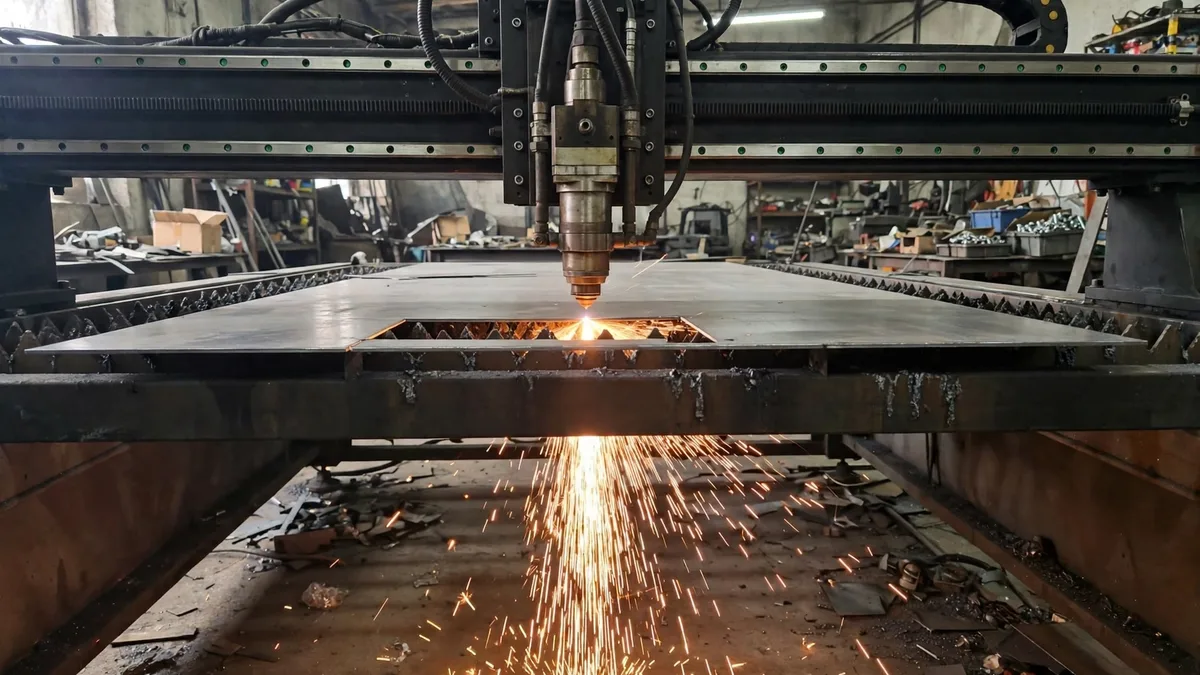
The workshop is dark except for the cutting head, which moves across the sheet of steel like a pen across paper — except the pen is a beam of light, and where it passes, the metal simply ceases to exist. There is a hiss of gas, a spray of orange sparks underneath, and a smell like a thunderstorm. Thirty seconds later the head lifts, and a part that would have taken a machinist an hour to mill is sitting loose in the sheet, its edges smooth enough to touch. This is laser cutting, and it has quietly become the way most of the world’s flat metal parts are made.
Laser cutting uses a focused beam of light to melt, burn or vaporise metal along a programmed path. A computer guides the beam, the metal never touches a tool, and the same machine can cut a watch gear in the morning and a ship’s bracket in the afternoon.
This guide explains laser cutting metal specs in plain English — power, thickness, speed, tolerance, and how the numbers compare with plasma cutting and waterjet cutting.
The Laser Cutting Specs, Explained
Figures below are typical for modern fibre laser cutting machines, the most common type in workshops today. Carbon dioxide (CO2) lasers, the older technology, cut slightly slower at the same power.
| Spec | Typical figure | What it means | How it compares |
|---|---|---|---|
| Laser power | 1–20 kW (fibre) | The power of the beam; most workshops run 3–6 kW machines | A 6 kW machine cuts three times faster than a 2 kW one on thin steel |
| Max steel thickness | About 25 mm at 6 kW; 40 mm at 20 kW | The thickest mild steel the machine can cut cleanly | Plasma cuts thicker plate; waterjet cuts almost any thickness, far slower |
| Max aluminium thickness | About 20–30 mm | Aluminium reflects the beam, so it cuts less thick than steel | Copper and brass are harder still — the beam bounces off them |
| Cutting speed | Up to 30–40 m/min on thin sheet | How fast the head moves on 1 mm steel | Around a hundred times faster than milling the same outline |
| Kerf width | About 0.1–0.3 mm | The width of material the beam removes — the cut itself | Thinner than a plasma cut (1–2 mm) and far thinner than a saw cut |
| Tolerance | About ±0.05–0.1 mm | How closely the cut part matches the drawing | Tighter than plasma (±0.5 mm); close to CNC milling on flat parts |
| Assist gas | Oxygen, nitrogen or compressed air | Gas blown through the nozzle to clear molten metal from the cut | Oxygen cuts faster on steel; nitrogen gives cleaner, rust-free edges |
| Estimated machine cost | About $100,000–$500,000 (estimate) | A complete fibre laser cutting machine, installed | Cheaper than a five-axis mill; dearer than a plasma table |
How Laser Cutting Works
Step 1: Making the beam
In a fibre laser, light from pump diodes travels down a long, thin glass fibre doped with ytterbium. The fibre amplifies the light until it emerges as a powerful, tightly focused beam. The head focuses the beam through a lens to a spot about a tenth of a millimetre wide, where the energy is intense enough to melt steel instantly. The precision machining that finishes many laser-cut parts is explained in our guide to how precision CNC machining is made.
Step 2: Melting the metal
Where the focused beam touches the metal, the temperature rises past the melting point in a fraction of a second. The metal does not need to boil away: for most cutting, it only needs to melt. A jet of assist gas, fired through the same nozzle as the beam, blows the molten metal out of the bottom of the cut, leaving a clean slot. With oxygen as the assist gas, the gas also reacts with the hot steel, which adds heat and speeds the cut; with nitrogen there is no burning, so the edge stays bright and rust-free, at the cost of a slower cut.
Step 3: Following the path
The cutting head rides on a gantry driven by motors and linear guides, following a path drawn in CAD software. The operator loads a sheet of metal onto the bed, the machine’s sensors find the sheet’s surface, and the head begins its route — cutting the outline of each part, then the holes inside it, then moving to the next. On thin sheet, the head can move at 30 metres a minute or more; on thick plate, it slows to a crawl, and the sparks underneath turn from a fine spray into a slow orange waterfall. The other great beam technology, electron beam welding, is covered in our guide to how electron beam welding works.

Step 4: The edge quality
A good laser cut needs no finishing. The edge is smooth, square and accurate to a tenth of a millimetre, and the heat-affected zone — the band of metal beside the cut whose properties the heat has changed — is only a fraction of a millimetre wide. That is why laser cutting replaced punching and sawing for so much work: parts come off the machine ready to bend, weld or bolt together.
Step 5: Thick, thin and reflective
Every laser has its limits. Thick plate needs power and patience; a 6 kW machine will cut 25 mm steel, but slowly, and the edge quality falls off. Reflective metals — copper, brass and, to a lesser extent, aluminium — bounce the beam back toward the head, and older machines could be damaged by their own reflected light. The practical rule is simple: the thinner the metal, the more the laser wins; the thicker it gets, the more the alternatives catch up. How the beam technology is used to join metal is explained in our guide to how electron beam welding is made.

How a Laser Cutting Machine Is Made
Building one is an exercise in precision. The gantry must stay rigid while accelerating a cutting head at several g, the linear guides must hold their accuracy over metres of travel, and the beam delivery — fibre, focusing lens and nozzle — must stay perfectly aligned while the head moves. The machine is assembled in a clean, temperature-controlled hall, calibrated with a laser interferometer, and tested by cutting sample parts that are measured to the hundredth of a millimetre.
What Laser Cutting Costs
A complete fibre laser cutting machine costs an estimated $100,000 to $500,000 depending on power and bed size, with 3–6 kW machines at the lower end and 12–20 kW machines at the top. For the customer buying cut parts, pricing is usually per minute of cutting time plus material: thin sheet parts can cost a few dollars each, while a thick plate part might cost tens of dollars.
A Rare Fact
Laser cutting was first used commercially not to cut metal at all, but to drill holes in diamond dies — the tiny, ultra-hard tools used to draw wire. In 1965, engineers found that a laser could drill a hole through a diamond in minutes, a job that had previously taken days of grinding. The same idea — light so intense it removes material without touching it — was then turned on sheet metal, and within two decades it had become the standard way to cut steel. The diamond drill and the shipyard’s steel cutter are the same technology, scaled up ten thousand times.


