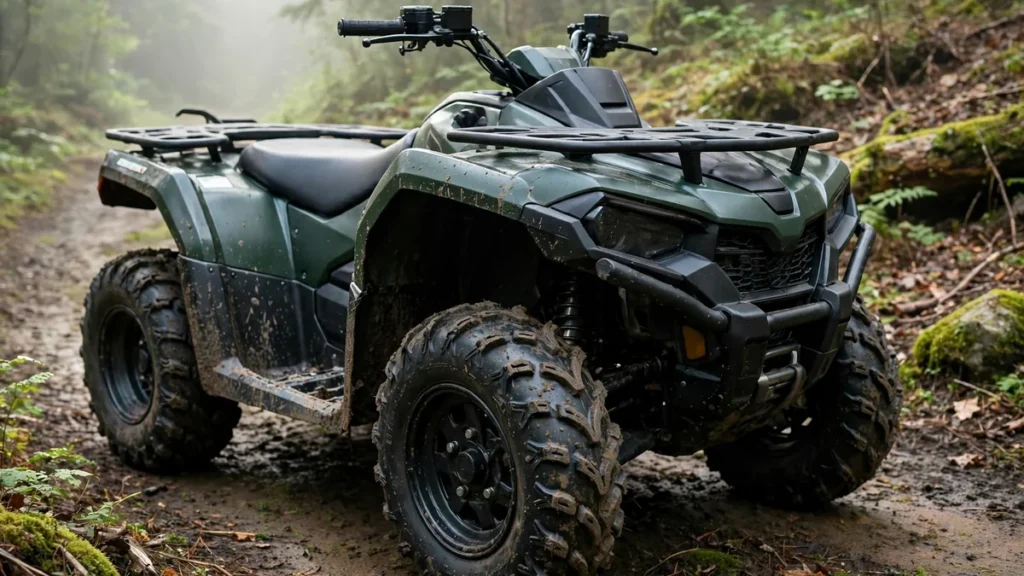
The trail ended at a river crossing, and the rider stopped to look at the water running fast over smooth stones. Behind him the track climbed steeply through pine forest, and ahead of him the river was the only way forward. He pressed a button on the handlebar, felt the front wheels bite, and rode straight into the water, the engine humming low and steady as the machine picked its way across.
A luxury ATV is built for moments like that, when the ground disappears and only grip, clearance and torque matter. Its spec sheet looks like a wall of numbers, though, and the numbers only make sense when you know what each one does on a real trail. This is what a luxury ATV spec sheet means, number by number.
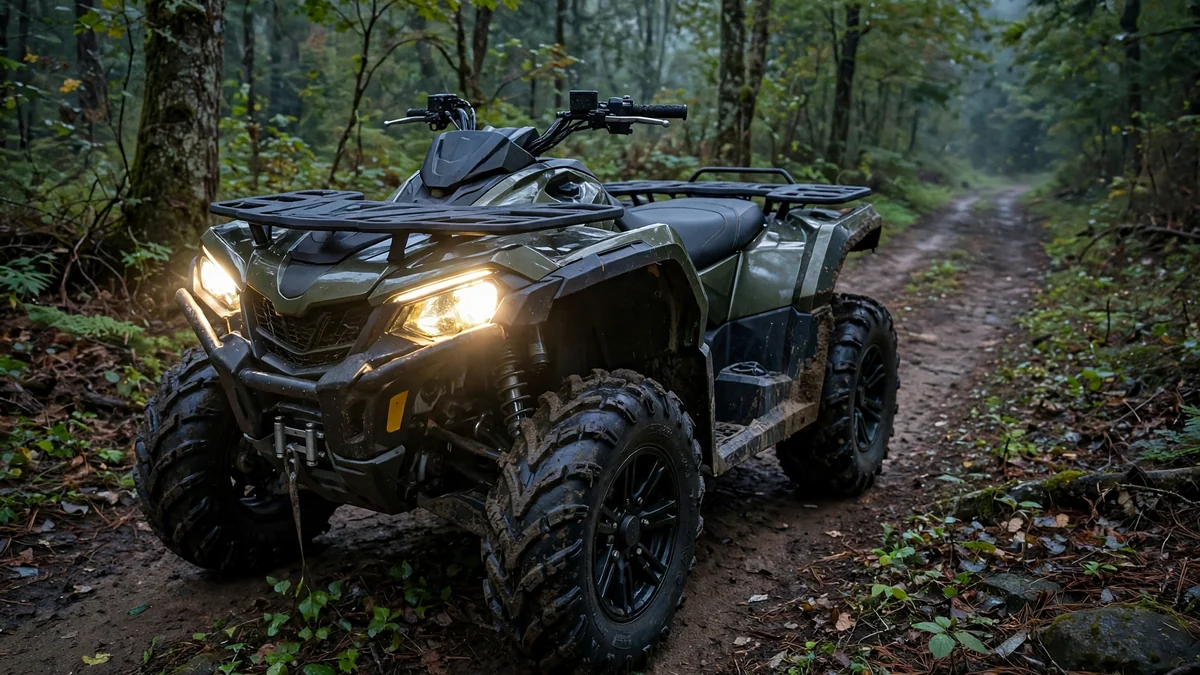
The spec sheet at a glance
- Engine: 700 to 1,000 cc, single or twin-cylinder four-stroke, liquid-cooled
- Power: roughly 45 to 90 horsepower, tuned for torque rather than top speed
- Torque: roughly 60 to 95 Nm, most of it available at low revs
- Drive: selectable two-wheel and four-wheel drive, with a locking front differential
- Suspension travel: roughly 20 to 28 cm at each wheel
- Ground clearance: roughly 28 to 35 cm
- Towing capacity: roughly 500 to 800 kg
- Payload and rack capacity: roughly 100 to 200 kg combined
- Dry weight: roughly 350 to 450 kg
- Price: roughly $12,000 to $25,000, with flagship models above that
Engine and torque: pulling power matters more than horsepower
The first number most buyers look at is horsepower, but on an ATV the more honest number is torque. Torque is the twisting force that turns the wheels, and it is what drags a loaded machine up a muddy slope or pulls a trailer out of a ditch. A luxury ATV engine of 700 to 1,000 cc typically makes 45 to 90 horsepower, which sounds modest next to a car, yet it makes most of its torque at low revs, exactly where a rider needs it when crawling over rocks.
The engines are almost always four-stroke, liquid-cooled units, mounted low in the frame to keep the centre of gravity down. Liquid cooling matters because an ATV often works hard at walking pace, with little airflow over the engine, and an air-cooled motor would overheat on a slow, steep climb in summer heat. The same low, strong engine philosophy is explained in the guide to how a luxury ATV works, where the engine, transmission and drive system are followed from throttle to tyre.
Suspension travel and ground clearance: the numbers that decide where you can go
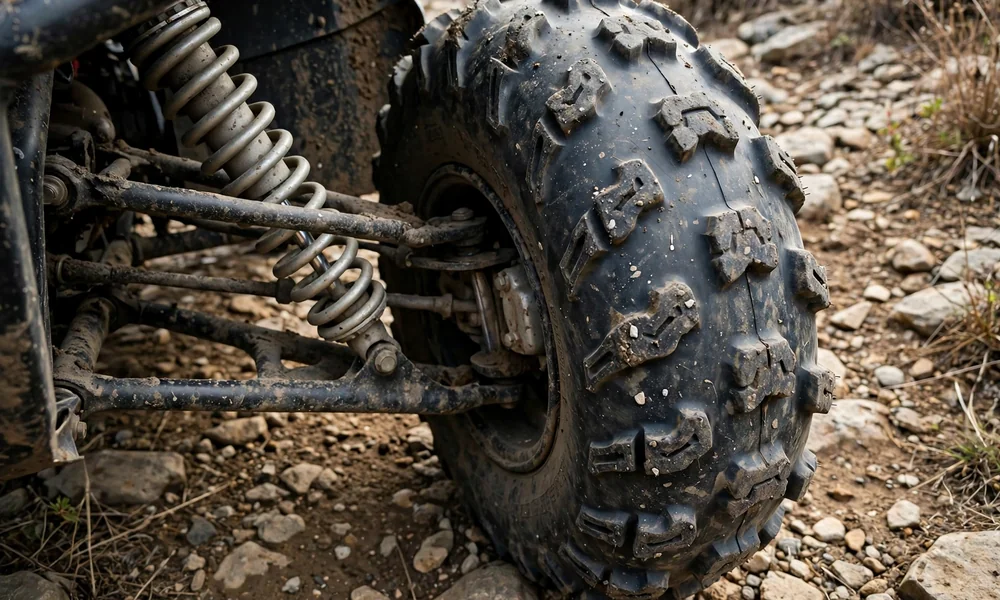
Suspension travel is the distance a wheel can move up and down, and on a luxury ATV it is roughly 20 to 28 cm at each wheel. That travel is what lets the wheels follow rocks, roots and ruts while the rider stays seated and in control. Short travel means the wheels lift off the ground and spin uselessly, while long travel keeps all four tyres pressed into the earth, which is where grip comes from.
Ground clearance is the height of the lowest part of the machine above the ground, usually around 28 to 35 cm on a luxury model. Clearance decides whether the ATV can cross a fallen log or a rock step without grounding its belly on the obstacle. A high clearance is useless without good suspension, though, because a machine that bounces over bumps will still lose traction, and the two numbers have to be read together.

Four-wheel drive and the locking differential: grip on demand
A luxury ATV runs in two-wheel drive on firm ground, which saves fuel and tyre wear, and the rider switches to four-wheel drive when the surface turns to mud, snow or loose gravel. The switch is usually a button on the handlebar, and the change happens without stopping, which matters when the machine is already halfway up a slippery slope.
The locking front differential is the feature that separates serious off-road machines from the rest. Normally a differential lets the wheels on an axle turn at different speeds, which helps steering, but it also means that if one wheel loses grip, all the power escapes through that spinning wheel. Locking the differential forces both front wheels to turn together, so the wheel that still has grip keeps pulling. It is the difference between driving out of a bog and walking home.
Weight, towing and payload: what the machine can carry
A luxury ATV weighs roughly 350 to 450 kg dry, and that weight is a trade-off. A heavier machine is more stable on side slopes and tows better, but a lighter one floats over soft ground and is easier to recover when it does get stuck. The frame is usually steel, built to survive rollovers and hard knocks, and the bodywork is a tough plastic that bends rather than cracking.
Towing capacity of roughly 500 to 800 kg means a luxury ATV can pull a small trailer of firewood, a sprayer or a boat trailer across a field, and the racks can carry a further 100 to 200 kg of gear. That working ability is why many owners buy a luxury model in the first place: it is a farm tool and a trail toy in the same machine, and the build quality is what lets it do both jobs for years. The way the frame, engine and bodywork come together is described in the guide to how a luxury ATV is made, from the welded steel frame to the finished machine.
Price: what the money buys
A luxury ATV costs roughly $12,000 to $25,000 as an estimate, with flagship models and limited editions going higher, and the money goes into the engine, the suspension, the four-wheel-drive system and the finish. A budget ATV can look similar in a photograph, but it will have shorter suspension travel, a weaker transmission and a frame that flexes under load, and those differences only show up after a season of hard use.
The gap between a mid-range and a luxury ATV is mostly felt rather than seen: smoother power delivery, suspension that stays composed over rocks, and controls that still work perfectly after years of mud and water. Buyers who ride every week tend to pay it, because a machine that never lets them down is worth more than a cheaper one that strands them. For a sense of how the ATV compares with its bigger cousins, the guide to how a luxury off-roader works shows what changes when the same off-road job is done by a full-size vehicle.
A rare fact worth knowing
Some luxury ATVs are fitted with a small winch as standard, rated to pull around 1,500 kg, and it is mounted low at the front behind a fairlead. It is not there for show. In deep mud, a rider can winch the machine forward a few metres at a time, using a tree as an anchor, and recover a machine that no amount of wheelspin would free. Owners who have used one once tend to call it the most important option on the whole spec sheet, and it is the kind of detail that never makes the headline numbers.