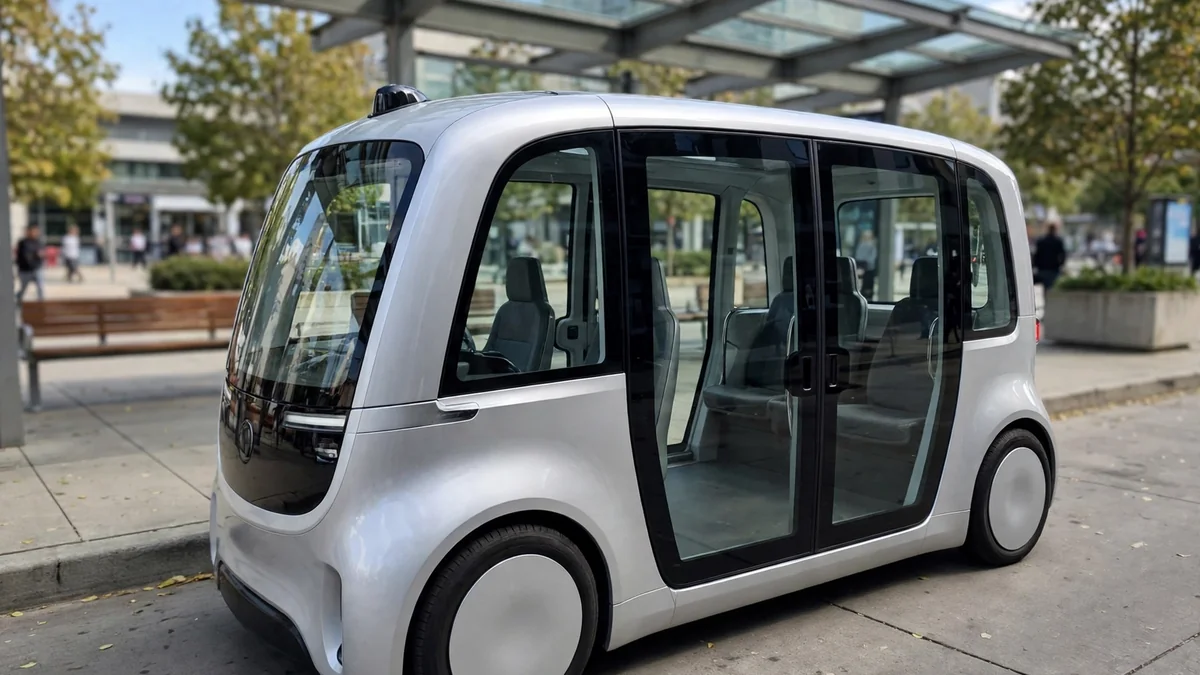
The shuttle arrived without a driver, without a sound, and without anyone on board seeming to notice. It simply glided to the kerb outside the hotel, its doors slid open, and four guests stepped out as calmly as if they had just left a lounge. Nobody waved it in. Nobody took the wheel. The vehicle had driven itself there, along streets full of traffic, cyclists, and pedestrians crossing where they pleased, and it had done so more smoothly than most human drivers manage on their best days. That quiet arrival is the whole promise of the luxury autonomous shuttle, and it is also the hardest thing in transport to engineer.
A shuttle like this is not a car with a computer bolted on. It is a vehicle designed from the floor up around the idea that no one will ever sit in a driving seat. The floor is flat, the seats face each other, the windows are enormous, and every system on board has a backup, because there is no driver to take over when something goes wrong. The specification sheet is the place where all of that caution becomes numbers, and learning to read it is learning to judge whether a shuttle is a serious machine or a demonstration piece that only works on sunny days in a closed car park.
Power, Range, and the Shape of a Working Day
A luxury autonomous shuttle usually carries a battery of 70 to 100 kilowatt-hours, which is roughly the size of a large family car’s battery, and it needs every bit of it. The shuttle runs all day, stopping and starting constantly, and its heating, cooling, and computing systems never switch off. The honest range figure, with passengers aboard and the air conditioning running, is 200 to 300 kilometres, and that is the number a hotel or airport should plan around. A shuttle that promises 400 kilometres in a laboratory will give you far less on a cold morning with the doors opening every few minutes.
Power is modest by design, usually 100 to 150 kilowatts from one or two electric motors, because a shuttle never needs to race. It needs to accelerate gently enough that a standing passenger does not stumble, and to hold a steady 40 to 50 kilometres per hour through city streets. Top speed is typically limited to around 70 kilometres per hour, which sounds slow until you remember that the shuttle’s job is a short, repeated route, not a motorway journey. Charging is usually done overnight at the depot, with a DC fast charge of 80 kilowatts or more for a midday top-up. The way the shuttle’s electric running gear works is explained in how a luxury autonomous shuttle works, which covers the motors, the battery, and the way the vehicle thinks about the road.
Seeing the World: Sensors, Cameras, and the Safety Net
The most important numbers on a shuttle’s specification sheet are not about power at all. They are about perception. A serious shuttle carries a spinning lidar unit on its roof, radar sensors in its bumpers, and eight to twelve cameras around its body, and it fuses all of those inputs into a single picture of the world, updated many times a second. The lidar alone can see 150 to 200 metres ahead, in darkness and in rain, and it measures the distance to every object around the vehicle with centimetre accuracy. That is the sensor that lets the shuttle spot a child stepping off a kerb before a human driver would even have looked.
The Cabin: A Lounge That Happens to Move
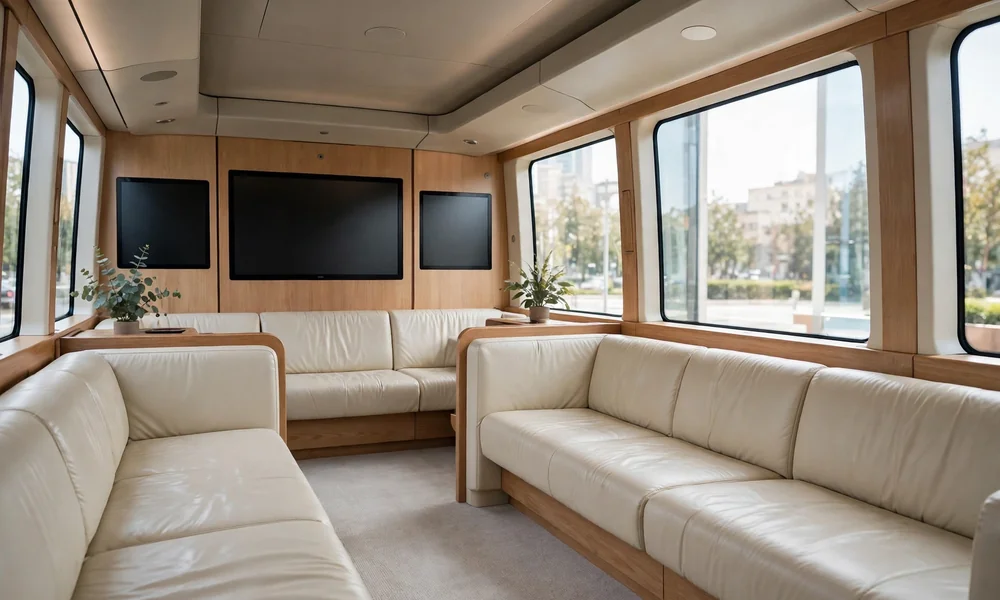
Inside, the shuttle is a lounge first and a vehicle second. The floor is completely flat, with no wheel arches or transmission tunnel, and the seats are arranged in a sociable layout, often facing each other across a small table. A luxury shuttle typically seats eight to twelve passengers, with room for luggage and for a wheelchair, and the wide doors open level with the kerb so that nobody has to climb. The cabin is quieter than a library reading room at cruising speed, because there is no engine, and the suspension is tuned for comfort over speed, smoothing out the potholes that a city bus would thump through.
The details are what make the cabin feel luxurious rather than merely functional. Look for soft leather or wool seats, warm wood trim, individual reading lights, and screens that show the route and the next stop, rather than advertising. The climate system is zoned, so the passenger by the door is not freezing while the passenger in the middle is warm. And because there is no driver, the front of the cabin is a panoramic window, giving every passenger the view that used to belong to the driver alone. The comfort lessons carry over from larger electric people-carriers, and the numbers are close to those in the luxury electric minibus specifications explained, which shares the same battery and cabin thinking at a larger scale.
The Numbers That Matter
| Specification | Typical luxury autonomous shuttle |
|---|---|
| Battery | 70 to 100 kWh |
| Range (real world) | 200 to 300 km |
| Power | 100 to 150 kW, one or two motors |
| Top speed | Around 70 km/h, software limited |
| Passengers | 8 to 12, plus wheelchair space |
| Sensors | Lidar, radar, 8 to 12 cameras |
| Charging | DC fast charge 80 kW or more; overnight AC |
| Autonomy level | Level 4 on a fixed, mapped route |
The autonomy level deserves a careful read. Level 4 means the shuttle drives itself with no human attention, but only inside a mapped area and in conditions it has been approved for. A shuttle that claims to drive anywhere is either exaggerating or describing a different machine. The honest specification names the route, the weather limits, and the speed limit, and a buyer should treat any sheet that hides those limits with suspicion. The engineering behind the driverless system is shared with other electric people-carriers, and how a luxury electric minivan works shows how the same motors and batteries behave when a human is still in charge.

Price, and What You Are Really Paying For
A luxury autonomous shuttle is not sold like a car. Operators usually lease one for around 350,000 to 600,000 dollars, and that is an estimate, not a list price, because every shuttle is built to order for a specific route. The price includes the sensors, the computing hardware, the mapping of the route, and the software licence, which is renewed every year. The vehicle itself is often the smaller part of the bill. The mapping, the safety case, and the remote supervision centre, where a human watches over a fleet of shuttles and can stop one at any moment, cost as much as the machine.
A Rare Fact Worth Knowing
Here is the detail that surprises almost everyone who rides in one for the first time. A luxury autonomous shuttle spends most of its computing power not on driving, but on predicting what people will do next. It watches a pedestrian’s shoulders, the angle of a cyclist’s front wheel, and the way a parked car’s door is opening, and it guesses, many times a second, what each of them is about to do. The driving itself is the easy part. Reading the street is the hard part, and it is the reason the shuttle carries more computing power than a small office. The next time one glides silently to your kerb, remember that it has already rehearsed your next three steps before you have taken the first one.


