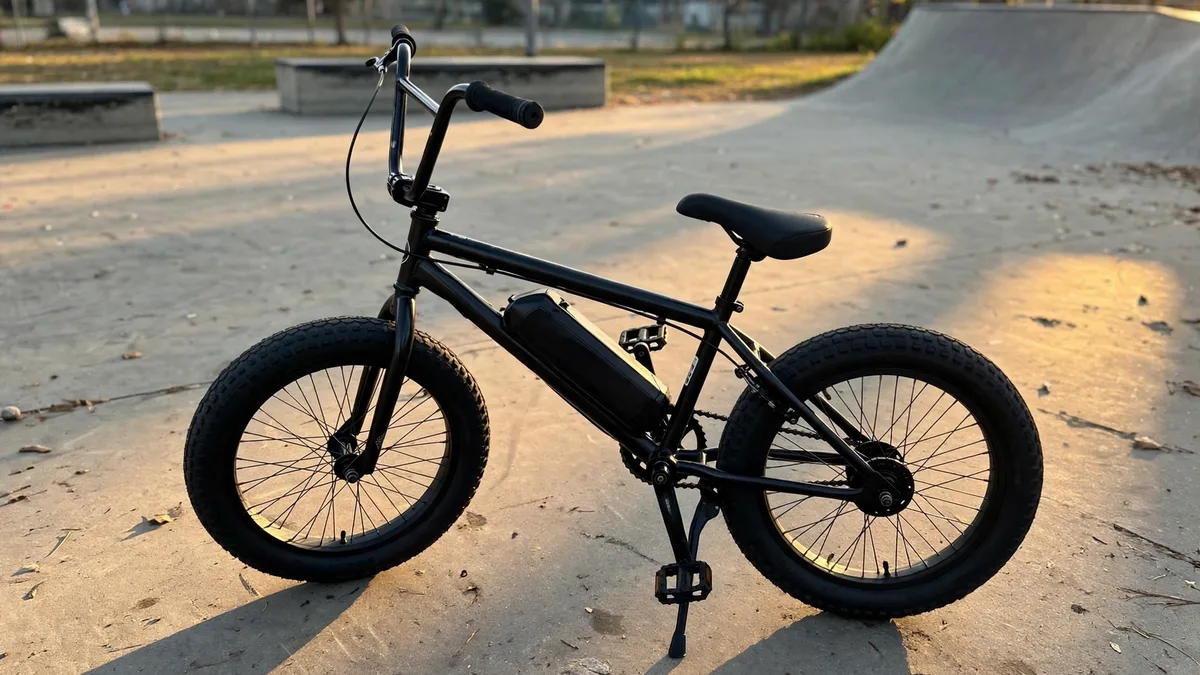
At the edge of a skate park on a Saturday morning, a rider rolls up to the start of a concrete bowl on a bike that looks, at first glance, like any other BMX. The frame is small, the bars are wide, the tyres are fat and knobbly. Then he twists the grip, and the bike pulls away without a single pedal stroke, climbing the lip of the bowl and dropping back in with a quiet hum. The other riders stop to watch, because a BMX was never meant to do that. A BMX was meant to be light, simple and thrown around, and the idea of adding a motor and a battery to one sounded, for years, like a joke. The luxury electric BMX is the answer to that joke, and its spec sheet is where the trick is explained.
The problem the makers had to solve was weight. An ordinary BMX weighs about ten kilograms, and a rider throws it around in the air, lands hard, and expects it to survive. Add a motor and a battery and the bike gets heavy fast, and a heavy BMX stops being a BMX. The luxury electric BMX keeps the weight down by using a small, powerful hub motor, a compact battery hidden inside the frame, and carbon fibre and titanium parts where an ordinary bike would use steel. The result is a bike that weighs roughly twice an ordinary BMX, which sounds like a lot, but it makes up for the weight with instant torque, and the spec sheet is the list of the numbers that make that bargain work.
Motor, Torque and the Feeling of Power
The first numbers on any electric BMX spec sheet are the motor power and the torque, and they decide how the bike feels. Power is usually quoted at 250 watts for road-legal bikes in many countries, while off-road luxury models run 500 to 1,000 watts, and some reach 1,500 watts. Torque is the twisting force the motor puts into the wheel, and a luxury electric BMX typically produces 60 to 90 newton metres, which is far more than an ordinary electric bike of the same power. That torque is what lets the bike pull hard out of a corner or up a steep ramp without the rider having to pedal, and it is the number experienced riders look at first.
The battery is the second half of the story. A luxury electric BMX carries a lithium battery of roughly 500 to 750 watt hours, hidden inside a fattened downtube so the bike still looks like a BMX. That gives a range of roughly 40 to 80 kilometres on flat ground, though in a skate park, where the rider is accelerating hard again and again, the real range is far shorter. The battery is removable on some models, which lets the rider swap in a fresh one, and on others it is fixed, which saves weight and keeps the frame stiff. Charging takes three to five hours on a standard charger, and a fast charger can cut that to about two.
The Spec Table, in Plain Numbers
| Specification | Typical luxury electric BMX | What it means |
|---|---|---|
| Motor power | 500 to 1,000 watts, off road | How much push the motor can give. |
| Torque | 60 to 90 newton metres | The pulling force at the wheel, felt at launch. |
| Battery capacity | 500 to 750 watt hours | How much energy the bike carries in its frame. |
| Range | 40 to 80 kilometres, flat ground | Shorter in a skate park with hard acceleration. |
| Top speed | 25 to 45 kilometres per hour | The motor’s limit, before the rider pedals. |
| Weight | 18 to 22 kilograms | About twice an ordinary BMX, light for an e-bike. |
| Frame material | Carbon fibre or chromoly steel | Carbon saves weight; steel survives hard landings. |
| Wheel size | 20 inches | The classic BMX size, quick to turn in the air. |
| Brakes | Hydraulic disc, rear only | Strong stopping power with one clean lever. |
| Charging time | 3 to 5 hours, standard charger | A fast charger cuts this to about 2 hours. |

Reading the Numbers Like an Engineer
The numbers only make sense together. A bike with a huge motor and a small battery will be thrilling for ten minutes and then dead, while a bike with a big battery and a weak motor will feel no faster than an ordinary bicycle. The way to read the sheet is to look for balance: power, torque and battery capacity should all point at the same kind of riding, and if one number looks far better than the others, the bike is probably being asked to do a job its frame cannot support. Weight is the quiet number that ties them together, because every extra kilogram dulls the handling that makes a BMX fun, and the best luxury models are the ones that keep the weight low while still delivering the power.
What a Luxury Electric BMX Costs
A luxury electric BMX is not a toy, and its price shows it. Prices are estimates, and they vary with the frame and the motor, but a luxury electric BMX is generally estimated at roughly $4,000 to $9,000, while a limited, hand-built model with a carbon frame can be estimated at $12,000 or more. An ordinary BMX might cost a tenth as much, and even a good electric commuter bike is usually cheaper, which is why the electric BMX remains a luxury choice rather than a standard one. The running costs are modest, though: there is no fuel, the battery should last several years if it is charged properly, and the parts that wear out are the tyres, the brake pads and the chain, just like on any BMX.

A Rare Fact Worth Knowing
Here is the detail that surprises even experienced riders: the first electric BMXs were built by hobbyists in their garages, not by bike companies. They bolted small motors onto ordinary BMX frames and hid batteries in backpacks, and the bikes were heavy, ugly and unreliable, but they proved the idea worked. The luxury models of today are the polished descendants of those garage builds, and some of the engineers who design them started out as the same kind of hobbyist, which is why the bikes still feel like a rider’s project rather than a corporate product. The sport grew from the bottom up, and the spec sheet is the record of how far it has come.
For anyone comparing electric BMXs, the advice is simple: start with the riding, not the numbers. Know whether the bike will live in a skate park, on dirt jumps or on the street, and then read the spec sheet to see whether the torque, weight and battery match that life. The most powerful bike is not always the best one, and a well-matched, lighter bike can be more fun than a heavier bike with a bigger motor. When the numbers line up, though, there is nothing quite like it: a small, quiet machine that climbs a ramp without a pedal stroke and still feels like a BMX. The story of luxury electric fat bike specs explained shows how a bigger e-bike balances power and weight, luxury electric cruiser bike specs explained covers the relaxed end of electric riding, and luxury electric trike specs explained gives the three-wheeled comparison that makes the BMX numbers stand out.


